Worth-it decision guide
Are Fridge Organizers Worth It for Meal Prep?
Fridge organizers are worth buying when one awkward shelf or frequently lost food category has a clear home to gain. They are not automatically an upgrade: bins also consume usable space, add another surface to wash, and can hide food when their sides are tall or opaque. Start with the friction in your own fridge, not a matching set.
As an Amazon Associate, GoodWeighFinds earns from qualifying purchases.
Quick verdict
- Buy one when the same small items repeatedly disappear, a deep shelf is hard to reach, or a removable bin makes a defined group easier to pull forward.
- Delay until you measure the shelf and watch what becomes hard to see during a normal week.
- Use what you have when an existing washable container, a shelf label, or moving frequently used food to eye level solves the problem.
- Skip when the fridge is already tight, bins would block vents or door clearance, or extra decanting and washing will make the routine harder.
The test: does a bin remove a repeated step?
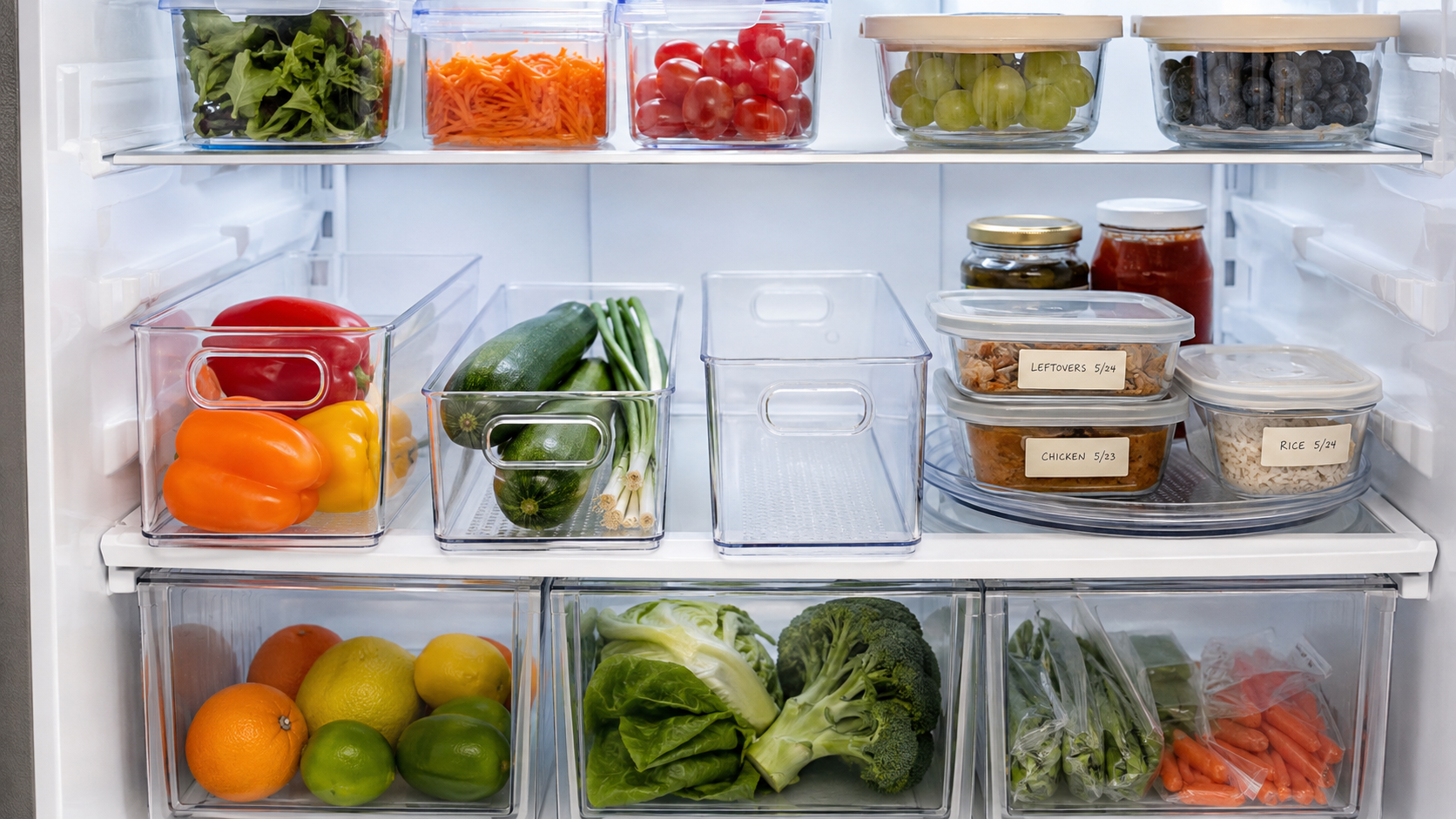
An organizer earns its place when it changes a specific action. A handled bin can pull small yogurt cups from the back of a deep shelf. A turntable can bring jars forward without unloading the row in front. A low open tray can keep “use soon” leftovers visible. None of those jobs requires a complete refrigerator makeover.
If the problem is simply not knowing what is in a closed container, labels may do more than another bin. If loose produce needs airflow or drainage features, a purpose-built produce container is a different decision. The routine-support tools guide explains the broader rule: buy for a repeated job, not a promised body result.
Measure the space the organizer will actually use
Measure shelf width, depth, and height at the narrowest usable points. Include the shelf lip, light housing, temperature-control hardware, door swing, and the space needed to lift or pull the bin out. Product listings often emphasize outside dimensions; compare those with usable inside dimensions so thick walls and handles do not erase the capacity you expected.
Leave refrigerator vents and controls unobstructed and follow the appliance manufacturer's placement guidance. An organizer should not be treated as proof that food will stay safe longer. Storage time and temperature depend on the food, appliance, packaging, and current food-safety guidance—not on a clear bin.
When organizers tend to be worth it
- Deep shelves: A bin lets you pull a group forward instead of reaching behind taller items.
- Small loose packages: One defined category can be easier to scan than several scattered items.
- Shared refrigerators: A clearly assigned zone may reduce mix-ups, provided everyone can see and reach it.
- Leftover visibility: A low tray or “use soon” area can keep sealed containers from drifting behind new groceries.
- Mess containment: A removable bin can be easier to wash than a full shelf when it holds a known spill-prone category, though it does not make leaks impossible.
When they become expensive clutter
Skip a set when the appeal is mostly visual uniformity. Tall bins can hide short containers, narrow bins may waste gaps between them, and lidded bins add a step every time food goes in or out. Decanting food can also separate it from useful package directions, dates, ingredient information, or lot details.
Cleaning matters too. Check whether corners, seams, grips, and turntable bearings are reachable and whether the maker labels the organizer for hand washing or dishwasher use. Do not assume clear plastic is heat-safe, dishwasher-safe, freezer-safe, or suitable for direct food contact unless the current product information says so.
A no-purchase trial
For one week, choose a single shelf problem and use a clean container you already own as a temporary zone. Put only one category in it, such as sealed lunch items or leftovers to use soon. Notice whether people pull the container forward, whether anything gets hidden, and whether the container is easy to return after cleaning.
If the trial works, measure that temporary container and note what needs improvement: clearer sides, a lower wall, a handle, more width, or a turntable rather than a bin. If it does not change how the fridge is used, an organizer is unlikely to fix the routine.
What to compare before buying
- Outside and inside dimensions: Confirm both shelf fit and realistic capacity.
- Visibility: Prefer a wall height and transparency that keep the actual contents easy to scan.
- Access: Check handle position, pull-out clearance, weight when full, and reach for everyone who uses the fridge.
- Cleaning: Look for current care directions and inspect corners, seams, lids, and moving parts.
- Material labels: Treat food-contact, temperature, and dishwasher claims as product-specific, not category-wide.
- Return terms: Fit can be hard to judge from a listing, so confirm the current seller and return conditions before ordering.
For a feature-by-feature shopping checklist, use the fridge organizer buying guide. If food identification is the real problem, compare food-storage labels instead.
Bottom line
Fridge organizers are worth it when a measured, washable piece solves one recurring visibility or access problem. Delay until a no-purchase trial shows the missing function. Choose an existing container or label when it does the same job, and skip organizers that reduce usable space or add more upkeep than they remove.