Paper-planning decision guide
Are Meal Planning Notebooks Worth It?
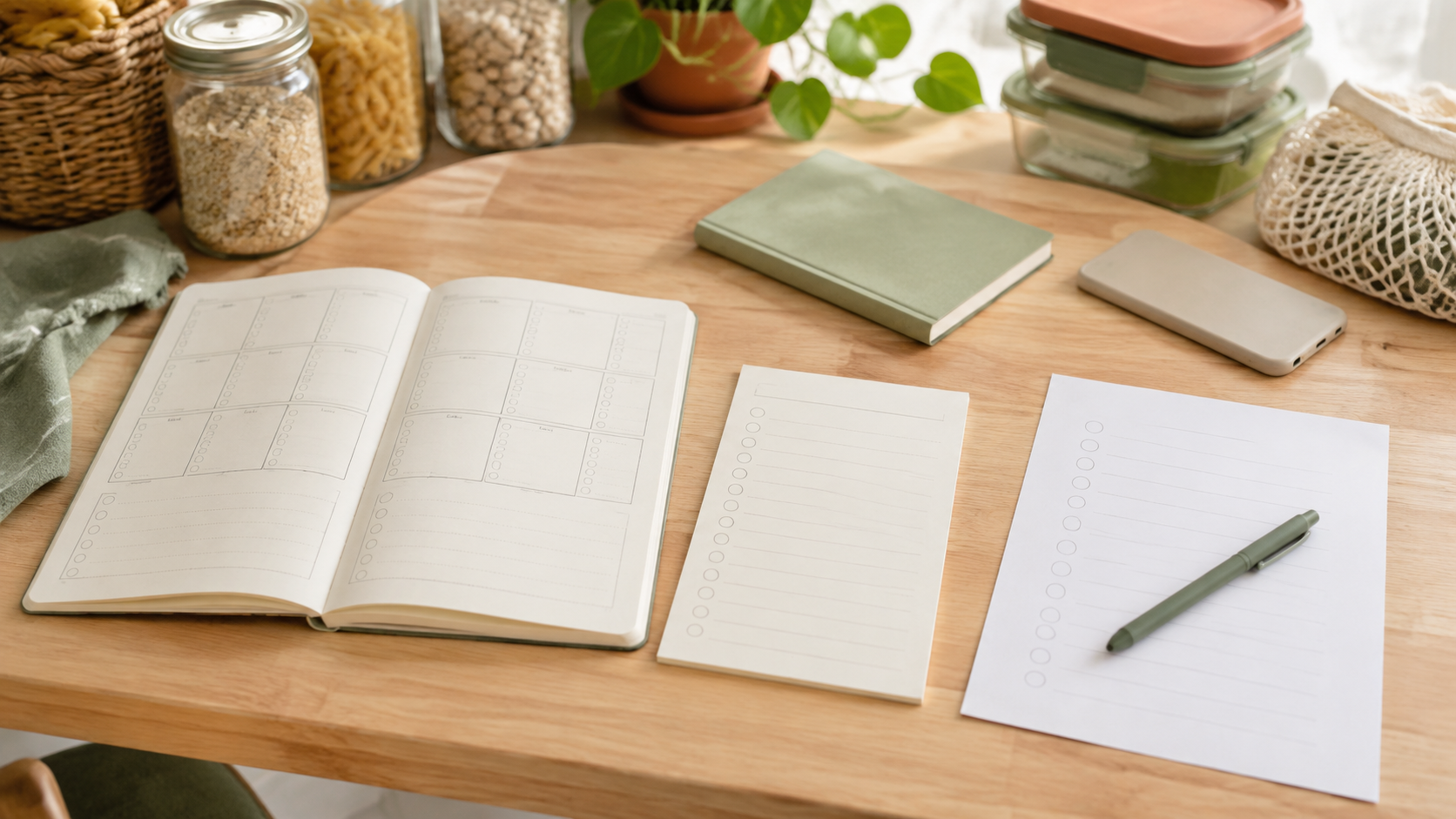
A meal-planning notebook is worth buying when one reusable place for meal ideas, shopping notes, and household reminders removes real friction. It is not necessary for planning meals, and a grocery pad, notes app, calendar, or blank paper may do the same job with less upkeep.
As an Amazon Associate, GoodWeighFinds earns from qualifying purchases.
The short answer
Buy one if you plan repeatedly, want meal ideas and shopping notes together, and will refer back to earlier pages. Delay if you do not yet know which sections you use. Choose a simpler tool if the main job is capturing groceries or sharing one visible weekly plan. Skip it if structured pages create pressure, go unused, or duplicate a system that already works.
This is a format decision, not a nutrition plan. A notebook cannot determine appropriate foods, portions, or health goals for an individual, and using one does not cause weight loss. For the broader low-pressure framework, start with the non-shaming habit and tracking guide.
When a dedicated notebook earns its space
- You need continuity: Bound pages keep several weeks of ideas, substitutions, and household notes in one place.
- Your list depends on the plan: A layout with meal ideas beside a detachable or clearly separated grocery list can reduce copying.
- You revisit useful combinations: Notes about what was convenient, portable, or easy to prepare may be more useful later than a one-time list.
- Paper is easier to see: An open notebook can stay available without unlocking a phone or opening an app.
- The household accepts the location: A shared kitchen spot can work when everyone knows where to add a note and private information is not included.
When a list pad, plain paper, or app is enough
A grocery list pad is usually the simpler choice when the only repeat task is collecting items for the next shop. Plain paper works when plans change often or you are still testing a layout. A notes app may fit better when several people need live updates, though permissions, accounts, notifications, and privacy deserve a check.
The meal-planning notebook versus grocery-list pad comparison examines those two paper formats directly. If you already know you want a bound planner and need layout criteria, use the meal-planning notebook buying guide.
Try a free two-week layout first
Fold a sheet of paper into a few sections: meals or prep tasks, ingredients to use, and groceries. Use only the sections that help for two planning cycles. At the end, ask:
- Did the page change a shopping or preparation decision?
- Did you look at it after writing it?
- Did you need earlier pages, or only the current list?
- Was the plan easy to revise without making the page feel “ruined”?
- Would binding, portability, or shared visibility solve a specific problem?
If the test page works, buy a format that resembles it. If it does not, another preprinted system is unlikely to fix the underlying friction.
What to check before buying
- Visible sample pages: Confirm the actual layout rather than relying on phrases such as “complete planner.”
- Dated versus undated: Dated pages provide structure but waste space after breaks; undated pages are easier to restart.
- Planning horizon: Decide whether you need a week at a glance, a running idea bank, or only the next shop.
- Grocery-list handling: Check whether lists are detachable, perforated, duplicated, or meant to stay in the book.
- Size and binding: Verify closed dimensions, writing space, whether it lies flat, and where it will live.
- Household visibility and privacy: A shared planner can coordinate routines, but it should not expose notes someone wants private.
- Restart flexibility: Look for neutral layouts that still make sense after a missed week.
- Cost and refills: Compare the full usable page count with an ordinary notebook, printable sheet, or existing calendar.
Marketing and pressure red flags
Skip notebooks built around guaranteed body changes, rapid results, “perfect” eating, punishment for missed days, rigid streaks, or moral labels for food. Prompts and customer anecdotes are not evidence that a planner produces a health outcome.
If recording meals, weight, portions, or exercise becomes distressing, compulsive, or tied to restriction or compensatory behavior, stop using the format. A planner is optional. Individual nutrition or health decisions belong with an appropriately qualified professional, not a stationery product.
Bottom line
A meal-planning notebook is worth it when its exact layout consolidates information you already use and makes the next ordinary decision easier. Test the workflow on free paper first, buy only the structure that proved useful, and keep the simpler system—or no system—when that feels calmer and works just as well.