Small-kitchen buying guide
Best Collapsible Colanders for Small Kitchens
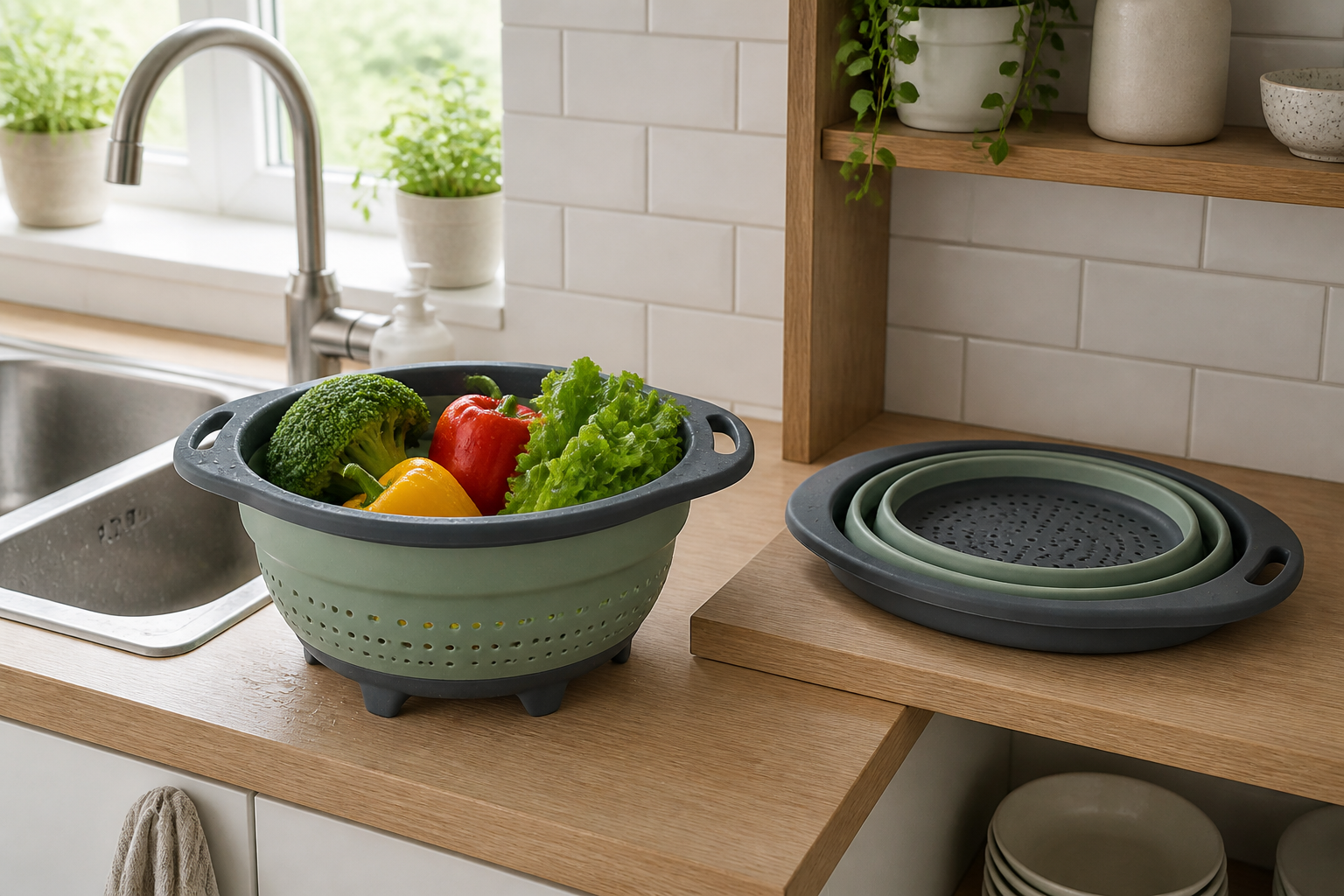
A collapsible colander can free cabinet space without changing the basic job of rinsing and draining food. The useful comparison is not which one looks smallest online, but whether its open capacity, folded height, drainage, and base fit your actual sink, shelf, and prep routine.
As an Amazon Associate, GoodWeighFinds earns from qualifying purchases.
Who this guide is for
This guide is for adults who need a full-bowl strainer for produce, pasta, or other ordinary kitchen prep but have limited cabinet or drawer space. It covers freestanding collapsible colanders, not clip-on pot strainers, over-sink baskets, or food-storage containers.
For a broader way to compare low-pressure kitchen helpers, use the routine-support tools guide. If the real need is storing prepared food rather than draining it, compare collapsible food containers instead.
Best-fit types, not unsupported rankings
- Best fit for general rinsing: A medium freestanding bowl with a broad base, two usable handles, and drainage across the bottom and lower sides.
- Best fit for a shallow drawer: A model with a verified collapsed height and handles that do not add hidden width.
- Best fit for larger batches: A higher-capacity bowl that remains stable when full; do not assume a wide rim equals usable bowl volume.
- Best fit for occasional use: A simple single colander rather than a nested set that takes more total room.
Selection criteria that matter
- Open dimensions and capacity: Compare the usable interior with the amount you usually rinse, not just the outside diameter.
- Collapsed dimensions: Measure height, width including handles, and any base that remains rigid. Check the exact drawer or shelf opening.
- Base stability: Look for a broad, level foot or ring. A flexible bowl should not fold inward when set down with food inside.
- Drainage pattern: More holes are not automatically better. Check their location, size, and whether the base can drain without trapping water against a flat sink.
- Handles: Verify grip area and clearance. Wet handles should be easy to hold without pressing the flexible walls inward.
- Material and use limits: Treat silicone, plastic, heat-resistant, BPA-free, dishwasher-safe, and food-contact statements as listing claims to confirm for the exact model.
- Fold design: Check how many accordion sections move and whether instructions explain opening and collapsing without twisting the rim.
- Cleaning: Grooves can retain food or water. Look for accessible folds and follow the listed hand-wash or dishwasher directions.
- Return terms: Confirm the seller, return window, and return-shipping terms in case the bowl is unstable or the folded size is misstated.
A practical comparison framework
Mark each candidate yes, no, or unclear. Verify every unclear item before buying.
- Does the expanded bowl hold a normal batch without crowding?
- Does the complete collapsed footprint fit the measured storage space?
- Can it sit level in the sink or on the planned draining surface?
- Are drainage holes placed where water can escape?
- Can both handles be gripped securely when the bowl is wet?
- Are material, temperature, and cleaning limits stated for the exact model?
- Can folds and drainage holes be inspected and cleaned easily?
- Would one colander solve the problem better than a multipack?
Collapsible colander or clip-on strainer?
Choose a freestanding colander when you need bowl capacity, want to rinse produce independently, or prefer to set the food down while it drains. A clip-on strainer may occupy less storage space and can drain directly from a compatible pot, but pot fit, attachment stability, and handling hot cookware become central concerns.
Do not buy both automatically. Name the recurring task first. For larger batches and hands-free draining, the full bowl is usually the clearer format; for draining one compatible pot in a very tight kitchen, a clip-on format may be enough.
Who should skip a collapsible colander
Skip it if a rigid colander already fits and is easy to store, or if flexible folds would add cleaning work you will avoid. Also skip candidates that lack clear dimensions, material guidance, use limits, or care instructions.
A small rigid mesh strainer may suit tiny portions better. If you routinely handle very hot, heavy cookware, choose a draining method that keeps a stable grip and follow the cookware and strainer manufacturers’ directions rather than relying on broad “heat resistant” wording.
What a collapsible colander cannot do
A colander can rinse and drain food while reducing storage height. It cannot make a meal nutritionally appropriate, guarantee food safety, control portions, or cause weight loss. Treat wellness or body-result language attached to an ordinary strainer as marketing, not a product capability.
Bottom line
The best collapsible colander for a small kitchen is one that fits twice: expanded for the food and sink you use, and collapsed for the exact shelf or drawer you measured. Prioritize stable support, usable drainage, cleanable folds, clear use limits, and one size you will actually reach for.