Small-kitchen buying guide
Best Collapsible Measuring Cups for Small-Kitchen Meal Prep
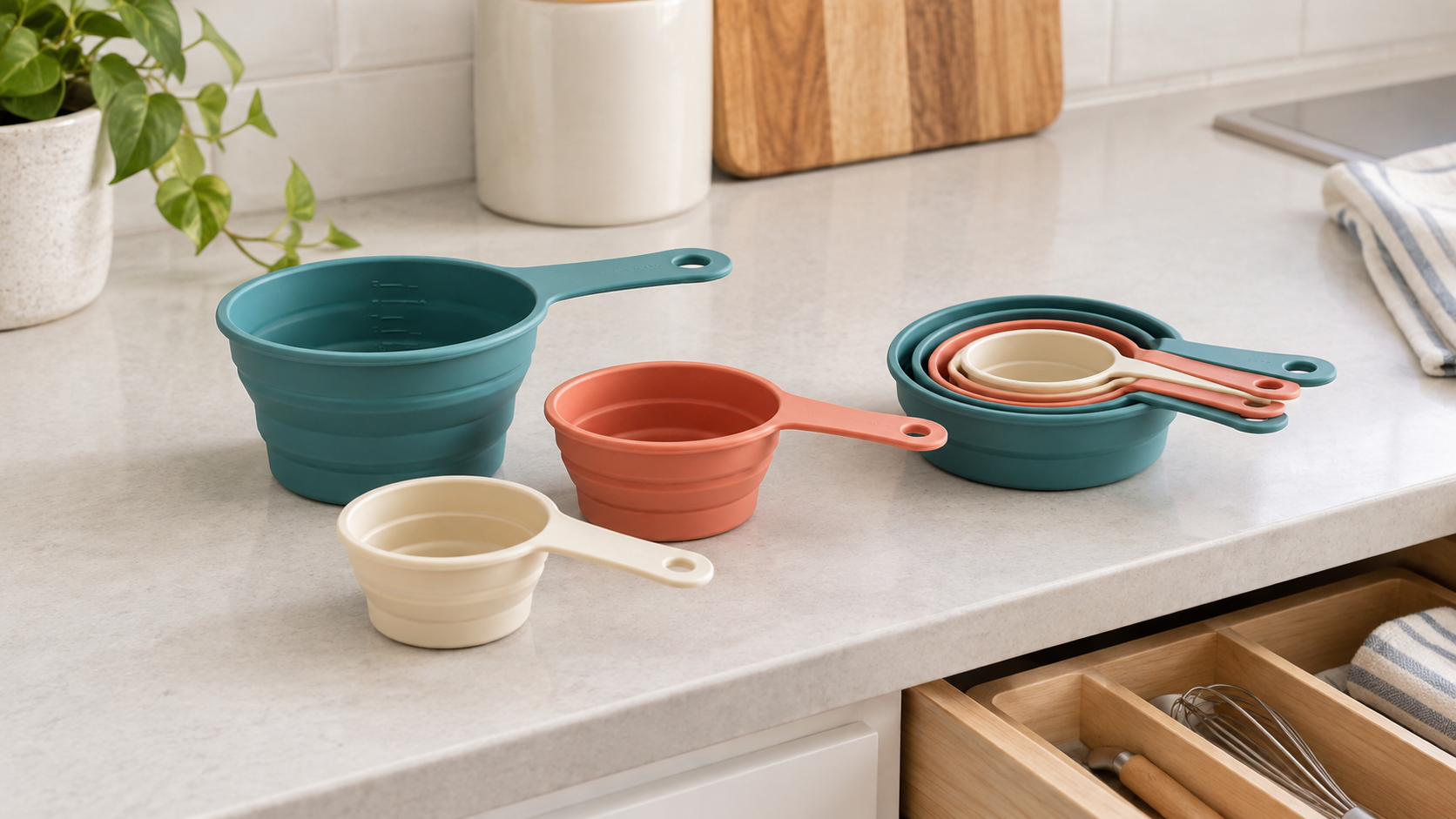
Collapsible measuring cups can trade drawer height for extra seams and moving parts. The best set for a small kitchen has the sizes you use, stays fully expanded while filling and leveling, fits the drawer when collapsed, and can be washed and dried without trapping residue.
As an Amazon Associate, GoodWeighFinds earns from qualifying purchases.
Measure the storage problem first
Empty the drawer or bin where the cups would live and measure its usable width, depth, and height after accounting for dividers and nearby tools. Then compare those numbers with the set's listed dimensions while fully collapsed and nested. A low cup body does not save much space if long handles still cross the drawer or the set does not nest securely.
Try rearranging the measuring tools you already own before buying. A hook, vertical container, or different drawer section may solve the problem without introducing flexible walls and extra creases.
Choose the included sizes, not the set count
List the volume measures your recipes repeatedly call for, then confirm that each size is individually marked. Do not assume a large piece count includes a complete useful sequence; accessories and duplicate sizes can inflate the number. Markings should be high contrast, positioned where they remain visible, and durable under the maker's stated care method.
Collapsibility does not establish measurement accuracy. Treat accuracy language as a manufacturer claim unless supported for the exact model. For tasks where small volume differences matter, use the tool and method required by the recipe.
Compare the formats
| Format | Potential fit | Check closely |
|---|---|---|
| Individual long handles | Easy reach into wider ingredient containers | Handle flex, drawer length, leveling edge, and how the set stays together |
| Short handles or tabs | Smaller overall footprint | Grip clearance, control when full, and whether fingers contact ingredients |
| Ring-connected set | Keeps sizes together in storage | Whether cups detach for use and washing, and whether the ring adds bulk |
| Round nested set | Familiar scooping shape | Collapsed stack height, rim rigidity, and access to every fold |
Test stability from rim to handle
A cup should stay fully expanded on a level counter and while being lifted with the amount it is designed to hold. Look for clear product views of the base, sidewall folds, rim, and handle connection. A rigid rim can help with leveling, but only the exact design and directions can establish intended use.
Consider how you normally measure. Scooping from a narrow bag, filling from another container, and holding a full cup over a mixing bowl place different demands on the handle and flexible body. Skip a design when the listing does not show how it locks or remains expanded.
Read material and use limits literally
Check the exact material statement and the maker's directions for ingredient contact, maximum temperature, microwave use, dishwasher placement, and any restrictions. “Silicone” alone does not answer those questions, and a heat-resistance claim does not automatically permit use near a burner, in an oven, or with very hot ingredients.
Do not use a flexible cup as a substitute for cookware or a ladle unless the current instructions expressly support that task. Keep it away from sharp drawer tools that could cut or puncture the folds.
Inspect the wash-and-dry path
Expand every fold for washing so both sides of each crease are reachable. Check whether the cup can remain open while drying and whether water can drain from the rim, handle joint, and accordion folds. Dishwasher-safe wording should name the applicable placement or cycle restrictions; otherwise follow the stated hand-wash directions.
A compact tool that requires awkward scrubbing or stays damp in its collapsed position may create more friction than a rigid nested set. Plan where it will dry fully before returning it to a closed drawer.
When rigid cups are the better choice
- Choose rigid cups when your current nested set already fits and is easy to read, level, wash, and dry.
- Skip a collapsible set when collapsed dimensions, included sizes, material details, or care directions are missing.
- Prefer another format when flexible walls or handles feel hard to control for your usual ingredients and motions.
- Skip measuring tools entirely when volume measuring is not useful for how you cook, or when food tracking feels rigid, stressful, or shaming.
- Replace a cup according to maker guidance if folds, rims, handles, or markings become damaged or unusable.
A paper-template check before ordering
Draw the listed collapsed outline and handle length on paper, cut it out, and place it in the intended drawer. Mark the stated stack height with a folded strip of paper. This quick check exposes handle collisions, divider conflicts, and clearance problems that a product photo can hide.
Keep the tool in perspective
Measuring cups can support recipe consistency or low-pressure portion awareness, but they do not cause weight loss or determine an appropriate amount of food for every person. The broader measuring cups and spoons guide covers readability and routine fit, while the food scale versus measuring cups comparison helps when the measuring method—not storage—is the actual decision. For the wider framework, use the routine-support tools guide.
Bottom line
Choose collapsible measuring cups only when their verified collapsed dimensions solve a real storage constraint. Prioritize a useful size sequence, readable markings, a stable expanded shape, manageable handles, accessible folds, complete care directions, and a realistic drying place. If a rigid set already fits, collapsibility may add complexity without solving a problem.