Reusable kitchen markers
Best Date Dials and Food-Storage Markers for Leftovers
A reusable date dial can replace a new adhesive label each time you store leftovers—but only if it fits the container, stays readable, and gets reset as part of the packing routine. Compare the mechanism before the styling, and skip a specialized marker when tape and a pen already work.
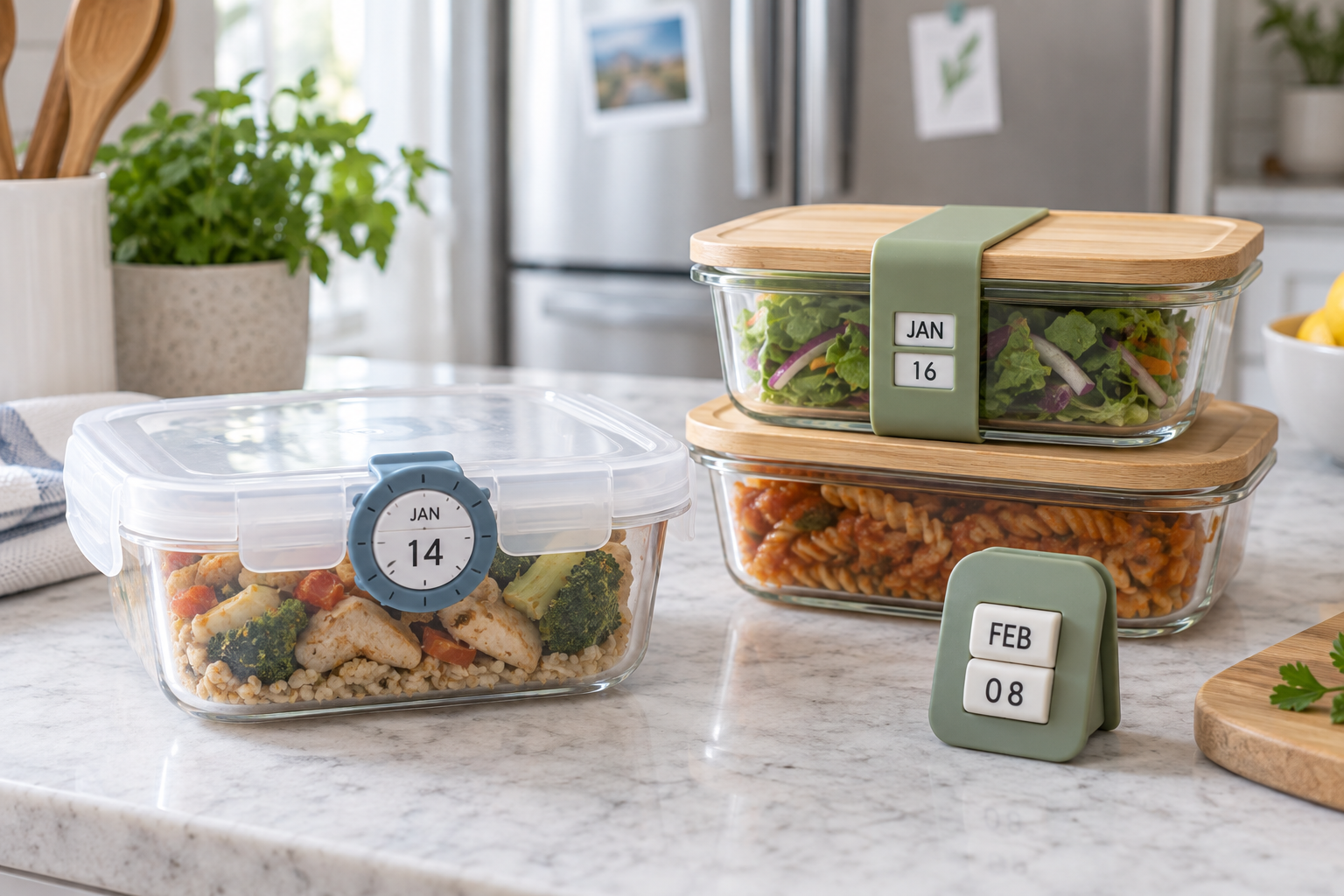
Choose the marker format by where the date needs to live
| Format | Useful when | Check before buying |
|---|---|---|
| Clip or dial | A lid edge or container feature provides a documented attachment point | Jaw opening, edge thickness, reading angle, and whether it obstructs the closure |
| Stretch band | The same band can fit a measured range of round or rectangular containers | Supported circumference, tension, date-window position, and wash instructions |
| Dial built into a lid | You are replacing or buying containers as a matched system | Exact container compatibility and whether replacement lids are sold separately |
| Reusable tag | A handle, latch, or bag closure can accept a removable marker | Attachment loop, written or rotating date format, moisture wording, and storage |
These formats are not interchangeable. A clip that fits one thin lid flange may not fit a thick glass-container lid, and a band can cover a latch or make stacking awkward. Treat every universal-fit claim as something to verify against measurements and maker instructions.
Start with the date information you actually use
Decide whether the routine needs a packed-on date, a use-first date, or a short contents note. A month-and-day dial can cover a simple date but cannot identify two similar-looking dishes. A marker with only day numbers may also be ambiguous across months. If household members use different date conventions, choose a format everyone can read without guessing.
A reusable dial is not a food-safety timer and does not determine how long a particular food should be kept. Use appropriate food-storage guidance for the food and storage conditions involved; the marker's limited job is to display the date you chose.
Measure the container, lid, and storage space
- Attachment point: Measure the lid edge, handle, latch, or container circumference the marker must fit.
- Closure clearance: Confirm that a clip or band does not interrupt the seal, latch movement, or vent specified by the container maker.
- Stacking clearance: Check whether the marker adds height or protrudes beyond the container footprint.
- Viewing angle: Make sure the date remains visible from the normal shelf or drawer position.
- Marker storage: Give loose clips or tags a defined home when they are not attached.
Inspect the setting mechanism
For rotating dials, look for clear month and day positions, a usable grip, and enough resistance that ordinary handling is unlikely to move the setting. That resistance must come from current maker documentation or your own later observation—not an assumption based on product photos. For sliders or tiles, check whether every needed character is present and whether the selected date remains visible.
Product photos sometimes enlarge date windows or show only ideal viewing angles. Use listed dimensions to estimate character size, and consider whether low contrast or small type will be hard to read in the refrigerator. Decorative colors matter less than a date that can be interpreted quickly.
Check cleaning and material instructions
Read the care directions for the complete marker, including any moving parts, printed characters, elastic sections, adhesive mounts, or small removable pieces. Do not assume a marker can go through a dishwasher, freezer, or microwave because it appears next to compatible containers. The marker and the container may have different limits.
Choose a design that can be inspected around joints and date windows. If the maker gives no useful care instructions, or the mechanism traps residue where you cannot reach it, a simple removable label may be the more practical choice.
Run a no-buy test first
For one week, date leftovers with removable tape or another container-safe method you already use. Notice whether dates are consistently added and checked. Count how many containers need markers at the same time, and note whether a contents label is also necessary.
If nobody reads or updates the temporary labels, a reusable mechanism is unlikely to repair the workflow. If the test works but repeatedly writing and discarding labels is the only friction, a dial, band, or tag may earn its place.
Listing red flags and skip criteria
- No measurements for the clip opening, band range, tag loop, or compatible lid.
- “Universal” compatibility without a supported size range or attachment diagram.
- Claims that the marker keeps food fresh, proves food is safe, or prevents spoilage.
- Dishwasher, freezer, microwave, or temperature claims that conflict across the listing and instructions.
- A dial that cannot represent the date format your household uses.
- A multi-piece set that provides more markers than the actual leftover routine requires.
Skip this category when tape and a marker are already easy, when contents matter more than dates, when a clip would interfere with the lid, or when small loose parts would add clutter. If a paper or dissolvable label better fits the job, use the food-storage label guide instead.
Bottom line
The best reusable date marker is the simplest mechanism that fits the containers you own, shows the date format your household understands, survives the documented care routine, and gets reset consistently. Measure first, test the labeling habit with supplies already on hand, and avoid any listing that turns a date marker into a freshness or food-safety promise. For more low-pressure kitchen tools, visit the routine-support tools guide.