App-free planning guide
Best Freezer Inventory Boards for Batch-Cooking Routines
A freezer inventory board can make stored meals easier to see before another grocery trip or cooking session. The useful choice is not the busiest template: it is a board that fits the appliance surface, has enough writing room, erases cleanly, and stays simple enough to update.
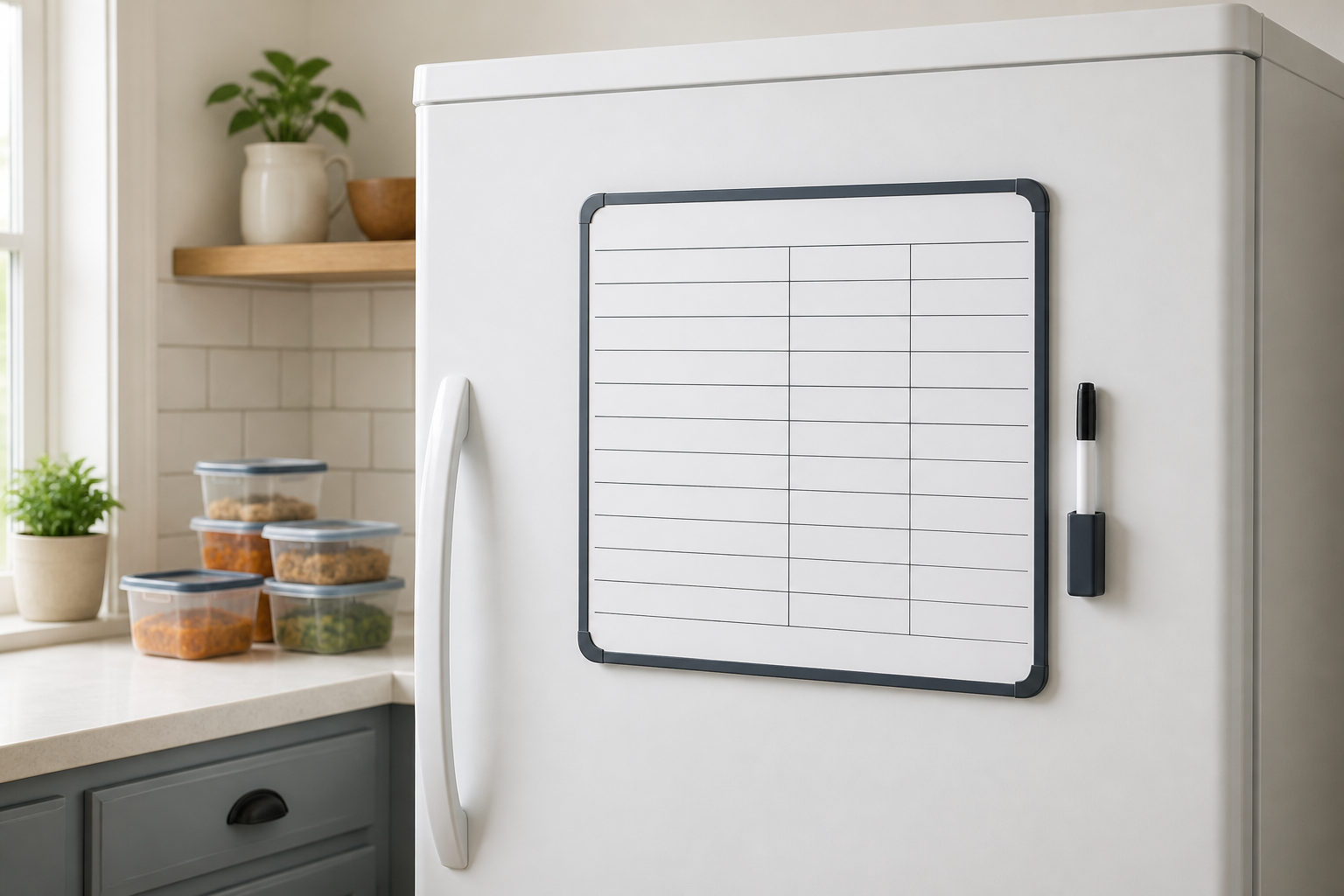
Who this guide is for
This guide is for adults who batch cook or freeze leftovers and want a visible, erasable list without adding another app. It tracks household inventory rather than calories, body measurements, or dietary compliance. If prompts or streaks create pressure, the board can stay limited to practical fields such as item, date, and quantity.
For a broader approach to calm, restart-friendly records, use the non-shaming tracking pillar. For the containers themselves, compare freezer containers for batch cooking and freezer-safe label tapes.
Best-fit formats, not unsupported winners
No boards were purchased, mounted, written on, or ranked for this guide. These formats describe distinct fits to compare in current listings:
- Magnetic sheet: Thin and easy to reposition on a compatible steel surface; confirm that a magnet actually holds on your appliance.
- Rigid magnetic board: Offers a firm writing surface and frame, but projects farther from the door and may be heavier.
- Adhesive dry-erase sheet: May suit a nonmagnetic smooth surface; installation and removal deserve extra scrutiny.
- Clipboard or hanging board: Avoids adhesive and appliance compatibility issues when a nearby wall or hook works better.
- Plain blank board: Flexible for a short custom list and often calmer than a crowded printed template.
Selection criteria that matter
- Test the surface first: Stainless-look doors are not always magnetic. Use a household magnet in the intended spot and check the appliance instructions before attaching anything.
- Measure usable space: Account for handles, seams, dispensers, curved edges, door swing, and nearby cabinets—not just total door width.
- Count useful rows: Estimate the number of items normally stored. Tiny rows that cannot hold readable names and dates add friction.
- Prefer a simple layout: Item, date, and quantity are usually enough. Preprinted calorie, goal, or “cheat” fields are unnecessary for inventory.
- Check marker storage: A secure holder or magnetic cap keeps the marker near the board without blocking the door seal or falling behind the appliance.
- Verify cleaning directions: Look for the maker's recommended marker and cleaning method. “No ghosting” is a claim, not a permanent guarantee.
- Review mounting limits: Adhesive products need stated surface, temperature, removal, and residue guidance. Do not cover vents, controls, labels, or seals.
- Check readability: High contrast and adequate line height matter more than decorative headings.
A simple comparison framework
Mark each listing yes, no, or unclear against the same questions:
- Does the mounting method work on the exact intended surface?
- Do the measured width and height clear handles, seams, and door movement?
- Are there enough rows with readable writing space?
- Can the layout track item, date, and quantity without diet-focused prompts?
- Is marker storage included or easy to add?
- Are installation, cleaning, and removal directions specific?
- Can the board be updated without moving stored food or opening the freezer?
- Would paper on a nearby clipboard solve the same problem for less?
Use the board as a cue, not a perfect record
A board only helps when updates are quick. Add an item after it cools and is stored according to your normal food-handling routine, then cross it off when removed. Keep the written description consistent with the label on the actual container so the list does not become a guessing game.
The board is an organizational tool, not a food-safety device. It cannot verify storage temperature, determine whether food is safe, or replace container labels and applicable food-storage guidance. When the board and freezer disagree, inspect the actual labeled container rather than relying on the list.
Who should skip this purchase
Skip a dedicated board if a paper list, notes app, or existing dry-erase surface already gets updated reliably. Skip magnetic products when the intended surface does not hold a magnet, and avoid adhesive sheets when removal guidance is vague or the appliance maker discourages attachments.
Also skip templates built around calorie limits, weight targets, shame-heavy “good versus bad” food labels, or more fields than the household will maintain. A smaller, plainer system is better when the purpose is simply to see what is already frozen.
Bottom line
The best freezer inventory board fits the actual surface, leaves enough room for readable entries, keeps a marker close, and asks for only the information you will update. Test the mounting surface, measure the clear area, and choose the simplest format that reduces forgotten food without adding tracking pressure.