App-free meal-planning buying guide
Best Index Card Systems for Repeat Meal Planning
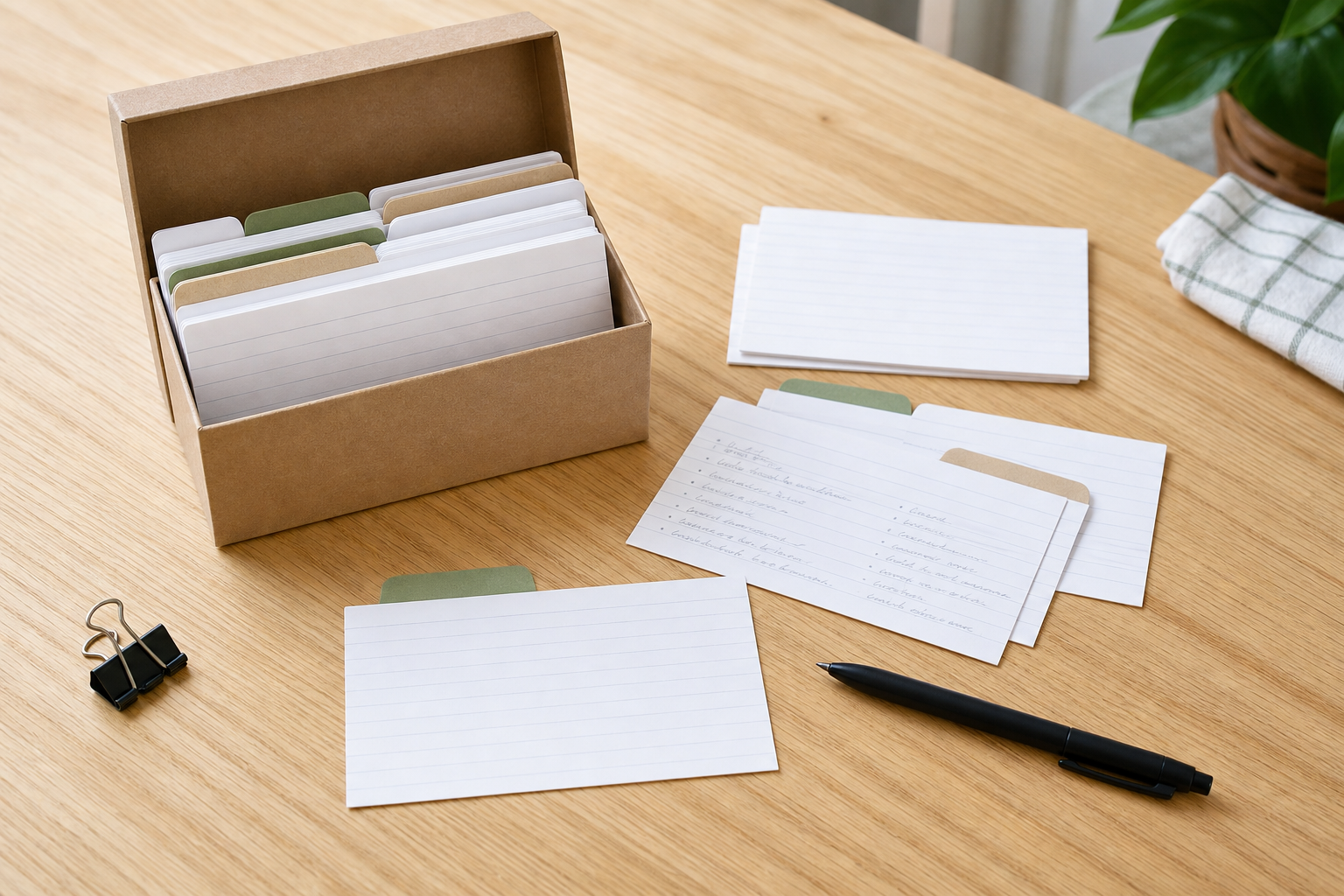
An index card system can keep familiar meal ideas easy to sort, move, and reuse without an app or a fixed weekly template. The useful choice fits the cards you will actually write, gives them a clear home, and stays simple enough to restart after an interrupted week.
As an Amazon Associate, GoodWeighFinds earns from qualifying purchases.
Who this guide is for
This guide is for adults who already repeat some meals and want a modular paper system for ideas, ingredients to remember, or household notes. It is not a diet plan, calorie tracker, nutrition prescription, or promise that planning meals will change body weight.
For the broader decision about planning without streaks or shame, start with the non-shaming habit-tracking guide. If you want to preserve full recipes and printed pages, compare recipe binders. For a week-by-week bound layout, see the meal-planning notebook guide.
Best-fit formats, not unsupported rankings
- Best fit for a growing home library: A lidded box with movable dividers, a stated internal card size, and empty capacity for future cards.
- Best fit for one active week: A small binder ring or clip holding only the cards currently in rotation, with the larger archive stored elsewhere.
- Best fit for short meal prompts: Plain or ruled 3-by-5 cards when a title and a few reminders are enough.
- Best fit for longer ingredient notes: 4-by-6 cards, provided the larger box or case still fits the available kitchen storage.
- Best fit near cooking splashes: Cards placed in removable clear sleeves or a wipe-clean display holder, following the maker's cleaning directions.
Selection criteria that matter
- Card size: Choose one standard—usually 3 by 5 or 4 by 6 inches—and confirm every box, divider, sleeve, and refill matches it.
- Usable capacity: Treat “holds 500” as a listing claim. Dividers, sleeves, thick cards, curled edges, and comfortable browsing space all reduce practical capacity.
- Divider system: Tabs should be readable when cards are filed and easy to relabel. Categories might reflect cooking method, time available, household favorites, or freezer options without labeling foods as morally good or bad.
- Writing surface: Plain card stock is broadly compatible; coated or laminated cards may need a specific marker and may smudge or erase differently than advertised.
- Box and closure: Check internal dimensions, hinge design, lid clearance, latch, and whether the box stays upright while cards are browsed.
- Kitchen durability: “Spill-resistant” does not mean waterproof. Compare care instructions and consider keeping the archive away from the sink and stove.
- Replacement supplies: Standard cards and dividers are easier to replace or mix than proprietary refills with unusual holes or dimensions.
- Working footprint: Measure the closed storage spot and the open area needed to browse, write, and temporarily lay out cards.
- Portability: A ring or clip is compact, but exposed cards can bend. A travel case protects cards but adds bulk and another closure to manage.
- Total cost: Compare the box, cards, dividers, sleeves, markers, and future refills—not only the price of the starter piece.
A practical comparison framework
Before buying, sketch the system on a scrap of paper and answer these questions:
- Am I storing complete recipes, short meal prompts, or both?
- How many cards do I have now, and how much browsing room should remain?
- Will every component accept the same standard card size?
- Can I move one card from the archive into an active-week group without recopying it?
- Where will the box sit, and how much space does it need with the lid open?
- Can I replace cards and dividers without depending on one seller?
- Would a plain rubber band, envelope, existing box, or binder clip already do the job?
- Would the system still be worthwhile if it produced no weight or health outcome?
Use two stages instead of a complicated taxonomy
A compact system can have an archive and an active group. The archive holds cards you want to keep. The active group holds a few options for the next several days. Afterward, cards return to the archive, and any useful shopping or preparation note can be added in plain language.
This rotation is what distinguishes index cards from a bound recipe binder: cards move independently. Avoid buying dozens of dividers before you know how you retrieve ideas. A few broad, erasable labels are easier to change than a rigid category system.
Index cards versus recipe binders and notebooks
Choose cards when frequent rearranging and a small active rotation matter. Choose a recipe binder when you store full pages, printouts, or protected recipes. Choose a meal-planning notebook when keeping dated weekly plans together matters more than reusing individual entries. One method is not inherently healthier or more effective, and combining all three can create needless maintenance.
Who should skip this purchase
Skip a dedicated system if an existing recipe box, envelope, notes app, binder, or stack held with a clip already works. Skip rings if cards must stay in a fixed order or the punched edge removes needed writing space. Skip coated cards if you do not want to manage special markers or test erasing.
Also skip meal-planning tools if they increase guilt, rigid food rules, compulsive tracking, or pressure to restrict. A neutral tool should reduce friction, not become a scorecard. When meal choices are constrained by allergies, a medical condition, medication, pregnancy, or an eating-disorder concern, a card system cannot determine what is appropriate for an individual.
Bottom line
The best index card system uses one standard card size, leaves room to browse, supports easy movement between an archive and an active group, and fits the kitchen space available. Start with fewer components than you think you need, test the workflow with ordinary cards, and expand only when a specific storage problem appears.