Buying guide
Best Mini Choppers for Small-Batch Meal Prep
A mini chopper can make small prep jobs less fiddly when a full-size food processor is too large to use, clean, or store. The best fit depends on the amount you actually chop, whether you prefer a manual or electric mechanism, and how safely and completely the parts come apart for cleaning.
As an Amazon Associate, GoodWeighFinds earns from qualifying purchases.
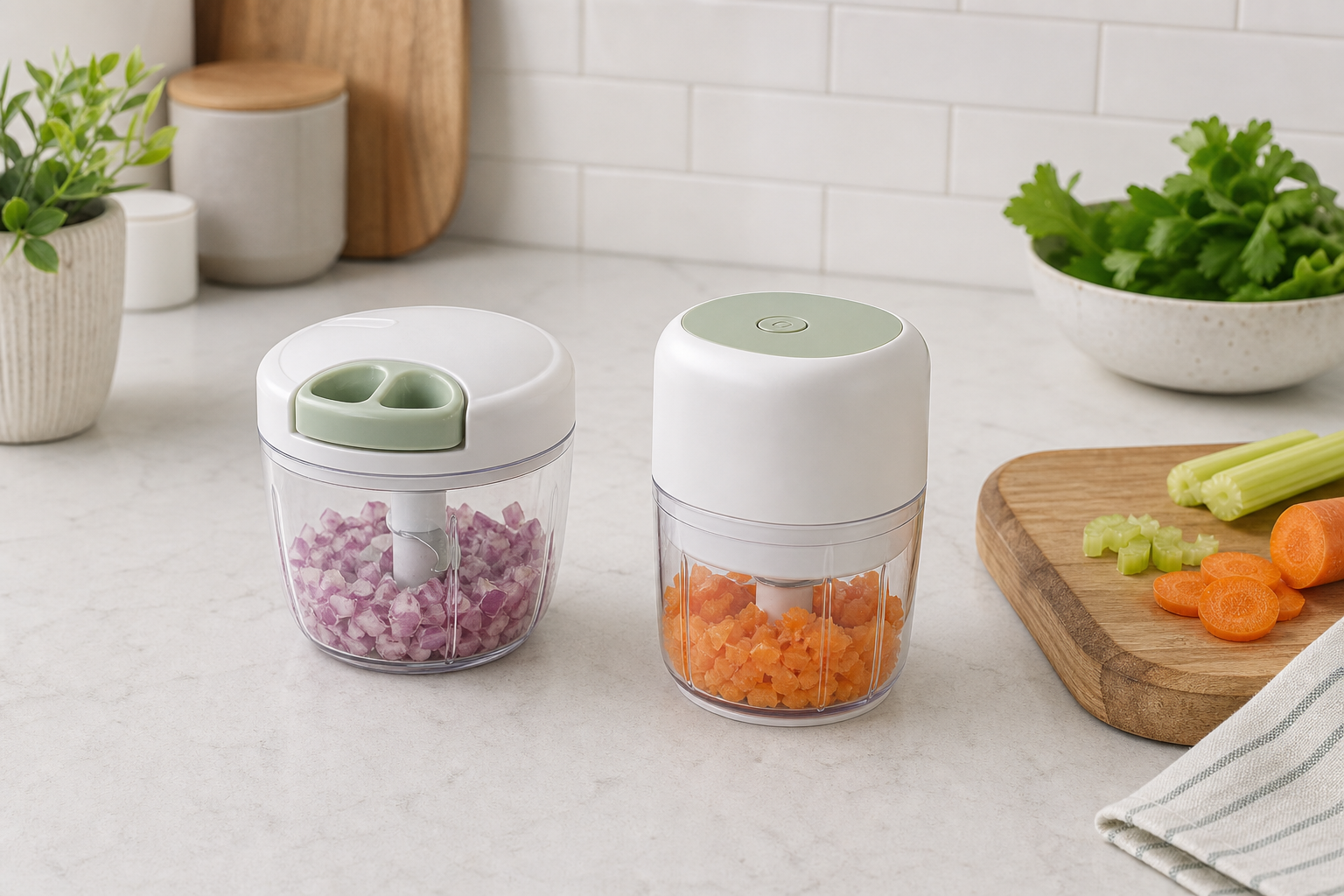
Who this guide is for
This guide is for adults who regularly chop modest amounts for sauces, toppings, aromatics, or small meal-prep batches and do not want the footprint of a full-size processor. It treats a chopper as a kitchen convenience—not as a tool that changes food intake, nutrition, or body weight.
For the broader decision about ordinary planning, storage, cooking, and walking tools, start with the routine-support tools pillar. If your prep jobs need more board space than appliance power, the small-kitchen cutting-board guide is the more useful comparison.
Best fits by job, not unsupported rankings
- Best for occasional small jobs: A simple pull-cord model with a stable base, enclosed blade assembly, and a bowl that can be cleaned without trapping food around the center post.
- Best for frequent use: A corded electric model with a simple press control, clearly stated continuous-run limits, and parts the maker identifies as replaceable.
- Best for tight storage: A short model whose lid, bowl, and blade nest securely without leaving a loose sharp component in the cabinet.
- Best for control over texture: A pulse-style control or manual mechanism that lets you stop and check before ingredients turn uneven or overly fine.
- Best for easier cleanup: A model with few lid crevices, a removable blade hub, and explicit dishwasher labeling for each washable part.
Selection criteria that matter
- Usable capacity: Compare the stated working or liquid capacity, not only the total bowl volume. A tiny bowl can require more batches than it saves in cleanup.
- Counter and cabinet footprint: Record the full width and height, including the lid or motor unit. Check whether the parts nest safely after washing.
- Mechanism: Pull-cord designs avoid a cord and outlet but require repeated pulling. Electric designs reduce that motion but add a motor unit, cord or battery, and operating limits.
- Controls: A simple press-and-hold or pulse control is easier to stop quickly than vague one-touch programs. Check whether the maker explains locking and restart behavior.
- Blade safeguards: Look for an enclosed blade assembly, lid interlock on electric models, clear assembly instructions, and a safe way to lift and store the blade hub.
- Cleaning: Treat “dishwasher safe” as incomplete unless the listing names the bowl, lid, blade assembly, and rack placement. Motor units and pull-cord lids commonly need different care.
- Replacement parts: Check for model-specific bowls, lids, blades, seals, or cord assemblies. Generic parts may look similar without fitting safely.
- Warranty and returns: Compare warranty length, exclusions, seller identity, opened-item returns, and who pays return shipping.
A practical comparison framework
Write the jobs you expect the chopper to handle, then mark each listing yes, no, or unknown:
- Is the stated working capacity large enough for the usual batch?
- Does the manufacturer describe the ingredients and tasks the unit can and cannot handle?
- Is there a clear locking or interlock sequence before the blade moves?
- Can every food-contact crevice be reached for cleaning and drying?
- Are the care instructions specific to each part?
- Can the sharp blade assembly be removed and stored without leaving it loose?
- Are replacement parts tied to the exact model number?
- Would the tool still earn its storage space if it made no health or weight difference?
Task limits to check before buying
Mini choppers are commonly designed for short pulses and small quantities. Do not assume one can handle ice, frozen ingredients, hard nuts, hot liquids, dough, coffee beans, or large pieces unless the current manual explicitly permits that task. Motor wattage alone does not establish safe performance, and customer anecdotes do not override the instructions.
Cut ingredients to the maker's starting size, keep hands and utensils away from the blade, unplug or disconnect power before reaching into an electric model, and follow the manual for assembly and cleaning. Replace cracked bowls, damaged cords, worn locks, or bent blade parts rather than improvising a repair.
Who should skip a mini chopper
Skip one if knife-and-board cleanup is already easier for your batch size, if the pulling or gripping motion is uncomfortable, if loose blade storage is not practical in your home, or if another appliance already handles the same jobs. A full-size processor may be the better fit for repeated large batches; a knife and stable cutting board may be better for precise or irregular cuts.
Readers who cannot safely assemble, grip, or clean around a sharp removable blade should choose another prep method or get appropriate help rather than relying on marketing that calls a chopper effortless or universally easy to use.
Bottom line
The best mini chopper for small-batch meal prep is the one with enough usable capacity, a mechanism you can operate comfortably, clear safeguards, reachable cleaning surfaces, and model-specific replacement parts. Measure the space, check the manual, and choose by repeatable kitchen fit—not by weight-loss language, dramatic speed claims, or an unsupported “best overall” badge.