Low-bulk walking visibility guide
Best Reflective Armbands for Walking Without a Vest
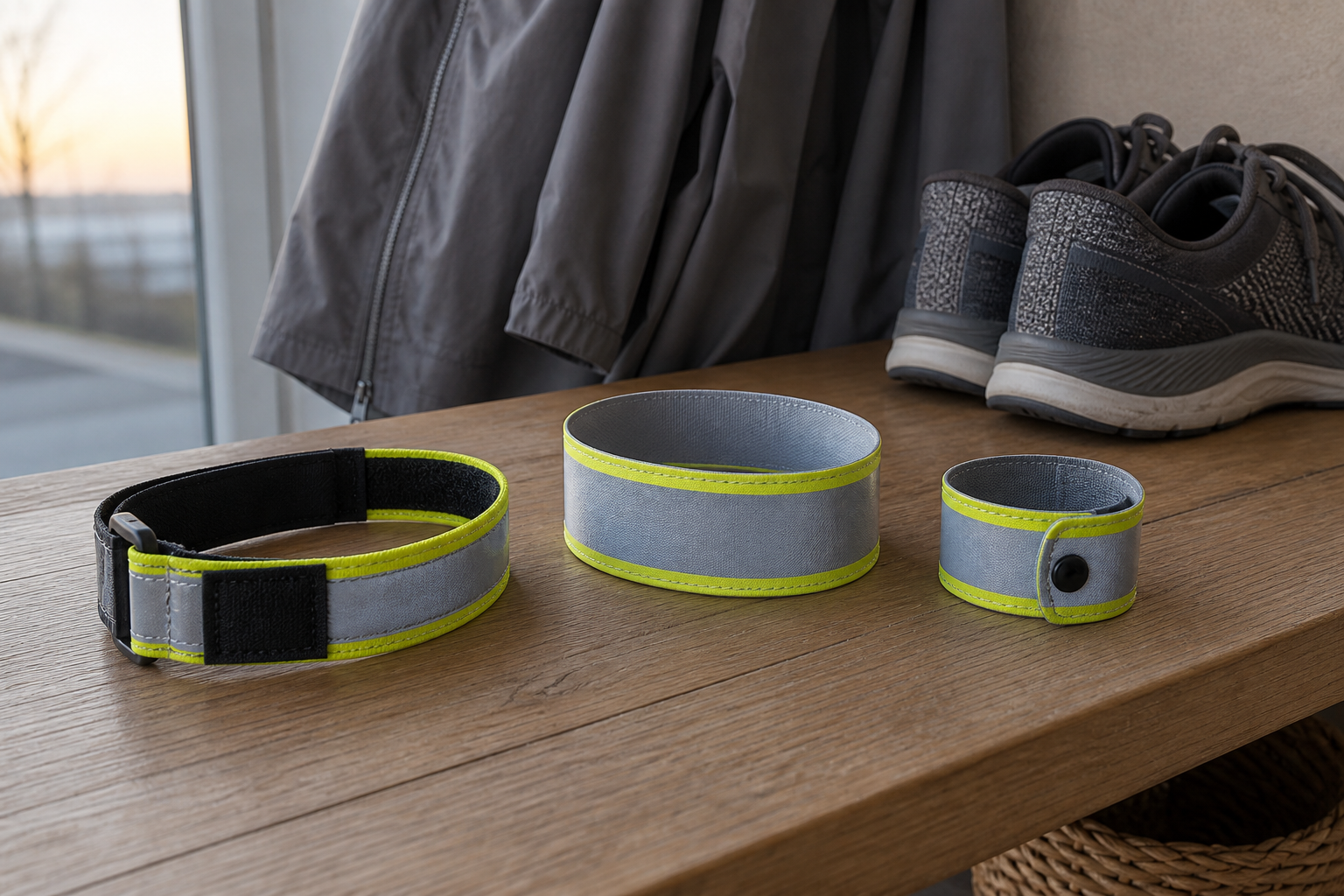
A reflective armband can add a compact visibility cue when a vest or sash feels too bulky. The useful differences are not motivational claims or a dramatic “visibility distance”: they are reflective area, direction, fit over real layers, closure, comfort, and whether the band stays in place.
As an Amazon Associate, GoodWeighFinds earns from qualifying purchases.
Who this guide is for
This guide is for adults who want a small, battery-free reflective accessory for a familiar low-light walking routine and do not want to wear a vest or sash. An armband may add a moving reflective cue, but its smaller surface creates important limits.
For vests, sashes, wrist and ankle bands, and active lights in one broader comparison, use the reflective walking gear guide. This page maps to the broader routine-support tools pillar.
Best-fit types, not unsupported rankings
- Best fit over changing layers: A wide adjustable band with enough overlap to secure over both a light shirt and a jacket sleeve.
- Best fit for simple pull-on use: An elastic band whose stated circumference fits without restricting movement or drifting down the arm.
- Best fit for compact storage: A snap-style band with covered, comfortable edges and enough usable length for the intended sleeve.
- Best fit when batteries are unwanted: A fully passive reflective band, with the understanding that it needs an external light source to return light.
- Best fit for more directional coverage: A pair worn on opposite arms, only if both remain comfortable and visible; two small bands still do not equal broad torso coverage.
Selection criteria that matter
- Usable fit range: Compare minimum and maximum circumference with the sleeve or jacket you will actually wear. “One size” is not a measurement.
- Band width: A wider band can present more reflective area, but it may feel warmer, stiffer, or more restrictive near the elbow.
- Reflective placement: Check whether reflective material wraps around the band or appears only as a short patch that can rotate out of view.
- Closure: Hook-and-loop closures allow adjustment but can catch fabric. Buckles add hardware. Elastic can stretch out. Snap bands need enough overlap to hold securely.
- Movement and comfort: Look for soft edges, low-bulk seams, and a position that does not pinch when the arm bends or swing into a bag strap.
- Layer compatibility: Test whether the band stays visible over a coat, rather than disappearing under a cuff, backpack strap, or dark outer layer.
- Care: Follow the stated wash and drying instructions. Abrasion, harsh cleaning, and repeated folding may affect the surface; do not invent a lifespan the listing does not support.
- Standards claims: If a seller cites a visibility or material standard, look for the exact standard, scope, and evidence for that exact model. A standards reference is not a collision-prevention guarantee.
- Return terms: Confirm seller and return details because comfort and grip can be difficult to judge from listing photos.
A practical comparison framework
Mark each candidate yes, no, or unclear. Treat unclear measurements or performance claims as questions to resolve before buying.
- Does the stated adjustment range fit both the lightest and heaviest planned sleeve?
- Does reflective material remain visible as the arm swings and the band rotates?
- Can the band stay above or below the elbow without pinching, sliding, or restricting movement?
- Is the closure easy to use and unlikely to snag the intended clothing?
- Are material, care, weather, and return details stated for the exact model?
- Would a vest, sash, ankle band, or active light address the route’s relevant directions better?
- Would the armband still solve a real visibility problem if it had no effect on weight, calories, pace, or fitness?
Armband, vest, or active light?
Choose an armband when low bulk and quick storage are the priority and a small moving reflective area suits the route. Choose a vest or sash when broader front, back, and side coverage matters. Consider an active light when there may be too little external light for passive material to reflect, while remembering that powered gear adds charging, battery, attachment, and weather considerations.
No format makes a route safe. Angle, distance, weather, obstructions, lighting, traffic, and another road user’s attention all affect whether gear is noticed. Phrases such as “visible for miles,” “360-degree safety,” or “keeps you safe” are marketing claims, not guarantees.
Who should skip reflective armbands
Skip this format if a small band would be hidden by outerwear, if it slides or restricts movement, or if you need broad torso coverage from several directions. Also skip a new purchase if reflective details already built into a jacket or bag solve the same problem.
Changing the route, time, or indoor plan may be more useful than adding accessories when traffic, lighting, weather, footing, or personal comfort makes a walk feel unsafe. Follow local road and pedestrian rules.
What an armband cannot do
A reflective armband can return some external light from a limited surface. It cannot illuminate a path, control traffic, prevent a collision, or guarantee that another person notices you. It also cannot burn fat, increase calorie burn, or cause weight loss. Avoid ordinary visibility products bundled with body-result or sweat-loss promises.
Bottom line
The best reflective armband is one with a measured fit range, enough reflective area for the intended direction, a closure that stays comfortable over real layers, and claims modest enough to verify. If those checks leave coverage gaps, move up to a vest or sash or add an appropriately maintained active light rather than expecting a small band to do every job.