Compatibility-first maintenance guide
Best Replacement Gaskets for Food Storage Container Lids
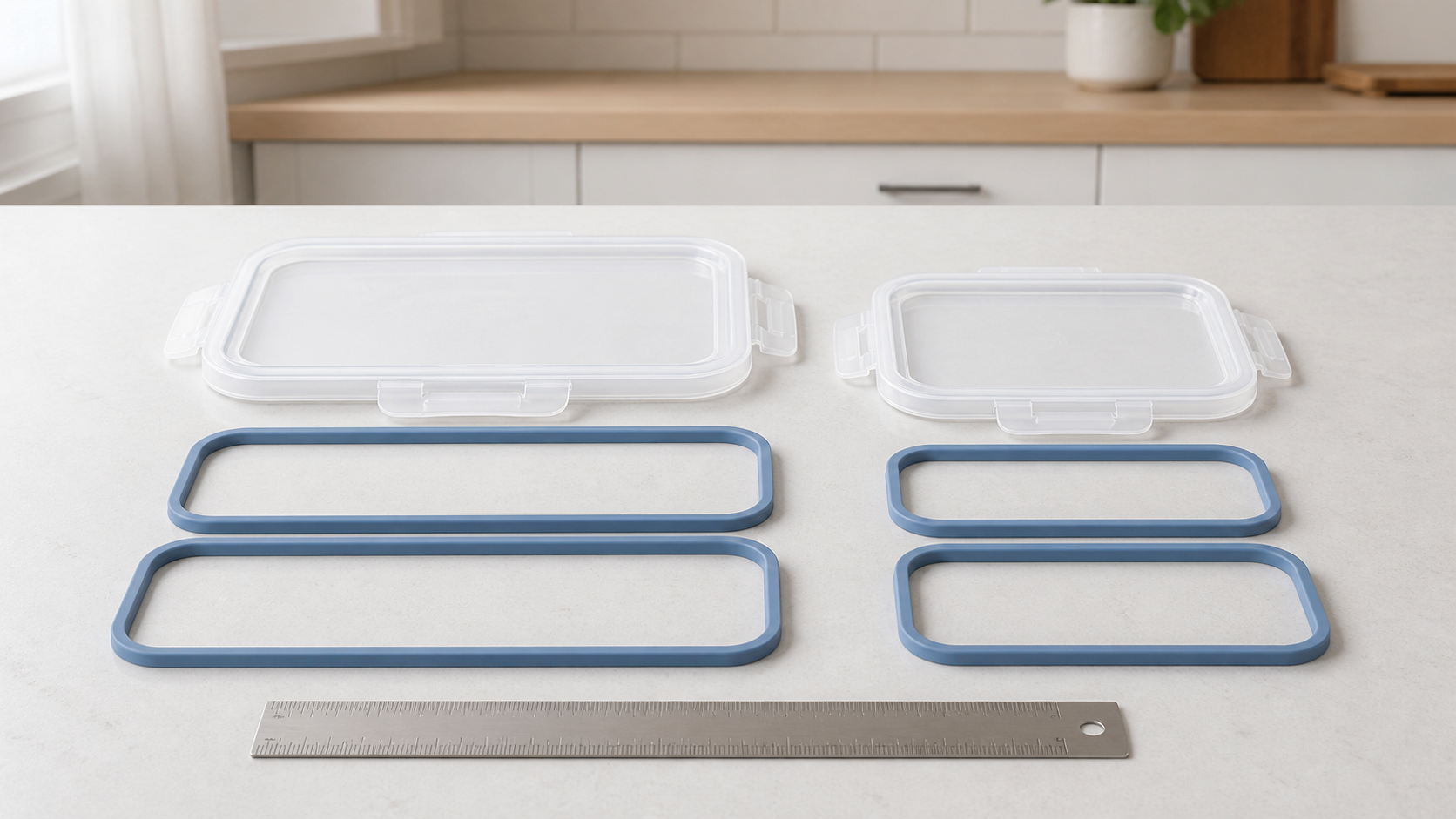
A removable gasket may look like a simple silicone ring, but shape alone does not prove fit. The useful replacement is the exact seal specified for your lid model—or one whose maker explicitly documents the same part number, dimensions, profile, and care limits.
As an Amazon Associate, GoodWeighFinds earns from qualifying purchases.
Who this guide is for
This guide is for adults whose otherwise usable food-storage lid has a removable seal that is worn, missing, stretched, or difficult to clean. It covers replacement gaskets only—not complete replacement lids, improvised seals, or claims that a new gasket makes a damaged container safe.
If the lid itself is cracked, warped, or missing, start with the replacement lids and sets guide. For broader low-pressure kitchen-tool decisions, use the routine-support tools guide.
Best-fit routes, not universal winners
- Best first route: A replacement part sold by the original maker for the exact lid model and size.
- Best route when a part number is visible: Match that number in the maker's current parts list or compatibility chart before comparing sellers.
- Best route when the model is unclear: Contact the maker with photos and molded codes; measurements can support identification but should not replace it.
- Best route for a discontinued system: Compare the cost and return risk of old stock with replacing only the containers you still use.
- Best no-buy route: Clean and reinstall the original gasket exactly as directed when it is intact and the maker does not call for replacement.
Selection criteria that matter
- Exact compatibility: Match maker, product line, lid model, container size, and replacement part number. Capacity alone is not enough.
- Gasket geometry: Compare overall length and width or diameter, corner radius, cross-section profile, thickness, and any tabs or orientation marks.
- Channel fit: The lid groove must match the seal profile. A ring that is merely close can twist, bunch, sit proud, or stretch unevenly.
- Maker guidance: Verify that the gasket is intended to be removable and replaceable. Some lid seals are bonded or are not sold as service parts.
- Material statements: Treat silicone, food-contact, BPA-free, temperature, freezer, microwave, and dishwasher wording as claims for the exact item—not assumptions based on appearance.
- Removal and care: Look for current directions covering removal tools, washing, drying, orientation, and reinstallation without stretching or damaging the channel.
- Package contents: Confirm seal count and sizes. A multipack is poor value when most rings do not fit anything you own.
- Seller and returns: Check seller identity, packaging, return window, opened-package rules, and return shipping before ordering a compatibility-sensitive part.
A practical compatibility framework
Mark each candidate yes, no, or unclear. Do not treat an unclear item as a likely fit.
- Does the original lid maker say its gasket can be replaced?
- Does the listing name the exact brand, line, lid model, and container size?
- Does the replacement part number match the maker's documentation?
- Do the gasket profile, corner shape, tabs, and orientation match the original?
- Are dimensions stated at the same measurement points you used?
- Are installation, cleaning, drying, and appliance limits stated for this part?
- Are seller and return terms clear if the fit is wrong?
- Is replacing the seal more sensible than replacing a cracked or distorted lid?
What “universal,” “airtight,” and “leakproof” do not prove
“Universal” may describe a range of listed sizes, not every lid with a similar outline. “Airtight” and “leakproof” are performance claims under particular assembly and use conditions; they do not prove compatibility with an unlisted lid or restore the condition of damaged plastic, latches, or sealing channels.
Do not trim, splice, glue, heat, or heavily stretch a gasket to force a fit. Do not use a replacement to compensate for a cracked rim, broken latch, warped lid, or damaged groove. Follow the original container maker's instructions and retire components that no longer close normally or cannot be cleaned as directed.
Cleaning and reassembly checks
Before removing any seal, confirm that the maker permits removal and note its orientation. Clean the gasket and channel using the stated method, allow both to dry as directed, and reinstall without twisting. If the seal will not sit evenly, stop rather than forcing the lid closed.
A fresh gasket does not establish food-storage time, reheating safety, or sanitation. Those decisions depend on the complete container, the food, handling, and the original maker's current use instructions—not on a replacement-ring listing.
Who should skip this purchase
Skip listings that rely on “fits most,” capacity, or appearance without naming compatible lid models. Skip multipacks without individual dimensions, improvised cord sold without lid-specific guidance, and any seller that instructs buyers to cut or permanently alter the seal.
Skip gasket replacement entirely when the lid channel, rim, hinge, vent, or latch is damaged; when the gasket is not designed to be removed; or when repeated guessing costs nearly as much as a small matched container set.
Bottom line
The best replacement gasket is not the closest-looking ring. It is the part documented for the exact lid you own, with matching identifiers, profile, care instructions, and manageable return terms. Use measurements to confirm identity, not to invent compatibility, and keep the no-buy option when the original seal only needs approved cleaning and reinstallation.