Small-kitchen meal-prep buying guide
Best Stackable Mixing Bowls for Small-Kitchen Meal Prep
A nesting bowl set can make it easier to mix, rinse, portion, and stage ingredients without filling a small cabinet. The right set is not the one with the most pieces: it is the one whose useful sizes nest tightly, stay steady, and match the prep jobs you repeat.
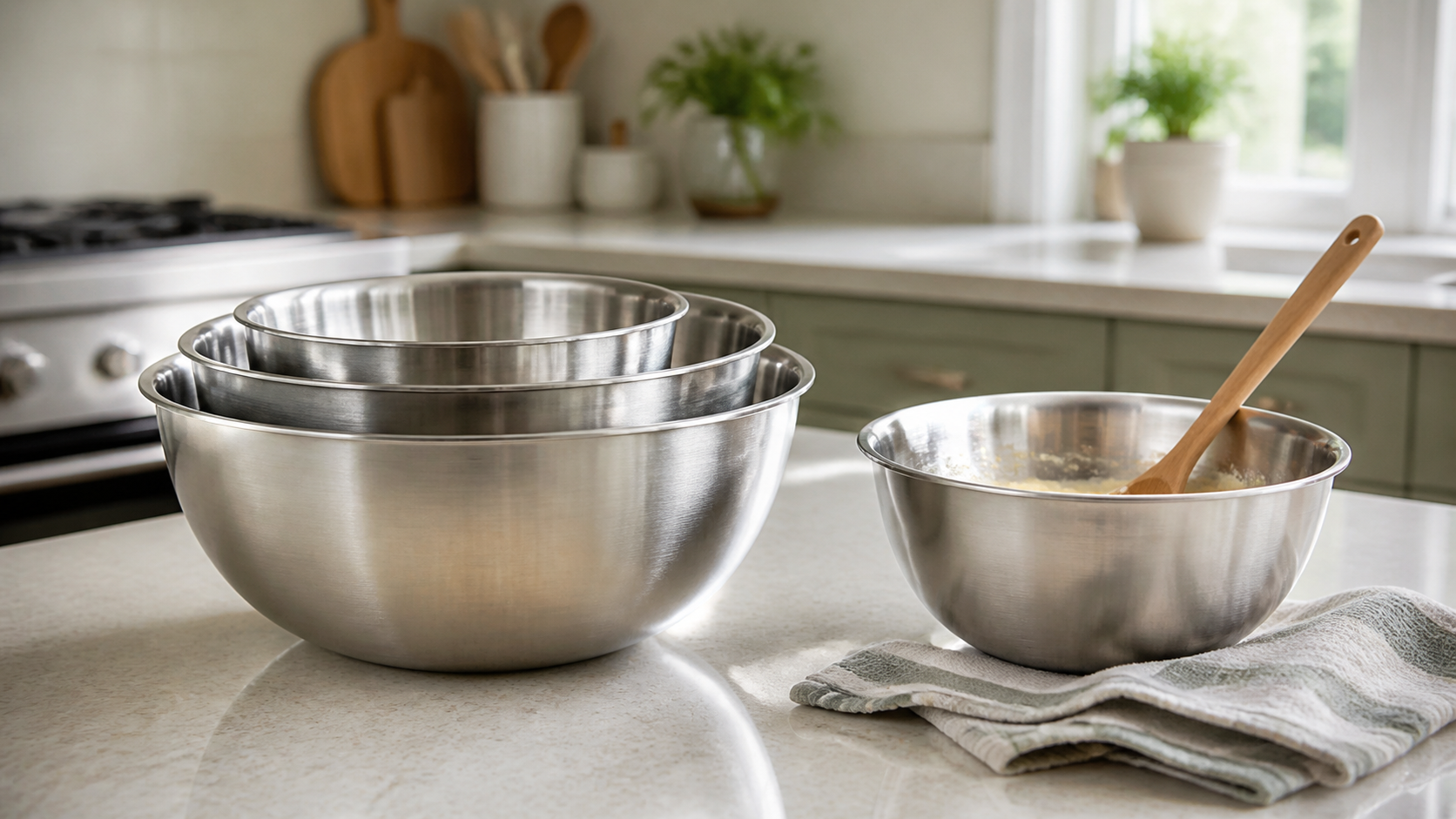
Who this guide is for
This guide is for adults who use several bowls to stage ingredients or repeat small-batch prep but have limited cabinet and counter space. It covers freestanding mixing bowls that nest inside one another—not food-storage containers, serving-bowl sets, or collapsible colanders.
If storage after cooking is the larger problem, start with the meal-prep container guide. For the broader buying framework, see the routine-support tools pillar. Mixing bowls are kitchen tools; they do not determine portions or produce weight-loss results.
Best-fit formats, not unsupported winners
No bowl sets were purchased, filled, washed, or ranked for this guide. Compare these common formats by the jobs they can reasonably handle:
- Stainless-steel nesting bowls: Usually light for their size and resistant to breakage; check base movement, rim comfort, and whether reactive-food or mixer-use claims are clearly stated.
- Glass nesting bowls: Let you see the mixture and may double as serving bowls, but they are heavier and need careful handling and shelf support.
- Plastic nesting bowls: Often light and available with lids or grips; inspect staining, odor, heat, scratch, and dishwasher guidance rather than assuming every use is supported.
- Bowls with nonslip bases: Can reduce sliding during stirring, but the base adds a seam to clean and may increase nested height.
- Bowls with lids: Can cover short staging tasks, provided the lids fit predictably and do not turn the set into a bulky storage problem.
- Bowls with handles or pour spouts: May help with batters and transferring ingredients, but directional features can use more cabinet width.
Selection criteria that matter
- List the capacities you will use: Look for the capacity and diameter of every bowl, not only the largest. A useful spread might cover a small sauce or garnish, a medium mixture, and a larger toss without near-duplicate sizes.
- Measure the nested set: Compare the total diameter and height while stored with your shelf opening, depth, and clearance. Include lids if they will live with the bowls.
- Check stability: A broad flat base or well-attached nonslip ring may help during whisking. Treat “nonslip” as a manufacturer claim and keep the bowl on a dry, stable work surface.
- Match material to handling: Consider weight when full, breakage risk, scratch and stain guidance, and whether the material fits the utensils and ingredients you use.
- Inspect rims and grips: Rolled rims, handles, or spouts should support comfortable lifting and controlled pouring without making the bowls awkward to store.
- Read appliance-use claims exactly: Do not assume a bowl is microwave-, freezer-, oven-, or mixer-safe. Follow the maker's stated temperature, appliance, and attachment limits.
- Count every cleaning surface: Nonslip rings, lid seals, spouts, and handles add edges that can trap residue. Check whether parts separate and what dishwasher placement is supported.
- Review replacement options: For sets with lids or removable bases, check whether model-specific replacements exist and whether the seller clearly identifies compatible parts.
A simple comparison framework
Score each listing against the same questions instead of treating a large set as automatically better:
- Are capacity, top diameter, base diameter, and height listed for every bowl?
- Will at least three sizes serve distinct prep jobs?
- Does the complete nested set fit the measured cabinet space?
- Is the largest bowl comfortable to lift when full?
- Does the base design suit vigorous stirring on the available counter?
- Are material, temperature, appliance, and dishwasher limits explicit?
- Will lids, handles, or spouts earn their extra storage and cleaning effort?
- Are seller identity, included pieces, and return terms clear?
- Would one or two bowls already at home cover the same tasks?
Practical limits and care
Nesting saves the space between bowls; it does not make the outer bowl smaller. Measure the largest diameter and full stacked height before buying. If damp bowls are nested immediately, trapped moisture can create odor or residue, so let every surface dry before storage.
Material and appliance claims vary. A metal bowl does not belong in a microwave, glass can chip or break, and plastic heat limits are product-specific. Use the current manufacturer's directions rather than broad category assumptions.
Who should skip this purchase
Skip a full set if one multipurpose bowl already handles most prep, if the cabinet cannot take the largest diameter, or if several included sizes duplicate bowls you own. A pair of individually chosen bowls may use less space and money than an oversized set.
Skip listings that omit individual capacities, dimensions, material details, care directions, or included-piece definitions. If rigid food measurement feels stressful or punitive, do not use marked bowls as a tracking requirement; choose tools around the cooking job instead.
Bottom line
The best stackable mixing-bowl set for a small kitchen has a deliberate size spread, a measured nested footprint, a stable base, manageable full weight, and care directions that fit your routine. Compare those facts before piece count, bundled extras, or vague “space-saving” language.