Kitchen-scale comparison
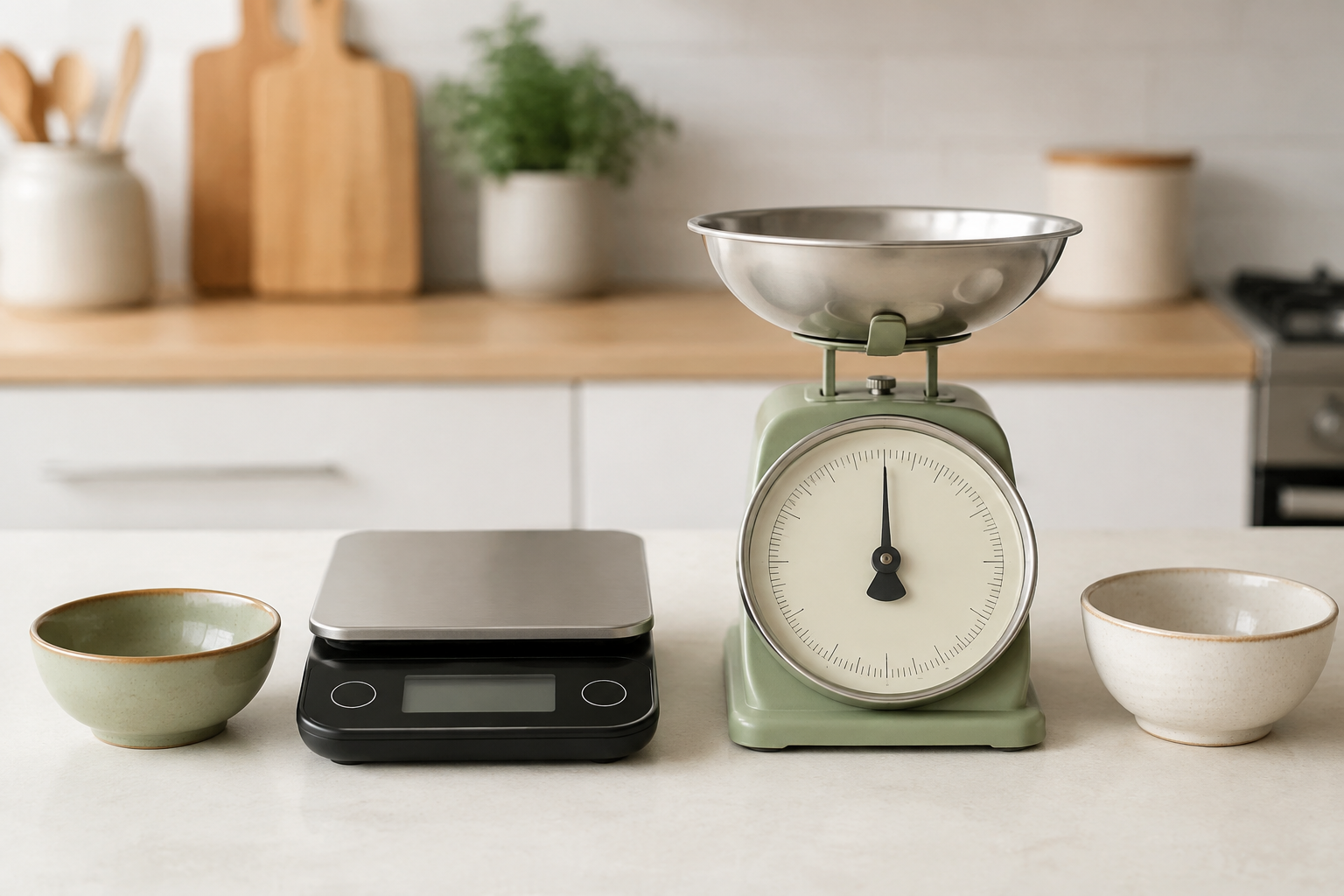
Digital Kitchen Scale vs Analog Kitchen Scale
A digital scale usually makes small measurements and container subtraction easier; an analog scale offers a battery-free dial and simpler controls. Neither mechanism is automatically more useful. The better fit depends on what you cook, what you can read comfortably, where the scale will live, and whether measuring supports or pressures your routine.
As an Amazon Associate, GoodWeighFinds earns from qualifying purchases.
The short answer
Choose a digital scale when you routinely need small increments, several unit options, a tare button, a compact flat platform, or a quick-to-read number. Choose an analog scale when battery-free operation, a persistent dial, basic controls, and a removable bowl matter more than fine increments or compact storage. Skip both when cups and spoons already suit your recipes, or when measuring food makes eating or tracking feel rigid or distressing.
Where digital scales tend to fit better
- Small increments: Listings commonly state a resolution, such as one gram, but resolution is not proof of accuracy across the full range. Check the manual and treat unusually precise marketing cautiously.
- Tare: A tare or zero button can subtract the container between ingredients. Check whether the scale retains enough remaining capacity after a heavy bowl is placed on it.
- Unit switching: Digital models may offer grams, ounces, pounds-and-ounces, or liquid-volume modes. Confirm the exact units and remember that volume conversion can depend on the liquid assumed by the device.
- Storage: A flat platform may slide into a drawer more easily than a scale with a permanent bowl, but side buttons and glass surfaces still need protection.
- Potential friction: Batteries, auto-off timing, touch controls, dim displays, and numbers hidden by a wide plate can interrupt use.
Where analog scales tend to fit better
- No batteries: A mechanical dial is available without charging or battery replacement.
- Always-visible reading: The pointer remains visible without an auto-off timer, although small markings, glare, and viewing angle can make a dial harder to read.
- Simple controls: Many models use one adjustment knob rather than buttons and modes. That simplicity does not guarantee easier reading or calibration.
- Included bowl: A removable bowl can be convenient for loose ingredients. Check its usable capacity, whether it obscures the dial, and whether the maker provides clear care directions.
- Potential friction: Analog mechanisms usually occupy more vertical space, may use broader increments, and require the pointer to be checked at eye level and reset to zero.
Compare these criteria before choosing
- Actual measurement job: Write down the smallest increment and heaviest combined bowl-and-ingredient load your recipes require. Do not pay for precision you will not use.
- Readable from your position: Check whether a display or dial remains visible behind your usual bowl. Consider contrast, marking size, glare, and whether you must bend to read it.
- Zeroing method: Digital tare is convenient but can time out. An analog zero knob is persistent but may take more adjustment. Neither corrects an overloaded or unevenly placed scale.
- Platform or bowl fit: Compare measured dimensions with your usual containers. A wide bowl can cover a digital display; a shallow analog bowl may not hold the quantity you prepare.
- Capacity and increments: Read both together. Maximum capacity says little if increments are too broad for the recipe, while fine resolution is unhelpful if the total load exceeds the limit.
- Counter and storage footprint: Measure the complete setup, including an analog bowl or digital display projection, then assign it a real storage location before buying.
- Power and controls: For digital models, check battery type, included-power claims, button placement, auto-off behavior, and low-battery indication. For analog models, check how the pointer is reset.
- Cleaning: Verify whether a bowl or platform detaches and follow the maker's directions. A kitchen scale is not automatically washable or water-resistant.
- Returns and documentation: Prefer listings with a readable manual, stated specifications, seller identity, and return terms over unsupported “professional accuracy” language.
Accuracy claims need context
“Precise,” “professional,” and “perfectly accurate” are marketing language unless the maker defines test conditions, tolerances, and the usable range. Readings can be affected by an uneven surface, off-center loads, low batteries, temperature, overloading, a bowl touching another object, or a pointer that was not set to zero.
A scale can support recipe consistency or general awareness, but it does not determine an appropriate serving for an individual and does not cause weight loss. If you need a cooking tool rather than a choice between mechanisms, the food scale vs measuring cups comparison covers that broader decision. The compact food-scale guide focuses on measured storage constraints.
A calm buy, delay, or skip check
Buy now only if a scale solves a repeated recipe problem and you can name the required capacity, increment, display or dial size, container fit, and storage spot. Delay if you have not compared those details or if a current measuring method works adequately. Skip if the product page leans on fat-loss promises, omits basic specifications, or if numerical food tracking increases anxiety, rigidity, or guilt.
For a broader way to evaluate practical tools without body-result promises, use the routine-support tools guide. If measuring is connected to individualized nutrition needs, a qualified healthcare professional can help determine whether and how it belongs in your situation.
Bottom line
A digital kitchen scale is generally the more flexible choice for tare, small increments, unit switching, and flat storage. An analog scale is a reasonable fit for battery-free, visually persistent, basic weighing when its dial and increments are easy for you to read. Choose from specifications and routine fit, not mechanism stereotypes or weight-loss claims—and keep using a simpler tool if it already does the job comfortably.