Small-kitchen buy-or-skip guide
Is a Spoon Rest Worth It for a Small Kitchen?
A spoon rest is worth buying when cooking regularly leaves a wet or coated utensil without a stable landing spot and a measured rest fits both that utensil and the counter. Skip it when a washable saucer, small plate, or heat-safe work surface already handles the job without adding storage or cleanup.
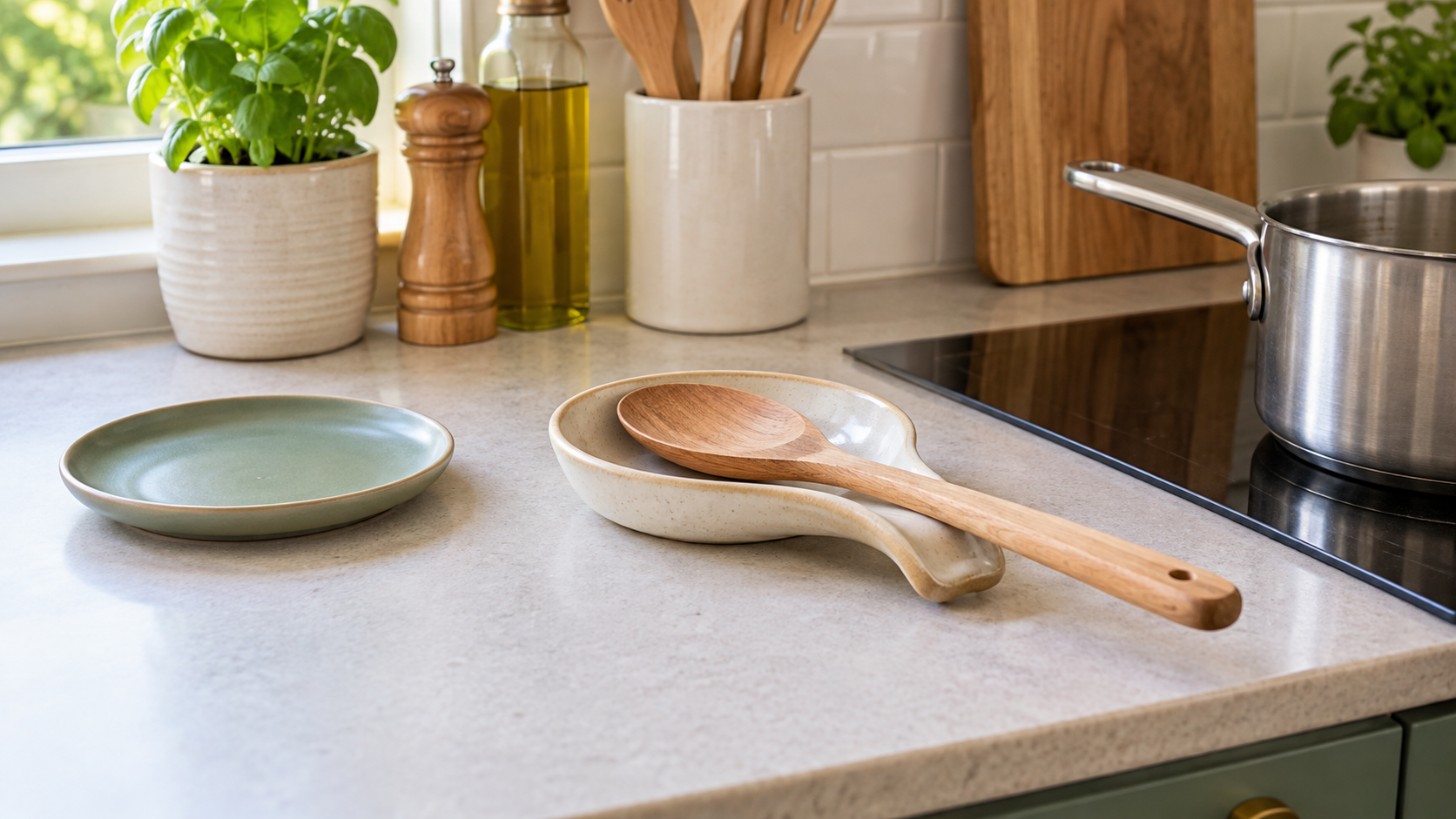
The short decision
| Decision | When it fits |
|---|---|
| Buy | The same utensil-placement problem happens several times a week, an existing saucer fails for a specific reason, and a measured rest has a workable drip area and footprint. |
| Delay | You have not counted the problem, measured the usual utensils, or tested an item already in the kitchen. |
| Choose an alternative | A small plate, saucer, shallow bowl, washable tray, or maker-approved work surface already provides a stable landing spot. |
| Skip | Counter space is tighter than drawer space, the rest would hold only one of several usual utensils, or it creates another item to wash and store without removing repeated friction. |
| Escalate | A listing makes unsupported claims about sanitation, eliminating contamination, protecting every counter material, or tolerating unspecified heat. |
Run a one-week no-buy test
For one normal week, note each time a spoon, spatula, ladle, whisk, or turner needs a temporary landing place. Record the utensil, whether it is wet or coated, how long it sits, and what you use instead. This is a workflow observation, not a hygiene test.
Place a washable saucer or small plate in the proposed spot for the same week. Count how often it solves the problem and what still goes wrong: the handle tips, the utensil bowl hangs past the edge, drips miss the surface, or the plate consumes too much workspace. A dedicated purchase is easier to justify when the same measured failure recurs.
Measure the utensil and landing zone
Measure the widest utensil head and note how far the handle extends beyond the counter area. Then measure the proposed spoon rest's usable well, neck or notch, complete exterior width and depth, and any raised edge. Listing photos can make a rest look larger than it is.
- Head fit: the utensil bowl or blade should land within the usable drip area rather than balancing on the rim.
- Handle balance: check whether the long handle pulls the utensil off center; decorative shapes do not prove loaded stability.
- Counter fit: include the handle's sweep and the hand path around the stove or prep board, not just the rest's base.
- Multiple utensils: if two tools are used at once, decide whether one rest actually solves the workflow or merely moves the second tool elsewhere.
Cost, setup, maintenance, and storage
The purchase price is only one tradeoff. Include delivery or return costs, any need for more than one rest, and the space used between cooking sessions. A dedicated rest has almost no setup beyond choosing a stable location, but it still needs a defined washing, drying, and storage routine.
Read the current maker's material and care instructions. “Ceramic,” “silicone,” “stainless steel,” or “dishwasher safe” wording is model-specific; do not transfer care directions from one item to another. Check edges, grooves, and decorative details for cleaning access. If the rest remains beside the stove, confirm that its position does not crowd controls, burners, cookware handles, or a hot surface.
Red flags in a listing
- No complete exterior dimensions or no usable-area view with an ordinary utensil.
- “Universal” fit without measurements for the well, notch, or supported utensil.
- Claims that the rest prevents contamination, keeps a kitchen sanitary, or is inherently hygienic without relevant evidence and use conditions.
- “Heatproof,” “counter-safe,” “stain-proof,” or “non-slip” wording without material-specific instructions and limits.
- Styled photos that hide the base, edge height, cleaning grooves, or scale.
- No clear material disclosure, care directions, seller identity, or practical return terms.
Who should skip a dedicated spoon rest?
Skip one if the problem happens rarely, the saucer test works, or your cooking tools already have maker-designed rests or hanging points that work safely in the actual setup. Skip it when the only available counter spot creates an obstruction, or when the item would live in storage so deep that it is unlikely to be retrieved.
Also skip a rest whose care instructions do not fit the household routine, whose usable area misses the usual utensils, or whose appeal depends on unsupported hygiene, surface-protection, or heat claims. A washable plate you already own is a valid long-term solution.
Bottom line
A spoon rest is worth it only when a one-week test shows repeated utensil-placement friction, the usual tool fits the measured drip area, and the rest earns its counter and storage footprint. Delay until those facts are known; choose a saucer or plate when it works; and skip vague products that promise more than a simple landing surface can establish.
If the ownership case is clear, use the spoon-rest format guide to compare dimensions, materials, care, and realistic skip criteria. For other low-claim kitchen decisions, continue with the routine-support tools pillar.