X vs Y comparison
Meal Prep Containers vs Freezer Containers
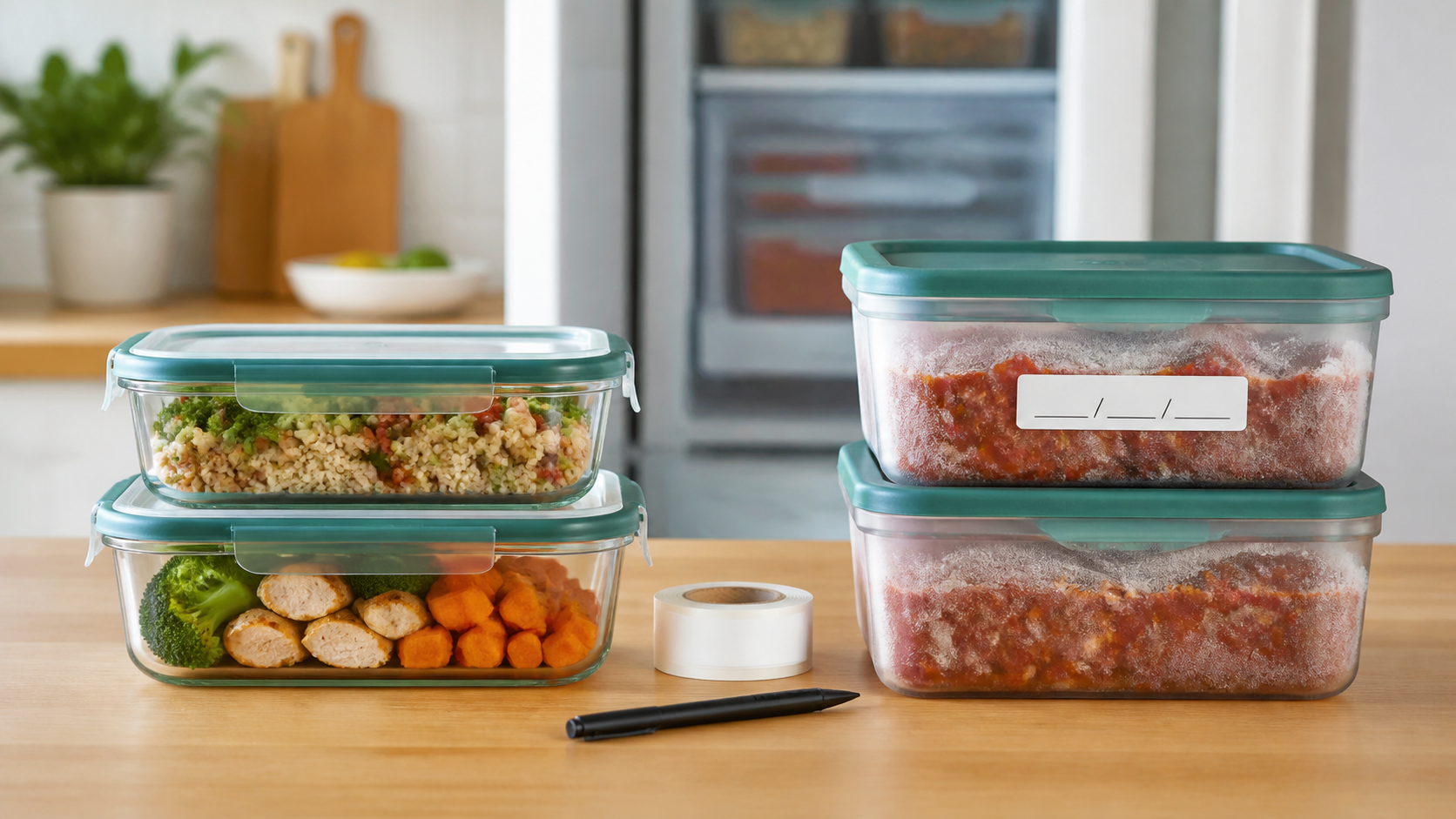
Meal prep containers make the most sense for food you expect to refrigerate, carry, and eat soon. Freezer containers are built around longer storage, expansion room, labeling, stacking, and a workable thawing plan. The categories overlap, but the routine—not weight-loss marketing—should decide which features matter.
As an Amazon Associate, GoodWeighFinds earns from qualifying purchases.
Quick decision
- Choose meal prep containers when the usual path is refrigerator to lunch bag to microwave or table within the next few days.
- Choose freezer containers when you batch cook, store food longer, need clear dates, and want shapes that stack efficiently in a freezer.
- Choose a dual-use set only when the maker clearly labels it for freezing and its size, lids, and thawing instructions also fit everyday meals.
- Buy neither when containers you already own safely fit the food and storage job.
What meal prep containers do well
Everyday meal prep containers are usually sized and shaped around a single meal. Shallow rectangular bases can be easy to see in the refrigerator, fit common lunch bags, and reheat more evenly than a very deep container. Dividers may keep foods separate, though fixed compartments also reduce flexibility.
The limitation is that “meal prep” is mostly a use label, not a technical standard. A thin, light container may work well for refrigerated lunches but become brittle, distorted, or difficult to seal after freezing. Never assume a product is suitable for a freezer because a listing shows batch cooking.
What freezer containers do well
Freezer containers should make longer storage easier to manage. Useful designs leave practical headspace for foods that expand, stack without wasting shelf height, accept a readable date label, and come in sizes that match what you will thaw at one time.
Deeper freezer shapes can be awkward in a compact lunch bag and slower to thaw. Large containers also encourage repeatedly thawing more food than needed. A freezer-ready set solves a storage job; it does not automatically become the best daily lunch set.
Who each option fits
Meal prep containers fit commuters, work lunches, visible refrigerator planning, and households preparing a few near-term meals. They are strongest when daily handling and cleanup matter more than dense freezer stacking.
Freezer containers fit batch cooks, people preserving extra portions, households rotating soups or sauces, and anyone whose main bottleneck is organizing food beyond the next several days. They require enough freezer room and a habit of dating, rotating, thawing, and cleaning the containers.
If you need both jobs, do not shop from the category name alone. Compare the exact set against both workflows and consider a small number of dual-use single-compartment containers instead of a large specialized bundle.
Tradeoffs worth comparing
- Shape: Shallow containers suit complete meals and quick refrigerator visibility; deeper vessels may suit soups, sauces, and compact freezer stacking.
- Capacity: Check usable dimensions, not just volume. Decide whether each container holds one thawing portion or several servings.
- Compartments: Dividers organize a packed meal but can trap residue, limit food shapes, and waste freezer space.
- Material: Confirm low-temperature, microwave, oven, and dishwasher instructions separately. The base and lid may have different limits.
- Lids: Look for closures you can operate comfortably, removable gaskets you can clean, and replacement-lid availability.
- Visibility and labels: Clear sides help identify food; a smooth label area makes dates and contents easier to read.
- Empty storage: Nesting saves cabinet space only when lids remain easy to match and retrieve.
- Cost: Compare the number of usable containers and replacement parts, not the biggest advertised piece count.
Setup and maintenance
Measure the refrigerator shelf, freezer drawer, lunch bag, and usual microwave before ordering. Test how the empty containers and lids will be stored. A set that fits food but overwhelms a cabinet adds friction before cooking begins.
For freezing, follow the food and container maker's instructions, allow appropriate expansion room, cool food using accepted food-safety guidance, label the contents and date, and use a consistent rotation system. Avoid sudden temperature changes unless the manufacturer explicitly supports them, especially with glass.
Check rims, tabs, and gaskets after washing. Stained material is not necessarily unsafe, but cracks, warping, persistent odors, damaged seals, or a lid that no longer closes as designed are signs to follow the maker's replacement guidance. Treat “leakproof” as a claim to verify and carry liquids upright when uncertain.
Skip criteria
Skip dedicated meal prep containers if ordinary food-storage containers already fit your bag and refrigerator. Skip freezer containers if you rarely freeze prepared food, cannot see or rotate what is stored, or do not have room to stack the set safely.
Skip a large set when only two or three pieces fit the routine, when replacement lids are unavailable, or when the care instructions are vague. Also skip listings that turn a storage tool into a guaranteed weight-loss system, prescribe one “perfect” portion for every adult, or bundle containers with supplements, detox products, appetite suppressants, stimulants, patches, or GLP-1 alternative claims.
Next steps
For detailed everyday-container criteria, use the meal prep container guide. If longer storage is the job, compare the freezer container guide and the freezer label guide.
If longer storage seems right but buying another set is uncertain, use the freezer-container worth-it guide to test a dedicated set against suitable containers or bags you already own.
This page maps to the routine-support tools pillar. If material is the unresolved question rather than storage duration, use the glass versus plastic container comparison.
Bottom line
Choose meal prep containers for repeated near-term packing, carrying, and reheating. Choose freezer containers for longer storage, clear dating, expansion room, and efficient freezer rotation. A carefully labeled dual-use set can cover both, but only when its documented limits and dimensions fit both routines.