Flexible packing or rigid protection
Reusable Freezer Bag vs Rigid Container for Small Freezers
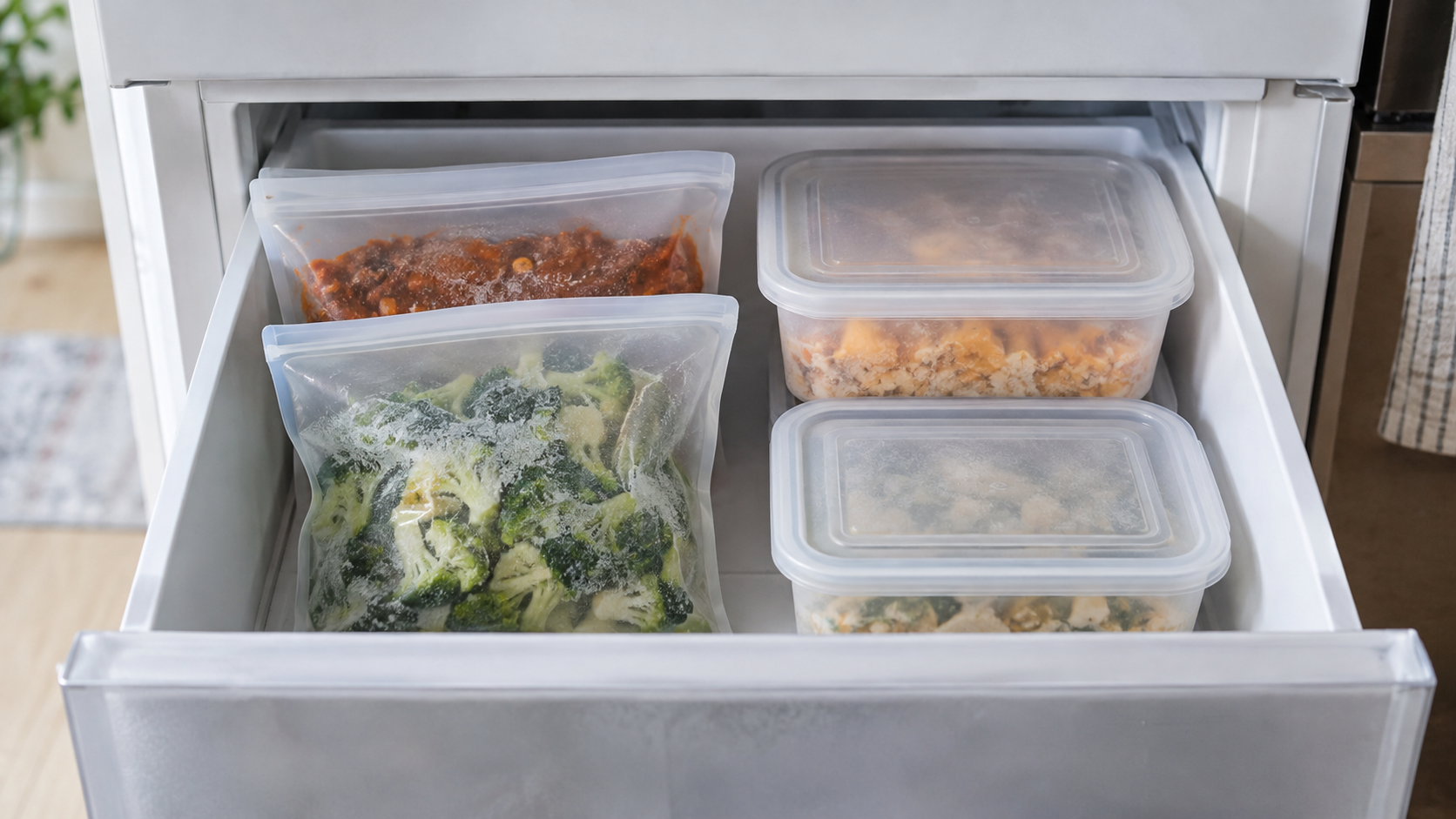
Reusable freezer bags can conform to narrow gaps and store flatter when empty. Rigid containers keep a fixed shape and can make stable stacks when their dimensions suit the freezer. The better choice depends on what you freeze, how you fill and retrieve it, and whether the cleanup routine is realistic.
As an Amazon Associate, GoodWeighFinds earns from qualifying purchases.
The quick comparison
- Reusable freezer bag: useful when flexible shape or flatter empty storage matters, provided its opening, closure, base, and drying routine fit how you work.
- Rigid container: useful when shape protection, upright filling, and predictable stacking matter, provided the footprint and lid clearance fit.
- Use both selectively: match the format to recurring foods instead of replacing an entire working storage set.
- Buy neither yet: first inventory compatible containers already on hand and test a freezer layout with their actual dimensions.
Measure the usable freezer, then the loaded item
Measure shelf or drawer width, depth, and height after accounting for rails, vents, bins, door swing, and the space needed to grasp an item. A bag's package capacity does not reveal its shape after filling; a container's outside dimensions do not reveal its usable interior. Compare the dimensions that affect your particular storage position.
Make paper rectangles for container footprints and note their heights. For bags, estimate the filled width, length, and thickness using a bag you already own or a folded towel—without blocking vents or forcing the drawer. A format that looks compact empty may become awkward when loaded.
Flexible space is not automatically organized space
A reusable bag can settle around neighboring items, but soft packages may slide, slump, or hide labels when piled. A compatible bin or upright file-style arrangement may make them easier to retrieve, though that accessory also consumes space. Do not assume a bag will stand on its own unless the specific design and load support that use.
Rigid containers preserve a consistent outline and may stack neatly when the manufacturer describes them as stackable and their lids match. Mixed shapes can create unused gaps, while tall stacks can make lower containers inconvenient. Test whether you can remove one item without dismantling the freezer.
Compare filling, access, and cleanup
- Filling: a rigid container naturally stays open; a flexible bag may need a stable base, wide opening, holder, or two-handed support.
- Access: consider whether you retrieve one portion, an entire batch, or several ingredients and whether labels remain visible.
- Cleaning: check the exact care directions. Corners, seals, lid channels, and bag closures can all retain residue.
- Drying: reusable bags must stay open long enough to dry according to their care needs; containers and lids also need adequate rack space before nesting.
- Empty storage: bags may fold or nest more compactly, while container bases and lids need a repeatable cabinet or drawer location.
Claims that still need model-level checking
Terms such as “leakproof,” “airtight,” “dishwasher safe,” “microwave safe,” and “freezer safe” are not interchangeable and should not be inferred from appearance. Read the maker's instructions for closure, filling, temperature, reheating, cleaning, and replacement parts. This comparison does not establish food-safety performance or how long food will remain suitable.
A practical decision rule
- Choose reusable bags when flexible loaded shapes solve a measured space problem and you can consistently fill, label, wash, and dry them.
- Choose rigid containers when protection and predictable stacking outweigh their fixed footprint and you have space for bases and lids.
- Keep a mixed system when each format has a clear job; standardize only enough sizes to make matching and retrieval manageable.
- Skip the purchase when the issue is unlabeled food, duplicate items, or an overcrowded freezer rather than the container format.
Bottom line
In a small freezer, flexible bags can use irregular space while rigid containers offer predictable shape and stacking. Neither is a universal space saver. Measure the loaded package, account for retrieval and cleanup, and buy only for a recurring storage job. For a broader ownership test, see whether freezer containers are worth it for batch cooking; for the wider framework, use the routine-support tools guide.