Bottle-cleaning tool storage comparison
Sink Caddy vs Suction Holder for Bottle-Cleaning Tools
A countertop caddy is easier to reposition and does not depend on a mounting surface. A suction holder can clear counter space, but only when the wall, sink, loaded tool set, and removal routine suit its documented setup. Neither format is automatically cleaner or faster-drying.
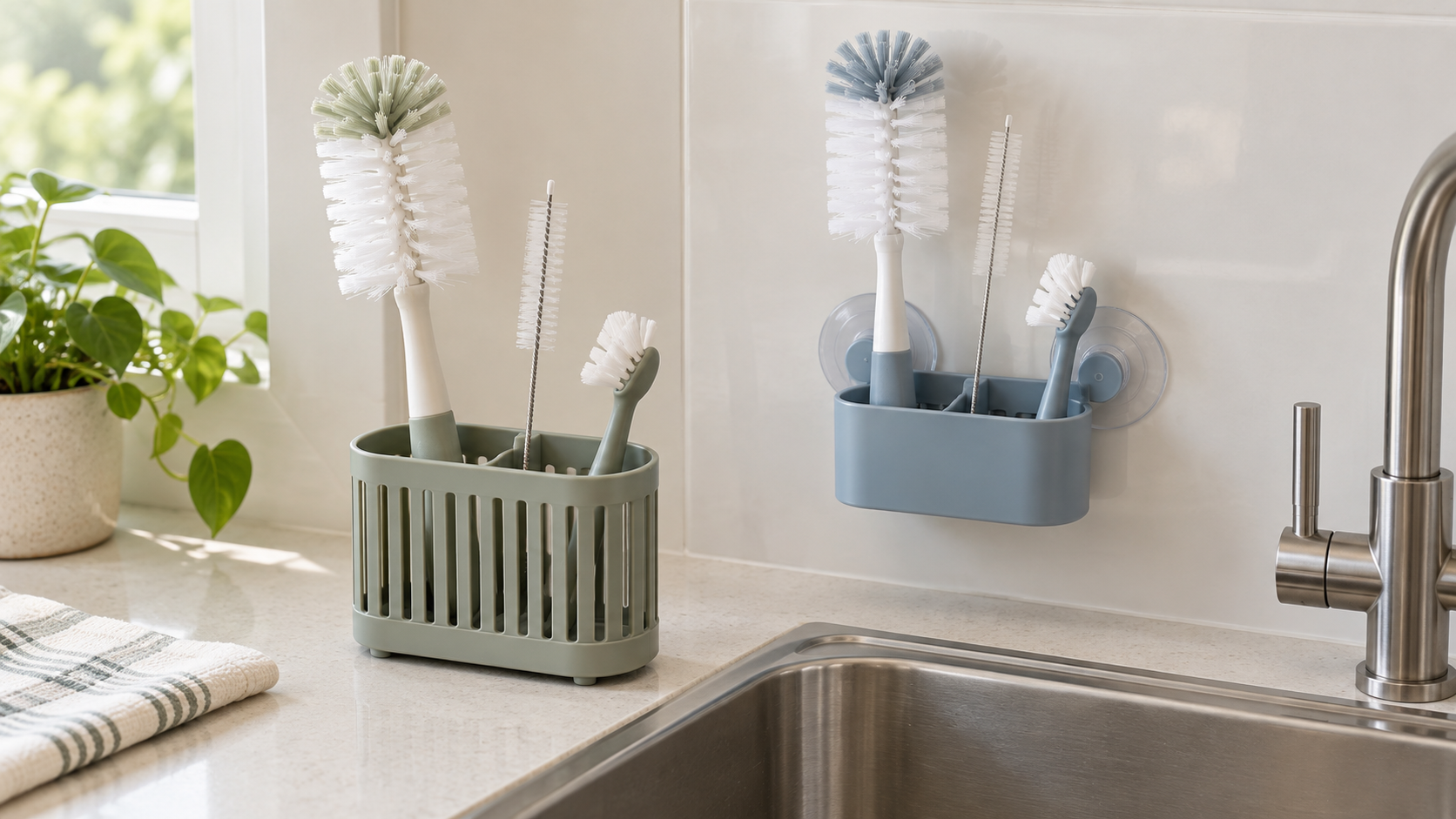
As an Amazon Associate, GoodWeighFinds earns from qualifying purchases.
The quick comparison
| Decision | Countertop sink caddy | Suction-mounted holder |
|---|---|---|
| Best fit | A clear patch of counter or sink ledge and a layout that may need to move | A compatible smooth vertical surface where counter space is tight |
| Setup | Place, load, and check stability | Prepare the supported surface and follow the exact mounting instructions |
| Space used | Uses horizontal footprint plus brush height | Uses wall area, brush height, and removal clearance |
| Drainage | May use slots, an open base, or a removable tray | May drain downward toward the sink or wall; the path must be checked |
| Upkeep | Lift, empty, and clean the base and tray | Remove as directed and inspect the holder, mounts, and covered surface |
| Skip when | It crowds sink work or tips with the loaded brush set | The surface is unsupported, uneven, porous, jointed, or frequently wet and soapy |
Choose a countertop caddy for simple repositioning
A freestanding caddy fits readers who can spare a measured patch beside the sink and want to move the holder for cleaning or faucet access. It avoids the surface-compatibility question, but its footprint is only part of the fit. Mark the listed width and depth, then include the tallest loaded brush and the room needed to lift it out.
- Load the real tool set: tall bottle brushes can shift the balance, especially as one tool is removed.
- Trace the drainage: check whether water reaches the sink, a removable tray, or a hidden base that needs manual emptying.
- Inspect the compartments: handles should fit without forcing damp brush heads together.
- Check access: the holder should not block faucet controls, soap, a window, or normal sink work.
Choose a suction holder only for a documented surface fit
A suction-mounted holder is the stronger candidate when the counter footprint is the repeated problem and a suitable vertical surface sits within easy reach. “Suction” does not establish universal compatibility or lasting hold. Use the exact maker instructions for supported surfaces, preparation, load, installation, repositioning, and removal.
- Inspect the whole mounting patch: grout lines, texture, curves, seams, porous finishes, and uneven tile can conflict with the stated setup.
- Measure the loaded envelope: include the holder, projecting brush handles, faucet movement, cabinet clearance, and space to remove each tool.
- Follow the stated load: count the holder and wet tools; do not infer capacity from a styled listing photo.
- Plan removal: confirm how the mount releases and whether the covered surface can be inspected and cleaned without damage.
Setup and maintenance tradeoffs
The caddy usually has the simpler first setup, but it adds a base or tray to the cleaning routine. The suction holder clears a horizontal patch, but adds mounting discs or cups, a covered wall area, and a possible drop zone. Position either format so a falling tool or holder cannot damage fragile items, contaminate ready-to-eat food, or interfere with the faucet.
Vent slots and open construction do not prove sanitation or faster drying. Clean the brushes and holder according to their separate care instructions, expose reachable surfaces, and let components dry as directed. Material labels alone do not prove dishwasher compatibility, rust resistance, or long-term durability.
Run a no-buy fit test
For the caddy, group the normal brushes in a washable cup or divided holder you already own and mark the candidate footprint with paper. For the wall-mounted layout, tape a paper rectangle matching the holder's outside dimensions to the proposed surface—without treating tape as an adhesion test—and check handle height, faucet movement, reach, drips, and removal clearance.
If the current cup remains stable, empties easily, and fits the cleaning routine, skip both. A hook or rail may suit loop-handled tools when its installation is allowed and the drip path works. A drawer can clear the sink entirely after brushes have dried.
Skip criteria
- Skip both when one or two tools already have a stable, washable home.
- Skip the caddy when its loaded footprint blocks prep, faucet access, or routine sink cleaning.
- Skip the suction holder when the exact surface is not listed as supported or the mounting and removal directions are unclear.
- Skip any design whose seams, tray, mounting parts, or covered surfaces are difficult to inspect and maintain.
- Skip listings that require you to trust unsupported adhesion, sanitation, mold-prevention, rust-resistance, or drying claims.
Bottom line
Choose a countertop caddy when you have a measured horizontal space and value easy repositioning. Choose a suction holder when counter space is the actual bottleneck and the documented mounting surface, loaded dimensions, and upkeep all work. If you have not yet established that a dedicated holder is necessary, start with the sink-caddy buy-or-skip test. For the broader screen of ordinary routine helpers, use the routine-support tools guide.