Buying guide
Best Boot Trays for Wet Walking Shoes in Small Entryways
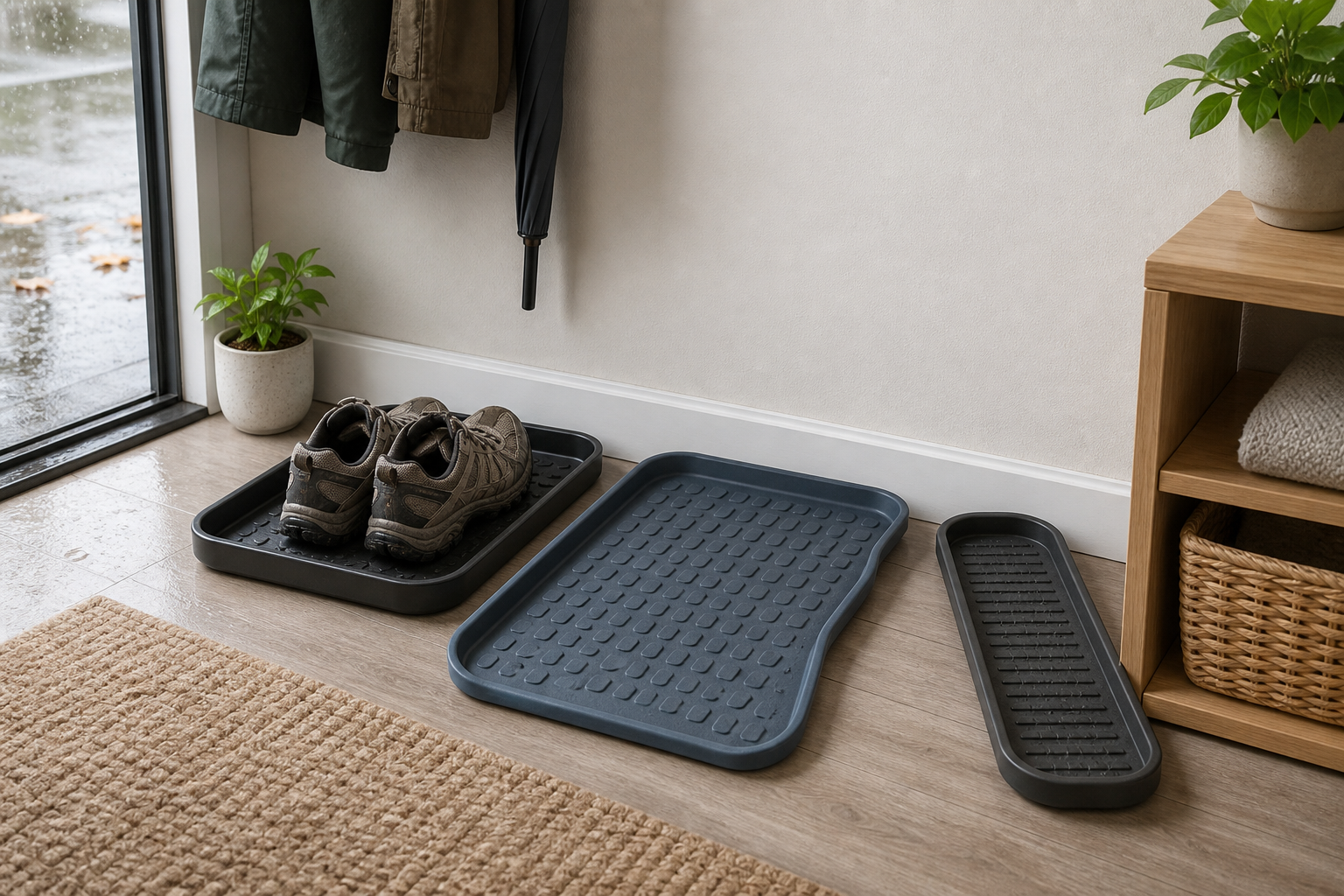
A compact boot tray can give damp or muddy walking shoes one defined landing place without taking over a narrow doorway. The useful comparison is about measured fit, raised edges, texture, cleaning, and floor compatibility—not claims that a tray dries shoes or guarantees floor protection.
Who this guide is for
This guide is for adults who return from ordinary walks with wet, muddy, or gritty shoes and need a contained place near a small entrance. It compares organizers, not footwear or shoe-care treatments. For the broader decision about practical gear, start with the routine-support tools pillar.
If you have not chosen a format yet, compare a shoe drying rack with a boot tray by separation, drip control, footprint, and cleanup. If the main problem is airflow around shoes after a wet walk, a shoe-drying rack guide addresses that separate job. A tray catches loose water and debris within its edges; it does not actively dry shoes.
Best-fit tray formats, not unsupported winners
No trays were purchased, leak-tested, or ranked for this guide. These formats are practical starting points for comparing current listings.
- Best format for one pair: A compact rectangular tray whose usable interior fits the shoes side by side without placing heels on the raised edge.
- Best format for a narrow wall: A long, slim tray that keeps shoe toes pointed toward the wall while preserving the walking path.
- Best format for flexible storage: A lightweight flexible tray that can be cleaned and stored according to its instructions without warping.
- Best format for several household pairs: A wider tray only when the measured doorway and door swing leave safe clearance.
- Best format for gritty shoes: A tray with visible raised texture that keeps soles above some loose debris while remaining easy to scrub.
Selection criteria that matter
- Measure the whole footprint: Record the maximum exterior width and depth available, including baseboards, door swing, vents, and the route people use through the entry.
- Check usable interior dimensions: Raised walls reduce the space available for shoes. Compare the interior length and width with the longest and widest pair you plan to place there.
- Compare lip height: A taller edge may contain more drips and grit but can be easier to catch with a toe. Avoid treating “spillproof” or “leakproof” as proven without a clear test method.
- Inspect surface texture: Ridges can separate soles from some collected water, while deep patterns may take more work to clean.
- Read the material description: Rigid plastic, flexible polymer, and rubber-like materials differ in weight, flexibility, odor, and care. Check the maker's exact labeling rather than assuming performance from appearance.
- Confirm floor compatibility: Water can still escape during handling or collect beneath a tray. Follow the flooring maker's care guidance and lift the tray to inspect and dry the area.
- Plan cleaning and drying: Make sure the tray fits the sink, tub, or outdoor cleaning space you would actually use and has a practical place to dry.
- Check current return terms: Flex, odor, dimensions, and stability can be difficult to judge from photos, so verify the seller and return path before ordering.
A simple comparison framework
Mark each listing yes, no, or unclear against the same short checklist:
- Do the exterior dimensions fit the measured entryway with the door fully open?
- Do the interior dimensions fit the intended shoes without resting them on the lip?
- Are lip height, material, and cleaning instructions stated?
- Can people pass without stepping over or catching the tray?
- Can you lift and empty it without spilling collected water back onto the floor?
- Is there a realistic place to wash, dry, and store it?
- Would it still be useful if it made no difference to walking frequency or body weight?
What a boot tray can and cannot do
A tray can define a shoe-storage zone and contain some loose water, mud, salt, or grit when the tray is intact and used within its capacity. It cannot guarantee that every floor stays dry or undamaged, prevent slips, sanitize shoes, remove odor, or speed drying by itself. Wipe up escaped water promptly and keep the entry route clear.
Be cautious with listings that imply a tray is universally safe for every flooring type or can hold a precise volume without explaining how that was measured. Product photos also may not show whether an adult shoe fits inside the usable area.
Who should skip this purchase
Skip a tray if the entry is so narrow that any raised edge creates a trip or accessibility problem, if the door cannot open fully, or if a washable mat or an existing shallow utility tray already solves the job. Skip flexible trays that cannot sit flat and oversized trays that block a shared route.
A tray is also the wrong tool when the actual need is drying soaked shoes, managing a plumbing leak, or protecting a floor from standing water. Solve that source problem directly rather than expecting an entryway organizer to contain it.
Bottom line
The best boot tray for a small entryway fits a measured space, holds the intended shoes inside its lip, stays out of the walking path, and is easy to lift and clean. Start with the doorway and shoe dimensions, then choose the smallest format that handles the real mess without creating a new obstacle.