Routine-support buying guide
Best Clip-On Lights for Early-Morning Walking
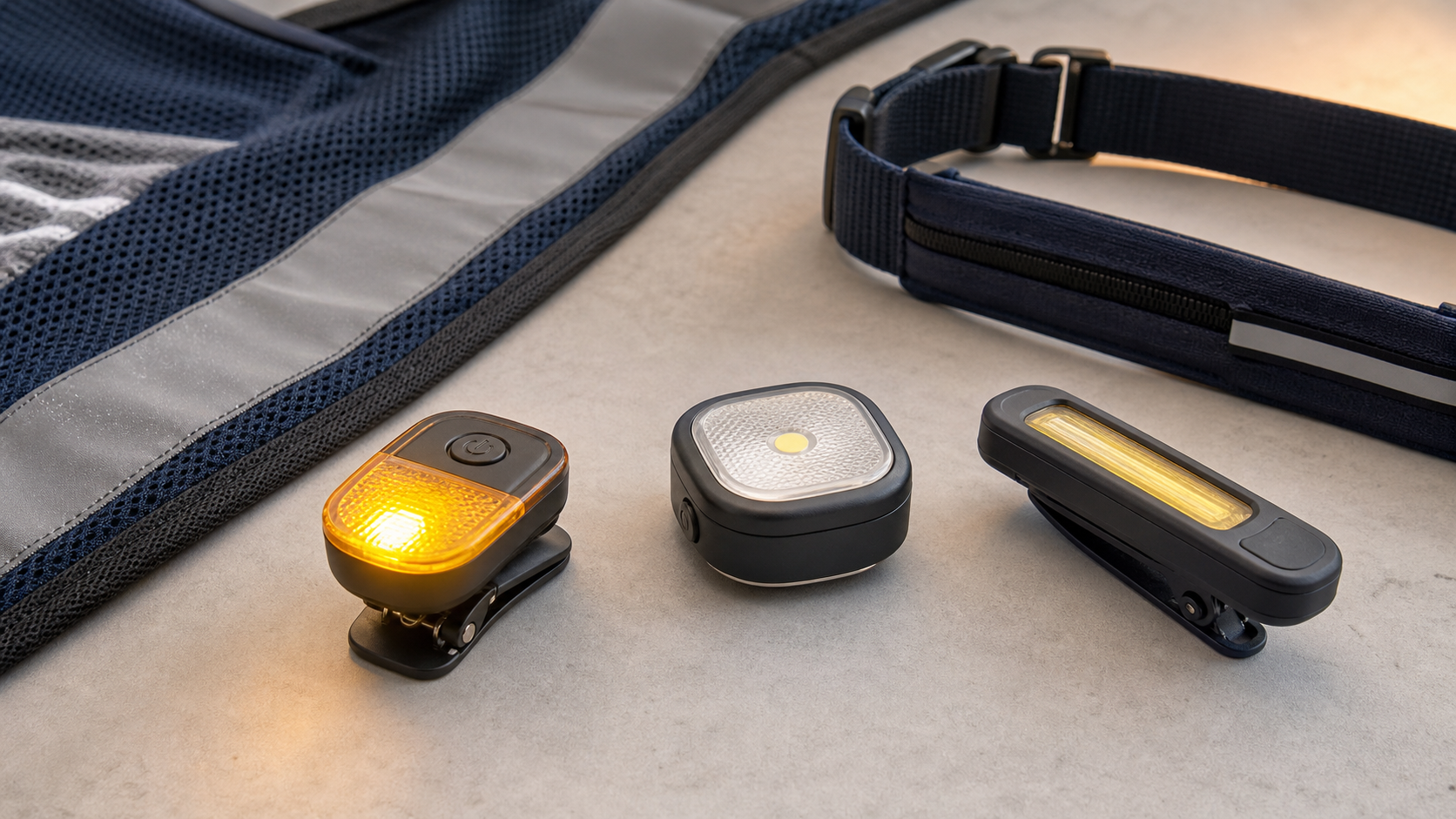
A small clip light can add active visibility when an early walk starts before daylight, but attachment, direction, power, and weather limits matter more than an impressive-looking beam photo. This guide compares useful formats without claiming that a light prevents collisions or makes every route safe.
As an Amazon Associate, GoodWeighFinds earns from qualifying purchases.
Who this guide is for
This guide is for adults who already walk in dim early-morning conditions and want a compact active light that can move between clothing, a belt, or a bag. It maps to the broader routine-support tools guide. A light may support the logistics of a walking routine; it does not cause weight loss or prove a route is safe.
Best-fit types, not unsupported rankings
- Best fit for a jacket or vest edge: A spring clip with enough jaw depth for the fabric and a body that can point forward or backward without twisting.
- Best fit for frequent use: A rechargeable light with a protected charge port, clear battery indicator, and a cable or connector you already keep available.
- Best fit for infrequent backup use: A replaceable-battery model if the battery type is common, the compartment is secure, and spare cells can be stored correctly.
- Best fit for low-profile attachment: A shoe or belt clip that stays visible through a normal stride and is not covered by a coat, shirt, or bag.
- Best fit for more than one direction: Two modest lights placed front and rear may be more useful than one brighter light facing only one way.
Selection criteria that matter
- Attachment: Check clip opening, jaw depth, spring tension, grip surface, magnet backing, and whether the maker shows the light on material similar to yours. A strong clip can still slide on thin or wet fabric.
- Orientation: Decide whether the light is meant to face approaching traffic, traffic from behind, or the ground. A small clip that rotates in use may not stay aimed.
- Light purpose: A marker light helps a person stand out; a path light needs a usable beam aimed at the surface. Do not assume one tiny light does both jobs well.
- Modes and controls: Compare steady and flashing modes, button size, accidental activation, mode memory, and whether the control can be used with gloves.
- Runtime: Match the stated runtime to the intended mode, not the longest number on the listing. Treat all runtime figures as claims until independently verified.
- Charging or batteries: Check port type, port cover, charging indicator, charge time, battery type, and replacement access. Built-in batteries eventually lose capacity.
- Weather rating: Prefer a defined IP rating with an explained limit. “Weatherproof” and “water-resistant” are not interchangeable with submersion protection.
- Weight and bounce: Look for a stated product weight. A heavy light on a soft pocket edge may swing, point down, or pull loose.
- Visibility claims: Treat lumen, distance, and “visible for miles” language cautiously. Angle, obstructions, ambient light, weather, and another road user’s attention all change real-world visibility.
- Return and warranty terms: Confirm the seller, return window, and coverage for charging, switch, and clip failures.
A practical comparison framework
Compare each candidate against the clothing and route conditions you actually use. Mark each item yes, no, or unclear:
- Does the clip fit the intended jacket edge, pocket, belt, bag strap, or shoe without damaging it?
- Does the light remain aimed and unobstructed while walking normally?
- Is it a marker light, a path light, or clearly designed to do both?
- Is the stated runtime given for the mode you would use?
- Can you check remaining power before leaving?
- Are charging, battery replacement, and storage straightforward?
- Is the weather limit specific enough for likely conditions?
- Would front and rear placement require a second light?
- Are dimensions, weight, seller details, warranty, and returns clear?
Clip lights and reflective gear do different jobs
A clip light emits its own light; reflective material returns light from another source. Either can be blocked by clothing or bags, and each works differently depending on angle and surroundings. For broader passive coverage and a combined approach, use the reflective walking gear guide. Do not interpret either category as a collision-prevention guarantee.
Who should skip this purchase
Not sure the category solves the problem at all? Start with the route-first clip-on-light ownership test. Skip a new clip light if a charged light you already own attaches securely and covers the needed direction. Skip models with no stated weight, battery details, usable attachment photos, weather limit, or return policy. Also skip a tiny clip light when the actual problem is an unlit or uncomfortable route that would be better addressed by changing the time, location, or indoor plan.
A clip light is not a substitute for a flashlight or headlamp when you need to inspect uneven ground, and it is not a substitute for legally required bicycle or road lighting. Follow local rules and use route judgment.
Claims and limits to keep straight
Brightness and runtime measurements can help compare products only when the test conditions and mode are clear. Phrases such as “keeps you safe,” “360-degree protection,” and extreme visibility-distance promises should not decide the purchase. A clip light supports visibility logistics; it does not burn fat, increase calorie burn, or guarantee that a walking routine changes body weight.
Bottom line
The best clip-on light for an early-morning walk is the one that grips the clothing or gear you actually use, stays aimed in a useful direction, has a realistic power routine, and states its weather limits plainly. Compare attachment before brightness claims, then decide whether you need a marker light, path illumination, or separate front and rear coverage.