Routine-support buying guide
Best Compact Umbrellas for Walking Commutes
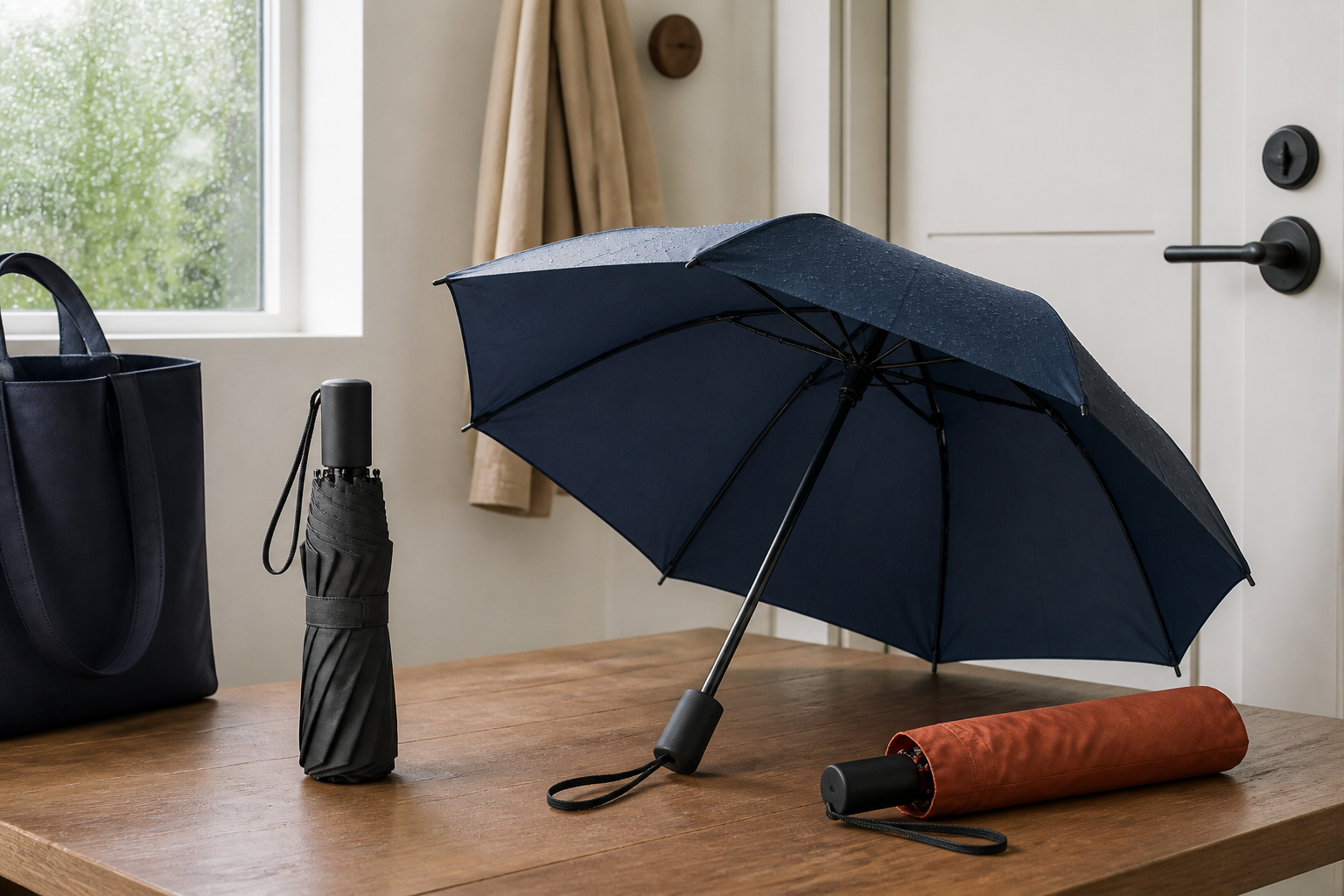
A compact umbrella can be useful when a walking commute includes exposed sidewalks and unpredictable rain. The right format depends less on marketing labels and more on packed size, usable coverage, grip, the route, and where a wet umbrella can dry at the other end.
As an Amazon Associate, GoodWeighFinds earns from qualifying purchases.
Who this guide is for
This guide is for adults who want portable overhead rain coverage during an ordinary walking commute. It covers product fit and practical tradeoffs—not a promise that an umbrella makes every storm, route, or mobility situation safe.
For the broader framework, start with the routine-support tools guide. A packable rain jacket leaves both hands free and may suit wind or crowded sidewalks better; a walking hat offers lighter coverage for brief drizzle.
Useful umbrella formats—not ranked winners
GoodWeighFinds did not wind-test current umbrellas or verify named-product inventory. These formats organize the decision without inventing a universal best model:
- Mini telescoping umbrella: Takes the least bag space, but a shorter handle and smaller canopy can reduce comfort and coverage.
- Standard compact umbrella: Balances packed size and usable canopy for many commutes, although weights and closed lengths vary.
- Automatic open-and-close umbrella: Can simplify door and transit transitions, but adds mechanical parts, may need more closing force, and is not automatically more durable.
- Vented compact canopy: Is designed to let some air pass through overlapping panels, but a vent is not proof that the umbrella can withstand strong gusts.
- Reverse-folding compact umbrella: Traps more of the wet canopy inward when closed, often with extra bulk and a different closing motion.
Selection criteria that matter
- Closed size and weight: Measure the intended bag or pocket and include the sleeve. A tiny packed length is less useful if the umbrella is too heavy to carry routinely.
- Usable coverage: Treat stated canopy diameter as one clue. Dome depth, shaft length, body position, and wind direction also affect how much rain reaches clothing or a bag.
- Handle fit: Look at grip length, shape, texture, wrist strap, and whether controls sit where they can be pressed accidentally.
- Opening method: Check clearance and force for manual or automatic operation. Never open an umbrella toward another person or in a confined space.
- Frame and wind language: Compare rib count, materials, venting, and maker instructions, but treat “windproof” as a marketing claim unless a clear test method and limit are provided.
- Visibility: A dark canopy can obstruct both the user’s view and other people’s view of the user. Check sight lines, edge visibility, and reflective claims cautiously.
- Drying and care: Confirm how the canopy should be opened or hung to dry, whether the sleeve can dry separately, and how dirt or salt should be cleaned.
- Returns and warranty: Mechanisms and frame joints can fail. Read exclusions, return windows, and whether a warranty requires shipping or registration.
A practical comparison framework
Write down the longest packed size the usual bag can hold, then compare each candidate with the same questions:
- Does the closed umbrella fit the bag without protruding or pressing against other items?
- Is its weight reasonable to carry even on dry days?
- Can the handle be held securely with the usual gloves, bags, or hand position?
- Can it open without creating a hazard at doorways, stops, or crowded sidewalks?
- Is the canopy large enough for the commuter and carried bag without blocking essential sight lines?
- Are wind claims backed by a specific test description, and are the limits believable for the route?
- Is there a realistic place to drain and dry it at work, school, or home?
- Are care, warranty, and return instructions clear?
Route and weather limits
An umbrella can become awkward in gusty wind, near traffic, on narrow or crowded sidewalks, under low branches, or when a hand is needed for a rail, mobility aid, bicycle, or carried item. Thunderstorms and severe weather require attention to current local guidance; an ordinary umbrella is not protective equipment.
Do not rely on “stormproof” or “windproof” language alone. If the route routinely has strong gusts or requires both hands, a properly fitted rain layer may be the more practical category, or the trip may need to be delayed.
Who should skip this purchase
Skip a compact umbrella if an existing one already fits the route, there is nowhere appropriate to dry it, the commute is routinely crowded or windy, or holding it conflicts with balance, grip, visibility, or another necessary task. Also skip listings that omit open and closed measurements, product weight, basic care, or meaningful return terms.
A compact umbrella is a rain-management tool. It does not increase calorie burn, cause weight loss, make a hazardous route safe, or replace checking the weather.
Bottom line
The most useful compact umbrella is the one that fits the everyday bag, offers enough coverage without blocking visibility, feels controllable on the actual route, and has a workable drying routine. Compare measurements and instructions before automatic mechanisms or broad durability claims.