Small-kitchen buying guide
Best Countertop Produce Baskets for Small Kitchens
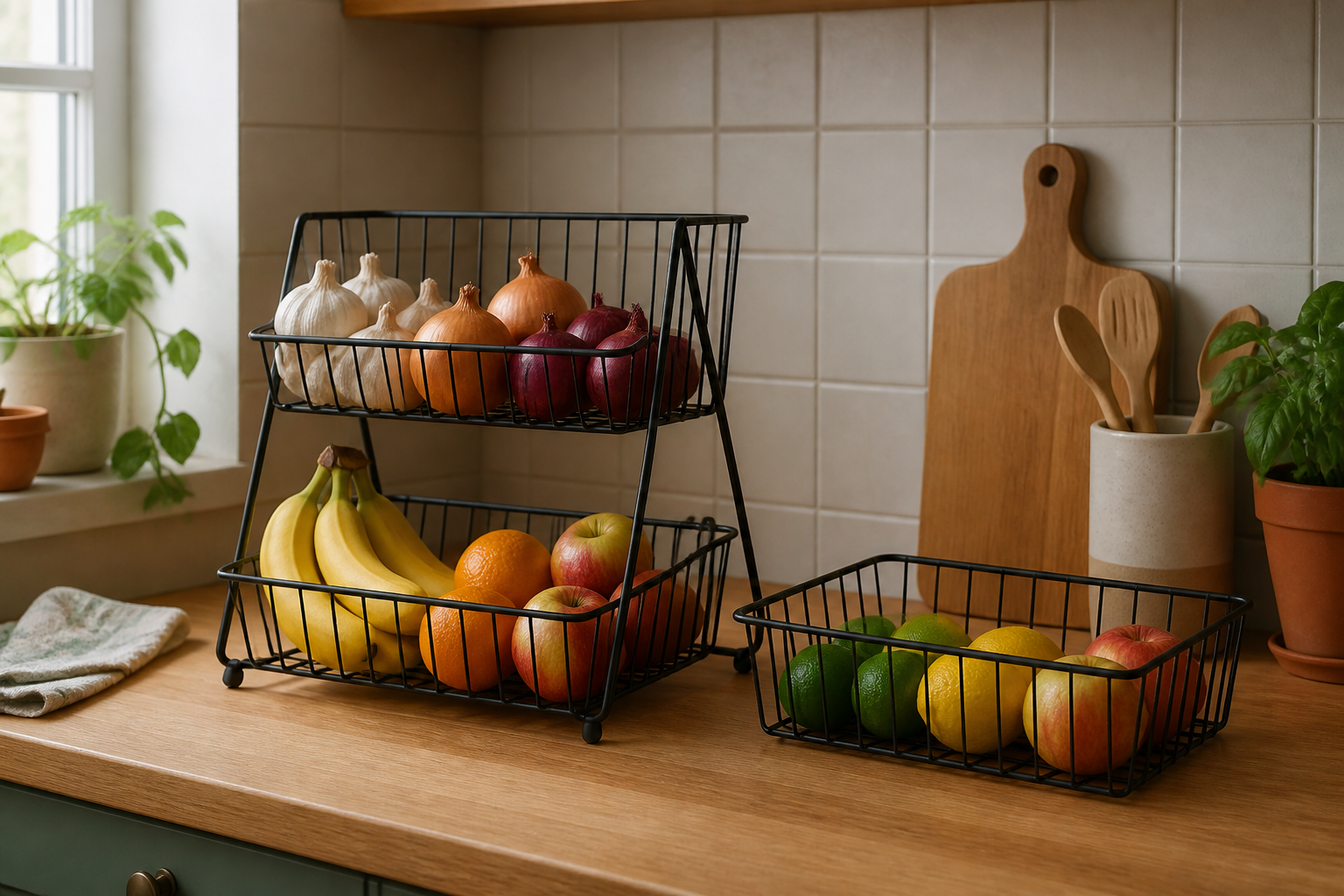
A countertop basket can keep suitable room-temperature produce visible without consuming an entire work surface. The useful choice is not the tallest or fullest basket—it is the one that fits a measured spot, stays stable, and lets you reach and clean around the food you actually store.
As an Amazon Associate, GoodWeighFinds earns from qualifying purchases.
Who this guide is for
This guide is for adults with limited counter, pantry, or cabinet space who regularly keep some produce at room temperature and want it visible and easier to reach. A basket is an organization tool. It does not make food last indefinitely, determine what is appropriate for your household to store at room temperature, or cause weight loss.
For the broader decision path, see the routine-support tools guide. If the real problem is refrigerated produce, use the separate produce-container guide instead.
Best-fit types, not unsupported rankings
- Best fit for one shallow counter zone: A low single basket that preserves overhead and visual clearance.
- Best fit for limited width: A stable two-tier basket when the upper tier remains reachable and the complete unit fits beneath cabinets.
- Best fit for mixed produce sizes: Open baskets with enough spacing and usable depth for the items you routinely buy.
- Best fit for frequent cleaning: Removable baskets or a simple frame with accessible corners and clearly stated care instructions.
- Best fit for a changing routine: Separate stackable baskets only when their stacked and unstacked dimensions are both verified.
Selection criteria that matter
- Loaded footprint: Measure width and depth at the basket's widest points, including feet, handles, hinges, and angled frames.
- Total height: Check the frame plus the tallest produce you expect to place on top. Leave enough room to lift items out beneath cabinets.
- Tier access: Confirm that the upper basket does not block your hand or view into the lower one.
- Stability: Look for a broad base, level feet, secure tier connections, and load guidance. Treat stability language as a listing claim until verified.
- Basket spacing: Open wire can support airflow around items, but gaps that are too wide can catch smaller produce or let it fall through.
- Surface protection: Check for non-slip feet or pads that suit the counter material without trapping debris underneath.
- Material and coating: Verify the stated material, finish, food-contact language where relevant, and care directions. Do not assume every decorative coating is equally durable.
- Assembly: Check the required tools, fasteners, and whether the baskets can be removed without weakening the frame.
- Cleaning: Favor shapes you can wipe fully, with no inaccessible seams where debris can collect.
- Return terms: Photos can disguise scale. Confirm the seller and return conditions before buying a large or assembled unit.
A practical comparison framework
Mark each candidate yes, no, or unclear. Verify every “unclear” item before ordering.
- Does the complete footprint fit without stealing needed prep space?
- Is there enough clearance to load and unload both tiers?
- Will the intended produce sit securely without falling through or being crushed?
- Does the unit remain stable when only one basket is loaded?
- Can every basket, corner, and counter area beneath it be cleaned?
- Are dimensions, materials, assembly, load guidance, care, and return terms stated for the exact listing?
- Would a bowl or existing tray solve the same visibility problem?
- Would the basket still be useful if it had no effect on weight?
Countertop basket or refrigerated produce container?
Choose a countertop basket for produce that you have already determined should be stored at room temperature and that benefits from visibility and easy access. Choose a refrigerator container when the food's storage guidance calls for refrigeration or when cold-storage organization is the actual problem. Follow the storage instructions that came with the produce and current food-safety guidance rather than treating a basket as preservation equipment.
Some produce should also be separated because one item can affect how quickly another ripens. A basket's open design does not automatically make every mixture appropriate. Plan the contents first; then choose the organizer.
Who should skip a countertop produce basket
Skip it if counter space is already the kitchen's main bottleneck, the planned location receives excessive heat or direct sun, the unit would interfere with an appliance or cabinet door, or the household rarely stores produce at room temperature. Also skip tall tiers when reaching the lower basket is awkward or when children or pets can easily pull the frame over.
A bowl, washable tray, pantry shelf, or simply buying smaller amounts more often may fit better. If overhead space appears usable, apply the produce-hammock worth-it test before choosing suspended storage: mounting permission, loaded clearance, access, cleaning, and failure path matter. Do not buy an organizer merely to fill it.
What a produce basket cannot do
A basket can improve visibility and use vertical space. It cannot make unsuitable storage safe, guarantee freshness, prevent spoilage, improve the nutritional value of food, or produce weight loss. Treat “healthy eating organizer,” “portion control,” and similar outcome language as marketing rather than a demonstrated basket capability.
Bottom line
The best countertop produce basket for a small kitchen fits a measured counter zone, keeps both tiers accessible, remains stable under an uneven everyday load, and is easy to clean. Start with the produce and available space; buy the organizer only if it solves that specific visibility problem better than a bowl or tray you already own.