Small-kitchen storage decision
Is a Produce Hammock Worth It in a Small Kitchen?
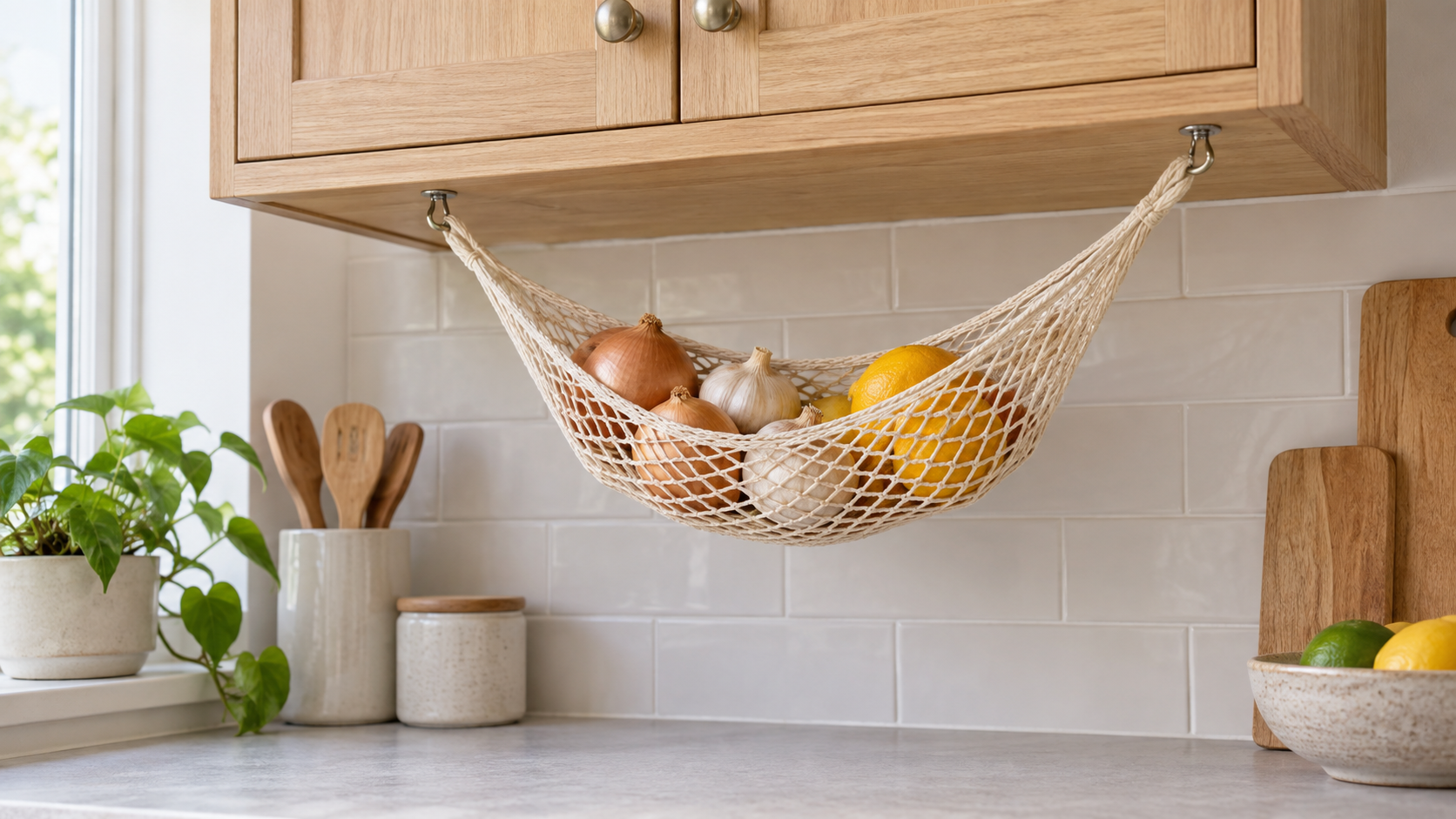
A produce hammock can recover a patch of counter space, but only when the kitchen has a suitable mounting location, enough loaded clearance, and produce that belongs at room temperature. It is worth considering for a repeated storage problem—not as a freshness tool or a reason to buy more produce than the household uses.
As an Amazon Associate, GoodWeighFinds earns from qualifying purchases.
Quick answer
A produce hammock may be worth it when an otherwise unused underside of a cabinet or shelf sits above a low-traffic counter zone, the mounting method is allowed, and a measured everyday load remains easy to reach without blocking work. Skip it when you rent without installation permission, the only location is above heat, water, food preparation, or an appliance, or a bowl or basket you already own works just as well.
Start with the space, not the hammock
Measure the clear width and depth beneath the intended cabinet or shelf. Then measure vertically from the mounting surface to the counter and subtract the hammock's stated hanging depth plus the height and weight of the produce you normally keep there. Flexible mesh changes shape under load, so an empty product photo does not establish the lowest loaded point.
Open every nearby cabinet, drawer, and appliance door. Reach across the counter as you would while cooking. A hammock that technically fits can still interrupt a prep zone, hide an outlet, block task lighting, brush against a faucet, or make a frequently used cabinet awkward to open.
Use a no-cost mock-up
- Mark the proposed mounting points with removable tape; do not drill or attach hardware during the test.
- Tie or hold an empty reusable bag at the approximate stated depth, away from heat, water, and active food preparation.
- Place the amount of produce normally stored at room temperature in a bowl on the counter beneath the mock-up so you can judge its real volume.
- Test cabinet access, counter work, visibility, head and hand clearance, and the path used to load and unload items.
- Keep the existing bowl or basket for a week and note whether its footprint repeatedly prevents a task. If it does not, the hammock may not solve a meaningful problem.
Check the mounting decision
- Permission: Confirm lease, household, cabinet-warranty, or workplace rules before drilling, screwing, clamping, or applying adhesive.
- Surface and hardware: Use only the installation method and compatible surface stated for the exact product. A generic hook, adhesive strip, or improvised fastener does not inherit the hammock maker's load claim.
- Stated load: Treat capacity as a manufacturer claim tied to the complete installed system. Include the hammock itself and do not use produce count as a substitute for measured weight.
- Location: Keep it away from a stove, toaster, kettle, sink splash, direct sun, and any place where it could contaminate or obstruct food preparation.
- Failure path: Consider what the hammock and contents would hit if a fastener, knot, seam, or mounting surface failed.
Fit the produce you actually store
A suspended organizer does not decide which foods belong at room temperature. Follow current storage guidance for each item rather than assuming open mesh makes every fruit or vegetable suitable for the counter. Do not interpret “breathable,” “airflow,” or “keeps fresh” wording as a guarantee of freshness, shelf life, or food safety.
Mesh openings and hammock depth also affect practical fit. Small items may press through wide openings; heavy items can settle onto softer ones; and an overfilled hammock can make the bottom layer hard to see or retrieve. Plan modest loading and check the contents regularly rather than treating the hammock as long-term overflow storage.
Cleaning and upkeep
Check whether the hammock detaches without removing its mounting hardware and how the maker says to wash and dry it. Knots, seams, hooks, cords, and wall contact points all need to remain inspectable. A washable textile still needs time and space to dry fully before it is reloaded.
Stop using the setup if the fabric tears, cords stretch unevenly, knots loosen, hardware bends, adhesive shifts, or the mounting surface shows damage. Those observations signal a compromised setup; they do not establish why it failed or what repair is appropriate.
Hammock, countertop basket, or existing bowl?
| Option | Useful when | Main tradeoff to check |
|---|---|---|
| Produce hammock | A suitable overhead zone is truly unused and counter footprint is the repeated problem. | Installation, changing loaded depth, access, and cleaning. |
| Countertop basket | Visibility and movable storage matter, and a measured counter zone is available. | Footprint, stability, tier clearance, and cleaning beneath it. |
| Existing bowl or tray | The household stores a modest amount and the container already fits the routine. | It uses counter space but avoids a new installation and purchase. |
| Fridge or pantry zone | That location matches the food's storage guidance and visibility is the main issue. | Shelf fit, labels, rotation, and remembering the contents. |
If a movable organizer is the better format, use the countertop produce basket guide to compare footprint, access, stability, and cleaning. For a broader check on whether an organizer removes enough routine friction to justify buying, see the routine-support tools guide.
Claims and evidence boundaries
Dimensions, component materials, included hardware, load limits, mounting directions, and care instructions should come from the current documentation for the exact item. Seller photos can help identify questions but may not show scale or normal loaded sag accurately. Customer comments are anecdotes, not proof that the same hardware, surface, load, or kitchen layout will work for you.
A produce hammock can relocate items. It cannot cause weight loss, improve the nutritional value of food, guarantee that produce gets eaten, prevent spoilage, or make unsuitable storage safe. Treat “healthy eating,” “portion control,” waste-reduction, and body-result language as marketing unless the specific claim is supported by appropriate evidence—and none of those claims is needed to judge the organizer's basic fit.
When to skip it
- The existing bowl or basket does not actually interfere with kitchen tasks.
- No allowed mounting location provides safe, usable loaded clearance.
- The planned position is above heat, water, an appliance, or active preparation space.
- The listing omits complete dimensions, compatible mounting surfaces, installation directions, stated load, or care information.
- The usual produce is too small, heavy, delicate, or difficult to see and retrieve in the chosen mesh.
- Cleaning or inspecting the hammock and hardware would be harder than wiping an existing container.
Bottom line
A produce hammock is worth considering only when a measured, permitted overhead location solves a repeated counter-space problem and remains accessible under a realistic load. Mock up the loaded depth, protect active kitchen zones, verify every installation and care detail, and keep the container you already own when it performs the same job with less upkeep.