Commuter bottle buying guide
Best Cup-Holder-Friendly Water Bottles for Commuters
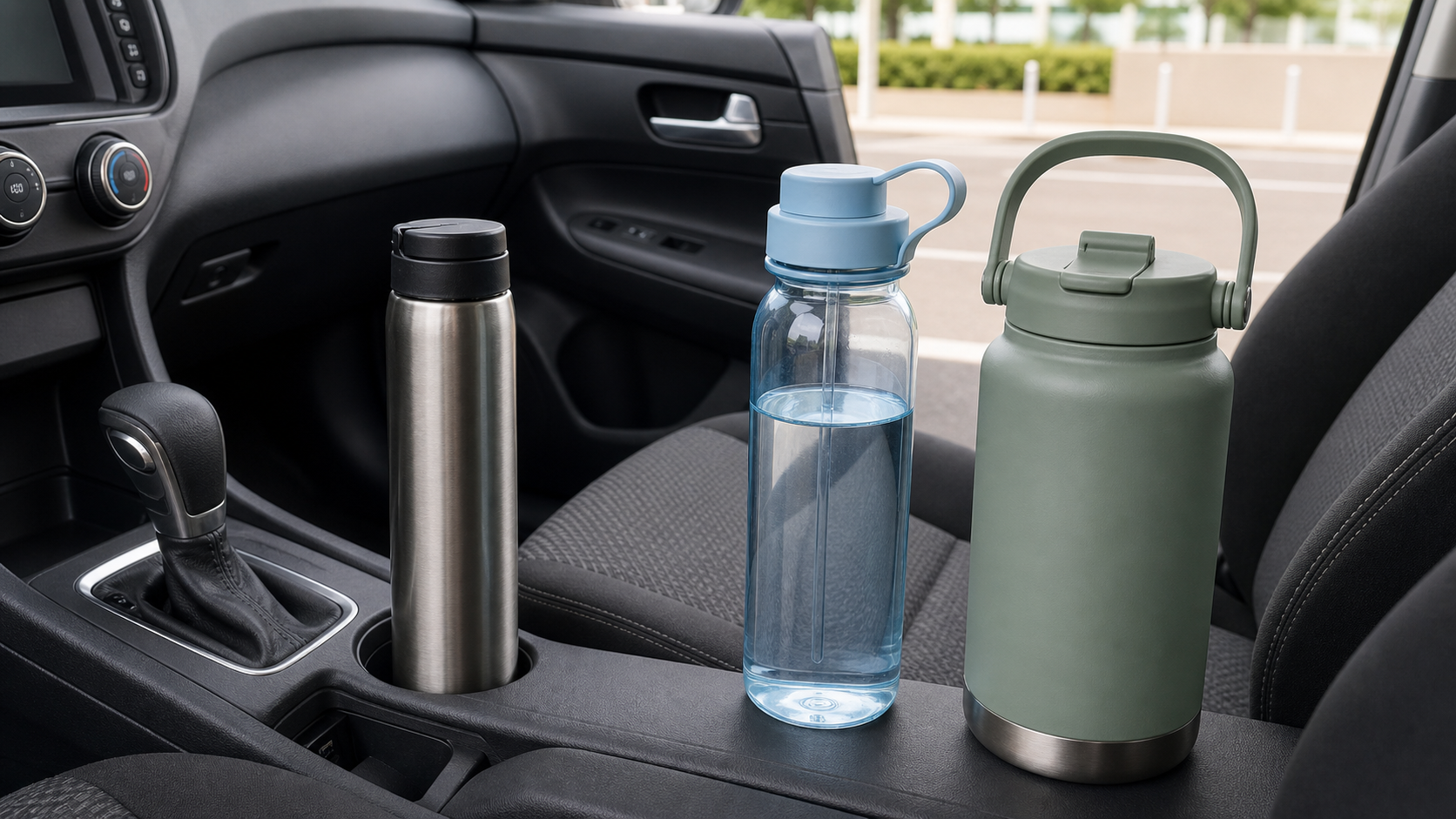
A bottle labeled “car friendly” can still wobble, block a control, or fail to fit your particular console. The best commuter fit starts with measurements of the bottle and the holder, then accounts for height, handles, lids, full weight, and how you will use it while parked.
As an Amazon Associate, GoodWeighFinds earns from qualifying purchases.
Who this guide is for
This guide is for adults replacing a bottle that is too wide, too tall, unstable, or awkward to move between a vehicle, transit bag, and desk. A well-fitting bottle can make a routine easier; it does not cause weight loss or change health outcomes.
For broader low-pressure tools, use the routine-support tools guide. If cleaning is the bigger obstacle, compare the lid and opening in our easy-clean bottle guide.
Best-fit types, not unsupported rankings
- Best fit for a narrow fixed holder: A straight bottle whose published base and widest diameters leave a little clearance.
- Best fit for carrying between stops: A lightweight bottle with a compact loop or handle that does not catch on adjacent controls.
- Best fit when capacity matters: A tapered bottle only after checking that the heavier upper body remains stable.
- Best fit for short vertical clearance: A low-profile lid that can be opened and removed without hitting the dashboard or armrest.
- Best fit for uncertain compatibility: A clearly measured, returnable model rather than a listing that only says “fits most cup holders.”
Selection criteria that matter
- Holder measurement: Measure the narrowest inside diameter and usable depth. Flexible tabs, liners, adapters, and tapered walls can reduce the real opening.
- Base and widest diameter: Record both. A narrow base does not help if the bottle shoulder, boot, handle hinge, or protective sleeve hits the console first.
- Height and clearance: Check the space below dashboards, screens, shifters, armrests, and vents. Include the extra height needed to lift or flip the lid.
- Stability: A tapered base may fit but wobble when the upper body is wide and full. Look for a level base and enough seating depth.
- Full weight: Compare stated empty weight and capacity. A large filled bottle may be inconvenient to lift or may stress shallow holder parts.
- Handle placement: Verify that fixed handles, side grips, and rotating loops clear neighboring holders and controls.
- Lid operation: Prefer a closure that can stay securely shut in transit. Open, close, or drink only when doing so is safe; never let bottle use distract from driving.
- Leak wording: Treat “leakproof” as a manufacturer claim, not a guarantee. Check closure instructions, gasket placement, beverage exclusions, and upright-carry requirements.
- Cleaning: Confirm the directions separately for bottle, lid, straw, and gasket. Complicated commuter lids can create more maintenance than a simple screw cap.
- Replacement parts and returns: Check exact-model lid and gasket availability plus the return window, especially when the listing omits a measurement.
A practical comparison framework
Use the same notes for every candidate instead of relying on “universal fit” language:
- Holder’s narrowest inside diameter and usable depth
- Bottle base diameter, widest diameter, and height with lid
- Clearance needed to remove or operate the lid
- Empty weight, capacity, and estimated carrying burden when full
- Handle position and interference with adjacent controls
- How deeply the bottle sits and whether the upper body is stable
- Closure instructions and limits behind any leak claim
- Care directions for every wet component
- Exact replacement parts, seller, warranty, and return terms
Measurements on listings may describe the package or the widest body rather than the base. Prefer a dimension diagram or manufacturer manual that labels each measurement. When a key dimension is missing, ask the maker or choose a returnable option rather than guessing.
Car commute versus public transit
A car holder rewards a stable, measured base and enough clearance around fixed controls. On a bus or train, the bottle may spend more time in a bag, so closed-lid security, bag-pocket fit, empty weight, and a snag-resistant handle can matter more. A model can suit one commute and fail the other.
If the bottle will also be hand-carried on walks, the walking-bottle guide covers carry weight and outdoor handling. Do not choose capacity from hydration or weight-loss marketing; choose a size you can comfortably transport and maintain.
Who should skip this purchase
Skip a replacement if a stable cup-holder adapter or a different bag pocket solves the problem safely and costs less. Skip oversized tapered bottles when the upper body blocks controls or the holder is too shallow to support them. Skip models with no usable dimensions, unclear care directions, or restrictive returns.
Also skip any setup that encourages reaching, opening a lid, or looking away from the road while driving. Place the bottle before departure and use it only when conditions make that safe.
Bottom line
The strongest commuter choice is not the bottle with the broadest “fits most” claim. It is the model whose base, widest point, height, handle, and lid match your measured space, with manageable full weight, clear care instructions, replaceable parts, and a return policy that protects against an imperfect fit.