Small-cabinet buying guide
Best Cutting-Board Organizers for Small Cabinets
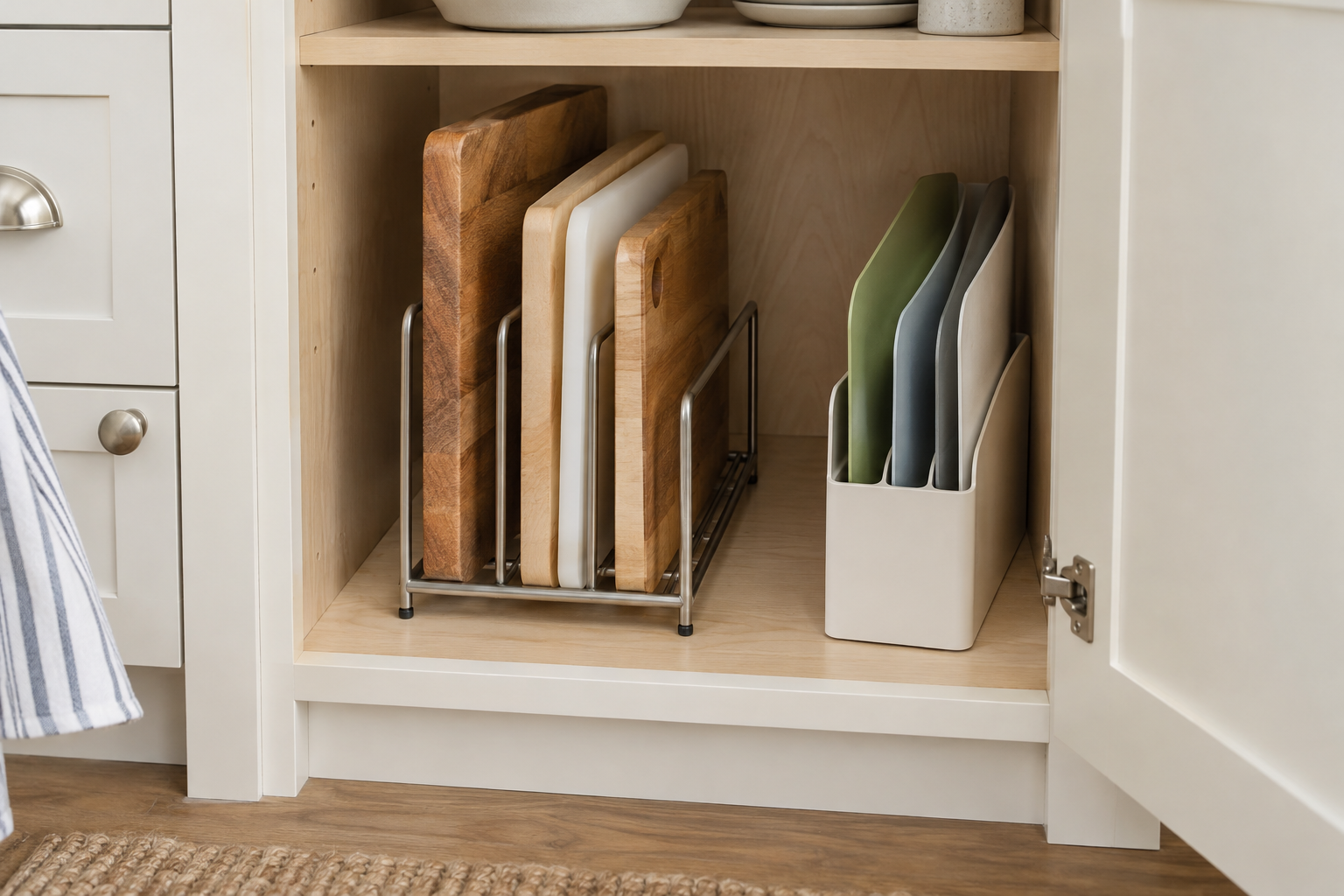
A cutting-board organizer can stop boards and thin prep mats from leaning into a pile, but only when its slots fit the boards and its full loaded shape clears the cabinet opening. This guide compares practical formats and measurements—not named winners or unverified capacity claims.
As an Amazon Associate, GoodWeighFinds earns from qualifying purchases.
Who this guide is for
This guide is for adults who already own several cutting boards or flexible prep mats and repeatedly have trouble storing or retrieving them in a small cabinet. If the purchase is really about choosing a prep surface, start with the cutting-board guide for small-kitchen batch cooking. If a board needs to span the sink during use, compare over-the-sink and standard boards instead.
This page supports the broader routine-support tools guide. A board organizer is cabinet storage hardware; it does not make meal prep healthier or produce weight-loss results.
Best-fit formats, not unsupported rankings
- Open-wire freestanding rack: A practical starting point when boards vary in height and can stand in separate slots. Check base width and whether the feet stay fully supported.
- Solid divided holder: Can corral thin mats or lightweight boards, but the walls may hide debris and reduce usable slot width.
- Adjustable-divider rack: Useful when board thicknesses differ, provided the exact divider positions, locked footprint, and assembly are documented.
- Cabinet-door organizer: Moves storage off the shelf but introduces mounting, hinge, handle, and closing-clearance questions. Do not assume a door can accept the hardware or loaded weight.
- Pull-out or mounted rack: Can improve access in a deep cabinet, but installation, rail clearance, and cleaning make it a larger commitment.
Measure the boards and cabinet first
Record the width, height, and thickness of every board that needs a slot. Include rubber edges, handles, feet, and warped corners in the maximum measurement. Then measure the cabinet opening—not only the interior cavity—and trace the angle needed to insert and remove the tallest board.
For a freestanding organizer, add the rack’s exterior width and depth to the loaded board height and overhang. Check shelves, hinges, pipes, door hardware, and items stored beside or above it. Product photos rarely show the complete loaded envelope.
Selection criteria that matter
- Usable slot width: Compare the narrowest clear dimension with the thickest board. A listed overall gap may not account for curved wires, tapered dividers, or protective feet.
- Slot spacing and count: Count boards only after checking actual thickness. More slots do not guarantee that the current collection fits.
- Loaded cabinet clearance: Confirm that board tops and handles clear the opening, shelf above, hinges, and door through the full removal path.
- Base support: Check the complete footprint on the real shelf. Treat nonslip, stability, and load statements as claims to verify, not guarantees.
- Board contact: Look for dividers without obvious sharp edges or narrow pressure points, then follow each board maker’s storage guidance.
- Mounting requirements: For door or wall formats, verify the permitted surface, fasteners, drilling, stated load, and loaded closing clearance. Avoid “damage-free” assumptions.
- Cleaning access: Prefer a format that can be emptied and wiped without trapping crumbs or moisture around seams, feet, or mounting hardware.
- Seller and returns: Re-check the exact item, included parts, assembly instructions, seller, and return terms before ordering.
Run a no-buy cabinet test
Group the clean, fully dry boards upright in the intended cabinet using a stable empty file holder, dish rack, or sturdy box divider already on hand. This is a geometry and workflow test only; do not use an improvised support that can tip, damage a shelf, or hold boards while damp.
For several prep sessions, note whether the tallest board clears the opening, the thickest board fits without forcing, each board can be removed without unloading the group, and the storage spot remains easy to clean. The test reveals the slot and access problem before another single-purpose tool takes cabinet space.
Who should skip this purchase
Skip a dedicated organizer when the board collection already stands securely in an existing dish rack or file holder, when boards need flat storage under their maker’s instructions, or when the cabinet opening makes upright removal awkward. Also skip door-mounted and pull-out formats when installation is not permitted or the loaded clearance cannot be verified.
Reduce or relocate rarely used boards before buying around them. A wider open bin may suit flexible mats better than narrow rigid slots, while one or two heavy boards may be simpler to store flat in a dry, accessible location.
Bottom line
The best cutting-board organizer is the simplest format whose documented slots fit the boards you own and whose complete loaded shape clears the cabinet. Measure the collection, opening, shelf, and removal path; then compare cleaning, mounting, seller terms, and return options. If an existing stable holder passes the same test, keep it.