Small-kitchen buying guide
Best Drawer Dividers for Meal-Prep Tools in Small Kitchens
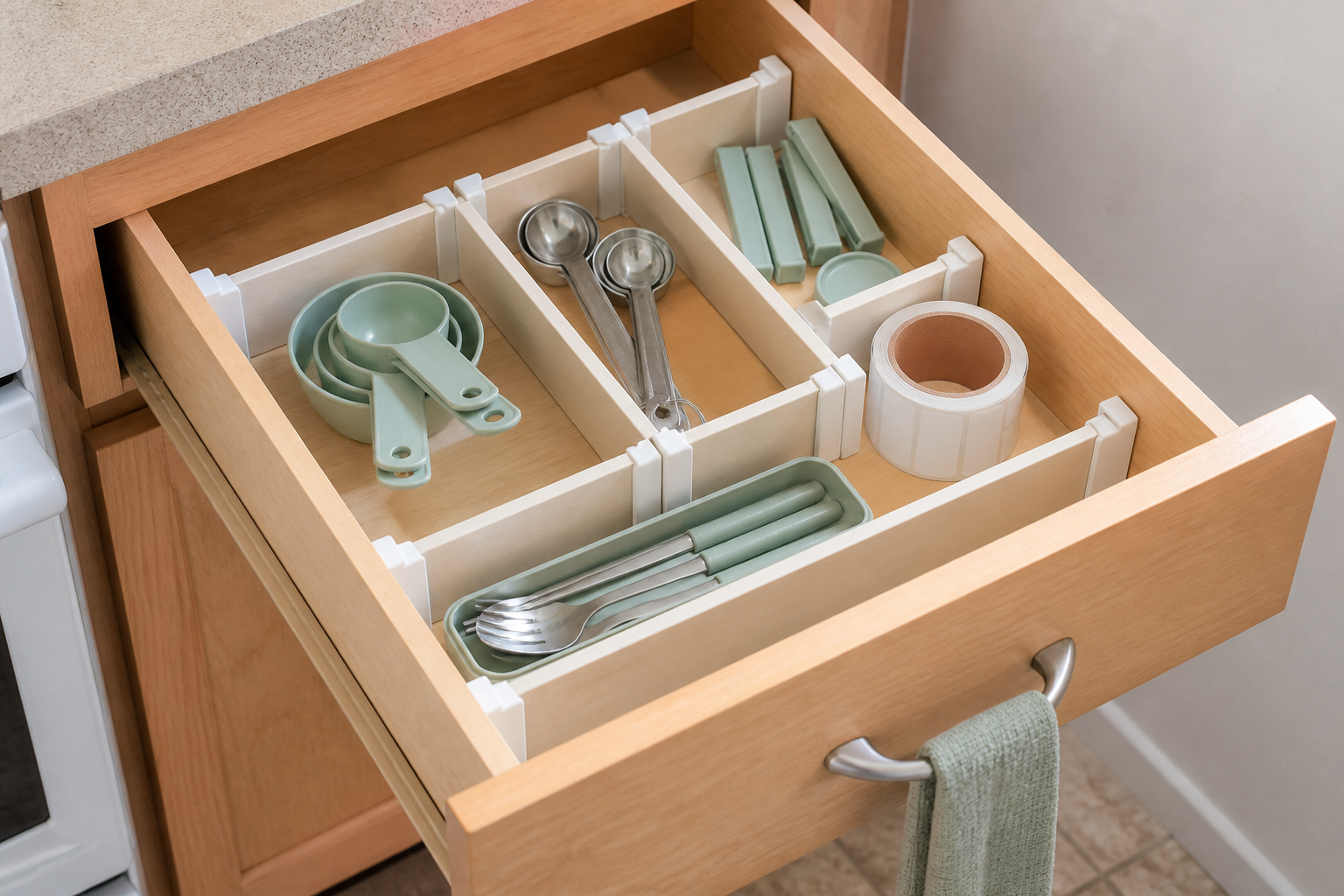
Drawer dividers can keep measuring cups, labels, clips, and reusable utensils from becoming one tangled layer. The useful choice is not the largest multipack—it is a divider that fits the drawer's actual interior, stays put without damaging it, and leaves the tools easy to lift out.
As an Amazon Associate, GoodWeighFinds earns from qualifying purchases.
Who this guide is for
This guide is for adults trying to make a small kitchen drawer more usable for meal-prep tools. It focuses on adjustable dividers for measuring tools, labels, clips, and utensils—not built-in cabinetry, food storage, or prescribed portions.
For the broader low-hype decision path, start with the routine-support tools guide. If the problem is pantry visibility rather than drawer access, compare pantry bins instead.
Best-fit formats, not unsupported rankings
- Best fit for changing tool groups: Individually adjustable dividers that can be repositioned without permanent hardware.
- Best fit for a deep drawer: A divider tall enough to stop stacked tools from crossing compartments, while still clearing the closed drawer.
- Best fit for a rental or finished wood drawer: A non-permanent format with broad, clean end pads and clear installation directions.
- Best fit for narrow compartments: Slim dividers whose end hardware does not consume too much usable width.
- Best fit for simple cleaning: Removable pieces with smooth surfaces and accessible end mechanisms.
Selection criteria that matter
- Usable interior measurements: Measure drawer width, depth, and height inside the box. Account for curved corners, side rails, screw heads, liners, and any taper.
- Adjustment range: The published minimum and maximum should contain your measurement with some working room; a divider at its absolute limit may be awkward to install.
- Divider height: It must contain the planned tools without catching the drawer frame, counter overhang, or tools that rise above it.
- Divider thickness: Multiply the width by the number of dividers. Thick pieces can take meaningful storage space from a small drawer.
- Locking method: Compare spring tension, lever locks, screws, or ratchets by installation effort and how easily the setting can be released.
- End grip and padding: Verify the end material, contact area, and maker's surface guidance. “Non-slip” and “no damage” are claims, not guarantees for every finish.
- Layout direction: Front-to-back dividers often make long lanes; side-to-side placement may create shallow zones. Check whether the drawer walls can support the intended orientation.
- Cleaning and removal: Favor pieces that lift out without tools and do not hide debris in deep tracks or open mechanisms.
- Multipack value: Count the dividers the finished layout actually needs. Extra pieces are not useful if their range or height does not fit another drawer.
- Return terms: Drawer fit is easy to misjudge, so verify the current seller and return conditions before ordering.
A practical comparison framework
Mark each candidate yes, no, or unclear, then resolve every unclear item before buying.
- Does the stated adjustment range fit the measured drawer in the intended direction?
- Will the divider and tallest tool clear when the drawer closes?
- How much usable width will all divider bodies and end mechanisms consume?
- Is the installation method appropriate for the drawer material and finish?
- Can frequently used tools be lifted out without crossing another compartment?
- Can each divider and the drawer beneath it be cleaned easily?
- Are material, care, installation, surface, and return details stated for the exact listing?
- Would a small tray, box, or rearrangement solve the problem with something already owned?
Plan the drawer before choosing a pack
Empty the drawer and group tools by job and frequency: measuring, labeling, closing bags, serving, or carrying. Put the most-used group nearest the natural hand position, then estimate compartment widths with the actual tools laid flat. Leave finger room; a compartment packed edge to edge can be harder to use than the original drawer.
Test the proposed lanes with cardboard strips or small boxes before buying. This exposes conflicts with oversized measuring cups, long handles, drawer-wall hardware, and tools that need to nest together.
Who should skip drawer dividers
Skip this purchase if the drawer is too shallow, tapered, damaged, or crowded by fixed hardware; if tension against its walls is not appropriate; or if the tools change so often that permanent lanes create more friction. A removable tray, shallow box, pegboard, wall rail installed correctly, or fewer duplicate tools may work better.
Also skip listings with no exact adjustment range, divider height, installation method, or surface guidance. Do not buy a large pack until one planned layout shows how many pieces fit without wasting usable space.
What drawer dividers cannot do
Dividers can improve visibility and access. They cannot expand the drawer, make unsuitable tools fit, guarantee protection for every finish, prescribe how much food anyone should prepare, or cause weight loss. Treat broad “healthy kitchen” or “portion-control organization” language as marketing rather than a demonstrated divider capability.
Bottom line
The best drawer dividers for meal-prep tools fit the measured interior with room to install, clear the closed drawer, hold their position without harming the surface, and create compartments you can actually reach and clean. Mock up the layout first, then buy only the number and size the drawer needs.