Work-lunch accessory buying guide
How to Choose Insulated Food-Jar Sleeves for Work Lunches
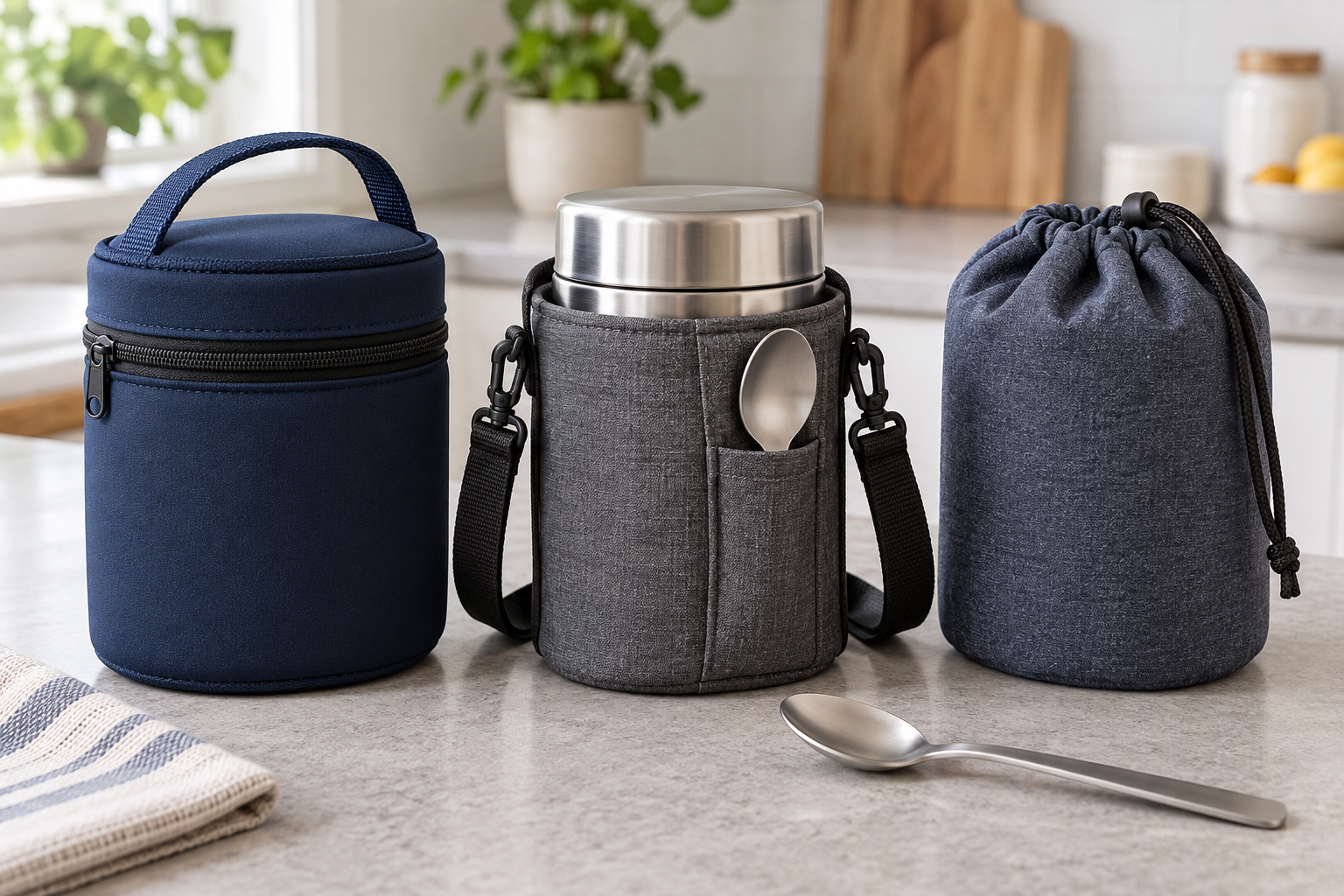
A fitted sleeve can keep a food jar, spoon, and carry handle together, but it cannot fix a poor jar fit or prove longer safe holding time. Start with the exact jar dimensions and the commute problem you need the sleeve to solve.
As an Amazon Associate, GoodWeighFinds earns from qualifying purchases.
Quick answer: match the sleeve to a measured job
| Format | Worth comparing when | Main check |
|---|---|---|
| Zippered handled sleeve | You want one compact piece to lift from a work bag or carry a short distance. | The loaded zipper closes without pressing the jar lid or handle. |
| Shoulder-strap sleeve | You sometimes carry the jar outside another bag and need your hands free. | The strap range, attachments, loaded swing, and total weight suit the route. |
| Sleeve with utensil pocket | A loose spoon repeatedly gets misplaced or soils another compartment. | The pocket fits the actual utensil and can be washed and fully dried. |
| Simple drawstring sleeve | You mainly want bag separation and flexible fit with few hardware parts. | The opening cinches below the lid without leaving the jar unstable or hard to remove. |
Measure the jar before opening a listing
Record the jar’s widest diameter, closed height, lid overhang, and any handle or outer cap. Then measure the spoon or fork you expect to carry. A seller’s exterior sleeve dimensions do not establish usable interior space, and a stated capacity does not establish fit for a different jar shape.
- Interior diameter: Look for an actual interior measurement or an explicit compatible-jar list. Allow for seams and padding rather than treating exterior width as usable width.
- Usable height: Check whether the closure sits above, around, or below the jar lid and whether the jar can be removed without pulling on the lid.
- Loaded opening: A sleeve may be wide inside but too narrow at its zipper, drawstring, or reinforced rim.
- Added footprint: Compare the loaded sleeve—not the empty product—with the lunch-bag opening, bottle, containers, and workplace storage space.
Selection criteria that separate useful sleeves from clutter
- Closure access: Check zipper path, drawstring hardware, flap overlap, and whether operation is practical with the jar loaded.
- Carry design: Compare handle clearance and strap range with the real route. Treat comfort language as subjective, not as proof.
- Utensil storage: Confirm pocket length, opening, closure, wash access, and whether an ordinary replacement utensil will fit.
- Material wording: Record what the maker actually names. “Insulated,” “neoprene-style,” and “water resistant” are not interchangeable and do not prove performance.
- Cleaning and drying: Prefer explicit care directions. Check whether padding, seams, pockets, and strap attachments can be opened to air-dry.
- Seller and returns: Verify the current seller, included parts, return window, and whether opening or washing affects eligibility.
Claims this accessory does not establish
A sleeve around a food jar does not establish that food will remain at an appropriate temperature, that the jar cannot leak, or that the sleeve will contain a spill. Holding conditions depend on the exact jar, its maker’s preparation and use directions, starting temperature, fill level, elapsed time, opening frequency, and route. Follow current food-safety guidance and the jar maker’s instructions rather than extending a sleeve listing’s marketing language.
A sleeve is also a carry accessory, not a weight-loss tool. It may remove a small packing inconvenience; it does not determine what, how much, or how often someone should eat.
Run a no-buy fit test first
- Measure the jar and utensil, including the lid’s widest point.
- Pack the jar in its normal work bag for three lunches and note the exact recurring problem: hard to lift, loose spoon, surface contact, or need for separate carry.
- Wrap the jar in a clean kitchen towel or place it in a simple reusable bag to test how added thickness affects the lunch-bag opening and storage.
- Buy only if a purpose-built sleeve solves that measured problem without creating worse access, cleaning, or bulk.
Who should skip a food-jar sleeve
- Your jar already travels securely inside a washable lunch bag.
- The listing omits usable interior dimensions or only says “universal.”
- You need proven temperature control or spill containment rather than a carry layer.
- The sleeve’s pocket, strap, or closure adds pieces you are unlikely to wash and dry.
- A small washable pouch you already own passes the fit test.
Related work-lunch decisions
If you are still choosing the vessel, start with the insulated food-jar guide. If the whole meal needs a carrier, compare a lunch bag with an insulated food jar, then use the insulated lunch-bag pillar for container fit, cleaning, and realistic temperature-claim limits.
Bottom line
The best food-jar sleeve is the one that fits a jar you already own and solves a repeated carry problem with minimal added bulk and care. Measure first, verify the current listing and return terms, and skip the accessory when an existing bag or washable pouch already does the job.