Routine-support buying guide
Best Insulated Food Jars for Commuter Lunch Routines
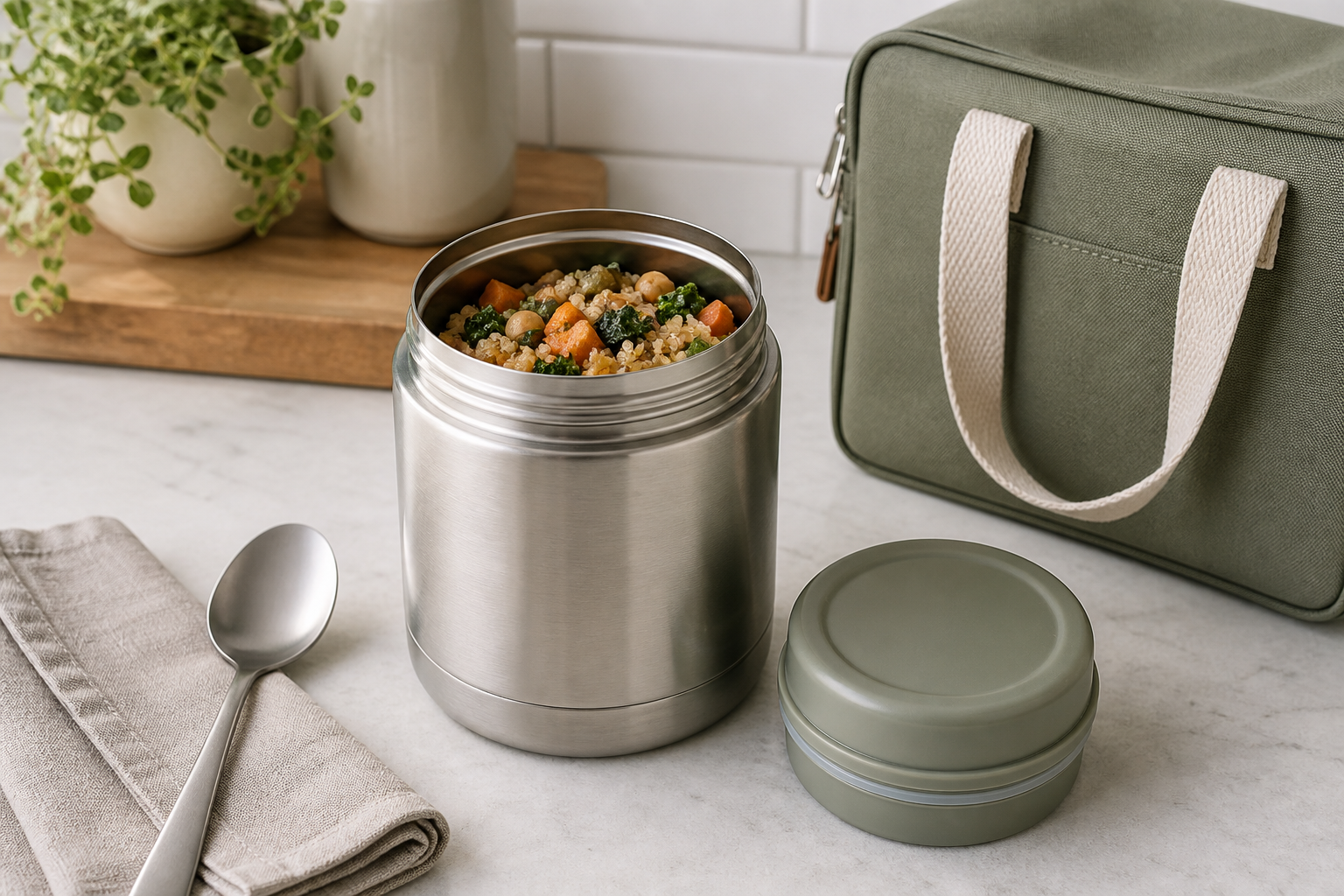
An insulated food jar can make a packed lunch more practical when a commute ends far from a refrigerator or microwave. It is a container, not a weight-loss tool, and its useful fit depends on the real trip: capacity, opening width, closed dimensions, cleaning, and the maker’s preparation and holding instructions.
As an Amazon Associate, GoodWeighFinds earns from qualifying purchases.
Who this guide is for
This guide is for adults who want to carry soup, stew, oatmeal, pasta, or another spoonable lunch through a commute without relying on a workplace microwave. If you have reliable refrigeration and reheating, a sealed microwave-ready container may be simpler; compare the work-lunch soup-container guide.
For the broader decision about products that remove friction without promising body results, start with the routine-support tools guide. If carrying space is the real constraint, the long-commute meal-prep bag guide covers bag dimensions and carry tradeoffs.
Best-fit formats, not unsupported rankings
- Best format for chunky foods: A wide mouth that accommodates an ordinary spoon and can be reached with a cleaning brush.
- Best format for a crowded commuter bag: A jar selected from verified closed height and diameter, with a lid that does not depend on a protruding handle.
- Best format for larger lunches: A higher stated capacity only after checking filled weight, bag fit, and whether the opening remains comfortable to eat from.
- Best format for fewer loose pieces: A model with a securely stored spoon, provided the utensil is actually usable and its storage channel can be cleaned and dried.
- Best format for simpler care: A jar with few lid components, an accessible gasket, and explicit washing directions for every piece.
Selection criteria that matter
- Capacity and filled weight: Compare the volume you normally pack, leave any headspace required by the maker, and remember that the filled jar may be much heavier than its listing weight.
- Mouth diameter: A wide opening makes filling, eating, and washing easier, but it can also increase the jar’s exterior width.
- Lid construction: Check gasket access, grip when wet, pressure-release directions if provided, and whether an outer lid doubles as a bowl.
- Heat-retention evidence: Treat stated hours as model-specific manufacturer claims under specified test conditions—not a promise for every food, starting temperature, fill level, commute, or weather condition.
- Preparation steps: Read the exact maker’s preheating or precooling instructions before buying. A routine that feels too fussy is unlikely to be followed consistently.
- Utensil storage: Confirm spoon length, storage method, washing access, and whether losing a proprietary utensil leaves an awkward compartment.
- Cleaning and drying: Verify which pieces are dishwasher-labeled and whether the base, threads, gasket channel, and lid cavity can be fully washed and air-dried.
- Bag fit: Compare the jar’s closed dimensions with the bag opening, interior height, bottle, ice packs, and upright position—not capacity alone.
A practical comparison framework
Record yes, no, or unclear for each candidate:
- Are the closed height, widest diameter, empty weight, and capacity stated for the exact model?
- Does the opening fit the food, utensil, and cleaning brush I expect to use?
- Can I follow the maker’s preparation, filling, closing, opening, and care directions on a normal morning?
- Are heat-retention claims tied to stated conditions rather than vague “all day” wording?
- Can every lid part and gasket be inspected, washed, and dried?
- Will the filled jar stay upright and leave space for the rest of the commute kit?
- Are replacement gaskets, lids, or utensils available for the exact model?
- Would this jar still be useful if it caused no change in weight or body measurements?
Food-temperature claims need caution
Vacuum insulation slows temperature change; it does not prove that any food will remain at an appropriate temperature for any schedule. Starting temperature, preparation, fill level, opening frequency, outside conditions, and elapsed time all matter. Follow the exact manufacturer’s directions and current applicable food-safety guidance rather than relying on listing photos, reviews, or an unspecified “hot for hours” claim.
Do not microwave a stainless-steel jar. Transfer food to microwave-safe cookware if reheating is needed, and follow the cookware maker’s directions. Use care when opening hot contents, especially if the jar has been shaken or pressure may have built up.
Who should skip this purchase
Skip an insulated jar if a refrigerator and microwave already make a standard sealed container easier. Skip it if the required preheating, hand washing, gasket care, or narrow cleaning access would add more friction than it removes. A plain wide-mouth jar may also be better than a utensil-storage model if you already carry ordinary cutlery.
Do not rely on a jar with a damaged seal, dented rim, cracked lid, trapped residue, or missing parts. For time- or temperature-sensitive foods and individual health needs, use current food-safety guidance or advice from an appropriately qualified professional rather than a marketplace claim.
Bottom line
The best insulated food jar for a commute is the simplest one that fits the actual lunch, spoon, cleaning routine, and bag. Verify dimensions and maker directions, treat holding times as conditional claims, and choose replaceable, cleanable parts over decorative extras or weight-loss marketing.