Routine-support buying guide
Best Phone Holders for Walking Without a Waist Belt
If a phone is the only item you need on a walk, a full belt or backpack can feel like unnecessary gear. The useful choice is a holder that fits the phone and case, keeps controls reachable, and stays attached during ordinary movement—not the listing with the boldest “no bounce” promise.
As an Amazon Associate, GoodWeighFinds earns from qualifying purchases.
Who this guide is for
This guide is for adults who carry a phone on ordinary walks but do not want a waist belt or backpack. It compares phone-focused holders only; it does not cover weighted gear, posture devices, running-performance equipment, or products promising calorie burn or weight loss.
For broader routine-support choices, use the routine-support tools guide. If you also carry keys or other small items, the walking-belt guide may fit better. For water and a light layer, compare compact walking backpacks.
Useful holder formats—not ranked winners
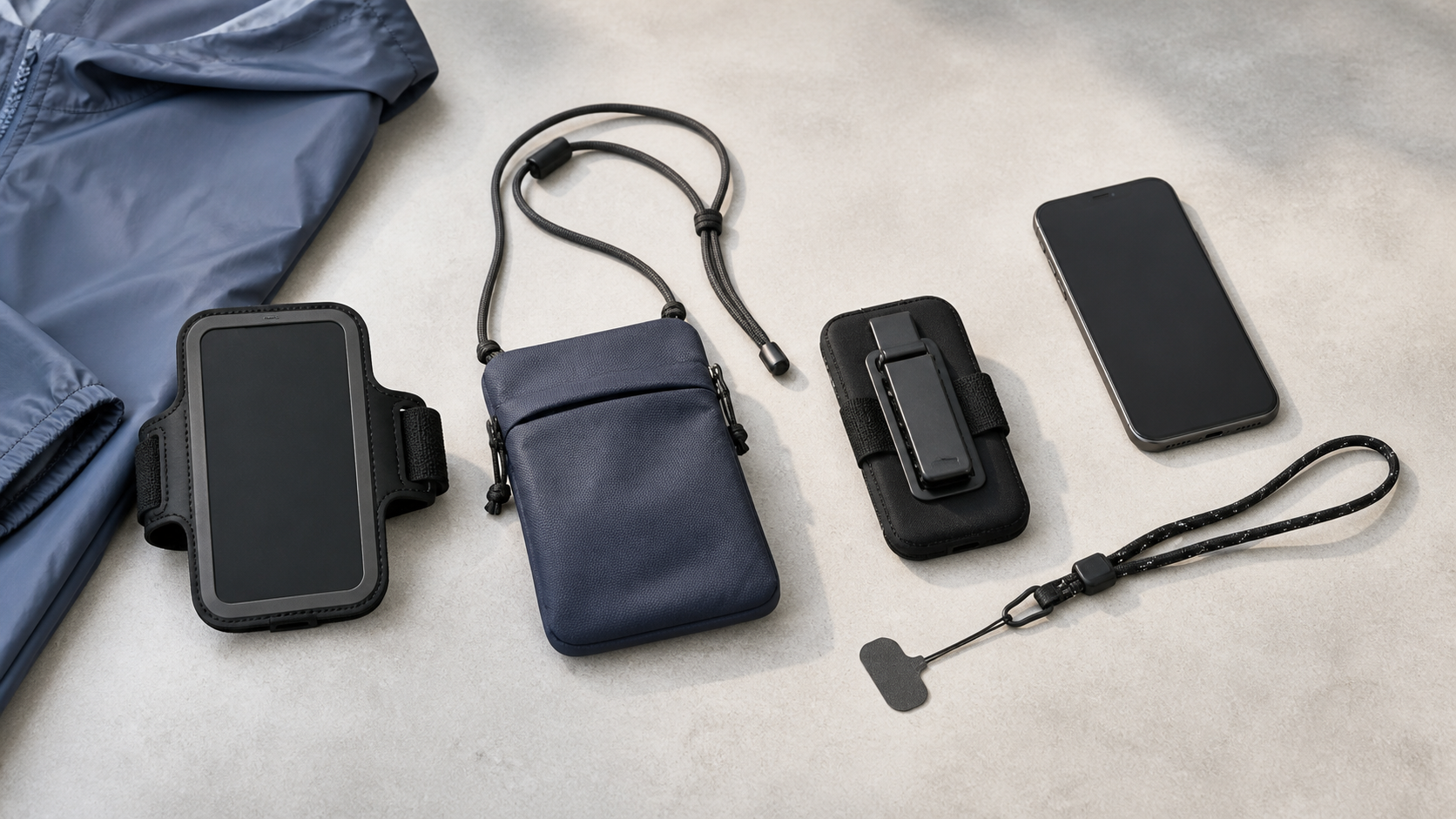
GoodWeighFinds has not wear-tested current phone holders or verified named-product inventory. These formats define distinct tradeoffs rather than winners:
- Upper-arm holder: Keeps the phone close to one arm and can leave hands free, but strap range, sleeve thickness, screen access, and pressure vary.
- Crossbody phone pouch: Offers a full enclosure and adjustable carry position, though the pouch can swing and may be slower to open.
- Clip holster: Can provide quick access on a firm pocket edge or waistband, but clip strength and garment compatibility need careful checking.
- Phone lanyard or tether: Uses little material and can keep a dropped phone attached, but a swinging phone and tether-tab compatibility may be poor fits.
- Hand strap or finger loop: Adds grip without attaching the phone to clothing, but it still occupies a hand and does not provide drop-proof retention.
Selection criteria that matter
- Phone and case fit: Compare exact length, width, thickness, camera position, and charging-port clearance. “Universal” does not guarantee fit.
- Retention: Look for a clearly described zipper, flap, cradle, tether, or clip. Product photos alone do not prove that a phone will stay secure.
- Attachment range: Check strap length, clip opening, lanyard adjustment, and whether the holder works over the clothing you actually wear.
- Access: Decide whether you need to see the screen, use side buttons, take a photo, or remove the phone before choosing an enclosure.
- Movement: “No bounce” is a seller claim unless independently demonstrated. A shorter strap or close-fitting holder may reduce movement, but fit and phone weight still matter.
- Weather limits: Water-resistant is not waterproof. A seam, zipper, screen window, and charging opening can all admit moisture.
- Comfort and skin contact: Check edge binding, strap width, ventilation claims, and care instructions. Stop using a holder that rubs, pinches, or restricts movement.
- Visibility: Reflective trim can supplement other visibility choices but cannot make someone visible from every direction.
- Returns: Because comfort and stability are hard to infer online, clear current return terms are especially useful.
A practical comparison framework
Measure the phone in its normal case, then mark each candidate yes, no, or unclear:
- Are the holder's interior dimensions stated and larger than the cased phone?
- Does the attachment fit the intended arm, strap, pocket, waistband, or neckline?
- Is there a positive closure or tether appropriate for the planned movement?
- Can required controls be reached without forcing the phone or blocking the camera?
- Would the phone strike the body, swing, or catch on nearby objects?
- Are sweat, rain, cleaning, and drying limits stated narrowly?
- Can the holder be tried safely in a low-stakes setting and returned if the fit is wrong?
Try the setup before a longer walk
Load the cased phone, close every fastener, and walk indoors or near home first. Check that the phone cannot slide out when you bend, that a strap does not loosen, and that the holder does not interfere with arm movement or access to assistance. Do not adjust or read the phone while crossing streets or navigating uneven ground.
A holder does not make distracted walking safe, protect a phone in every fall, or guarantee weather protection. Follow the phone and holder makers' current instructions, and use a separate protective enclosure when conditions exceed the product's stated limits.
Who should skip this purchase
Skip a dedicated holder if a secure existing pocket already works, if the phone can stay behind, or if a walking belt is needed for keys and other essentials anyway. Skip any listing without usable dimensions, attachment details, and return terms.
An armband may be a poor fit for someone who dislikes compression or has limited reach. A lanyard may be unsuitable where cords can snag, while a clip may fail on soft or loose fabric. Anyone who needs specialized access, fall protection, or mobility-equipment compatibility should choose around that requirement rather than a generic “best” label.
Bottom line
The best phone holder is the simplest format that fits the cased phone, attaches securely to the intended clothing, keeps needed controls accessible, and stays comfortable in a short real-world trial. Compare measured fit and retention before convenience claims.