Routine-support buying guide
Best Produce-Keeper Labels for Fridge Drawer Visibility
A label can make the contents of a crowded crisper easier to identify, but it cannot keep produce fresh or make a container safer. The useful choice is a removable label that stays readable on the surface you already use and comes off according to the maker’s directions.
As an Amazon Associate, GoodWeighFinds earns from qualifying purchases.
Who this guide is for
This guide is for adults who repeatedly lose sight of produce in opaque, deep, or shared refrigerator drawers and want a simple identification cue. It is narrower than the food-storage label guide, which focuses on dating prepared foods and leftovers. If the whole shelf layout is the problem, first decide whether a fridge organizer is worth adding.
For the broader measure-first approach to ordinary routine tools, use the routine-support tools guide.
Useful formats—not ranked winners
- Removable paper label: Useful for short-term identification when the maker lists the surface and removal method. Check whether condensation, wiping, or cold storage is within the stated use.
- Reusable plastic or vinyl label: A wipe-clean surface may suit changing contents, but confirm the required marker, drying time, cleaning method, and whether reuse is explicitly supported.
- Clip-on label: A clip avoids adhesive on compatible drawer lips or basket edges. Measure the attachment point and check door, drawer, and produce clearance.
- Label-window card: A replaceable paper card can make handwriting easy to refresh. Confirm that the holder fits securely and that the card does not touch food or obstruct airflow.
Start with the surface and viewing angle
Identify exactly where the label will go: smooth drawer front, textured bin, curved container, basket edge, or removable insert. Manufacturer compatibility for one surface does not prove compatibility with another. Measure the flat attachment area and choose a label that sits fully inside it without crossing a seam, vent, handle, or moving edge.
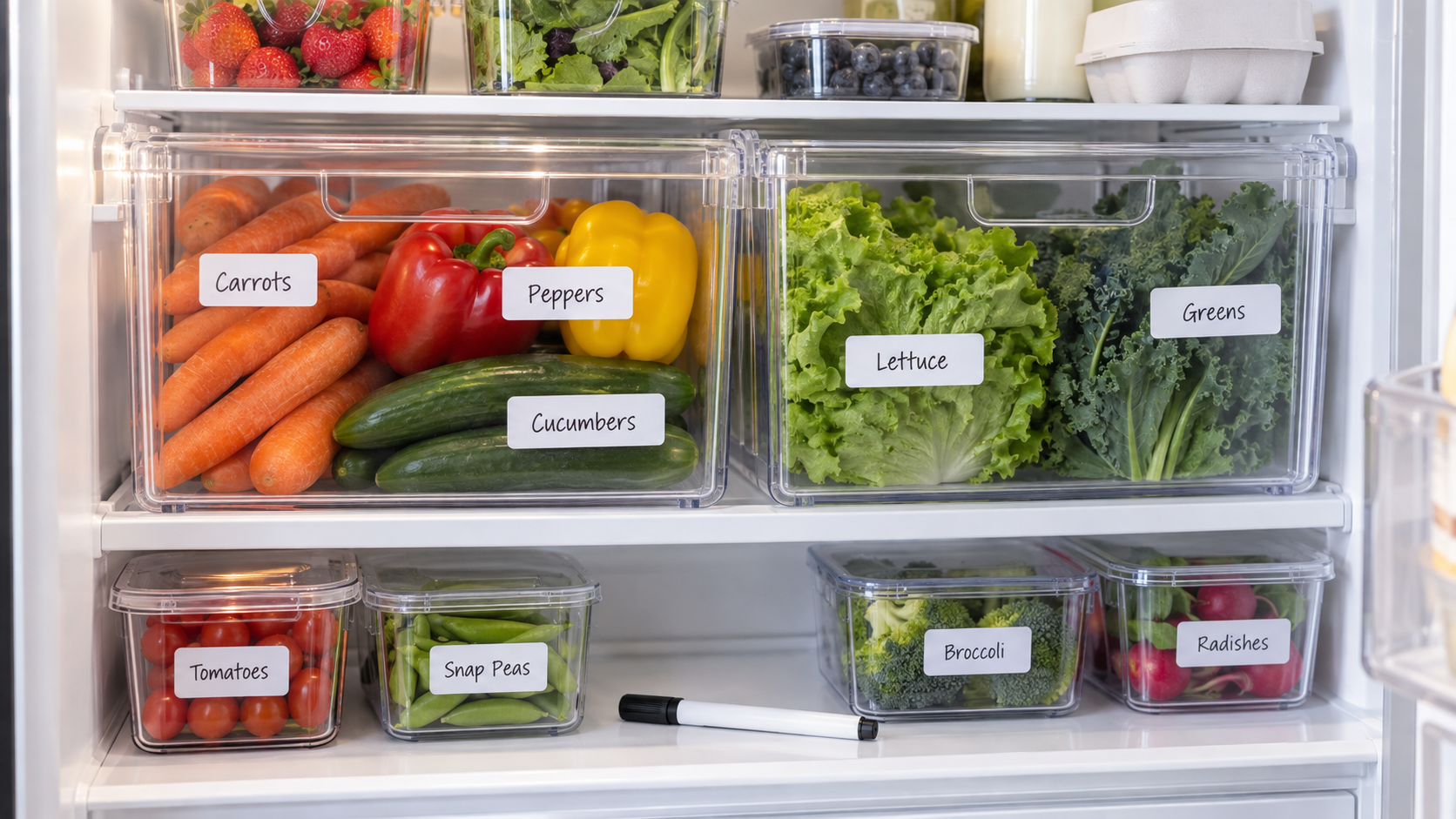
Then check the normal viewing angle with the refrigerator door open. Large lettering and strong contrast matter more than fitting extra details. A short category name such as “greens” is often easier to scan than a crowded inventory list. Avoid recording private diet, health, or weight information on labels visible to other household members.
Writing and removal checks
- Writing tool: Use only the marker, pen, or pencil type the maker specifies. “Chalk,” “dry erase,” and “permanent” are not interchangeable instructions.
- Set time: Follow any drying or curing directions before touching the label or returning the container to the refrigerator.
- Removal: Test one label on a small, inconspicuous part of the exact surface for the stated period, then remove it as directed.
- Cleaning: Check whether the label stays on during normal wiping or must be removed first. Follow the refrigerator or container maker’s surface-care directions too.
- Moisture wording: Treat water-resistant, washable, freezer-safe, and similar terms as separate claims. Look for the exact conditions and limits rather than assuming they mean the same thing.
- Food contact: Keep ordinary organization labels on the outside of drawers and containers unless the maker explicitly documents the intended food-contact use.
Run a no-buy test first
For one week, put a removable paper note or an index card in a safe visible spot outside the drawer. Use the same short category wording you would put on a purchased label. If nobody reads or updates the cue, a dedicated label set will not fix the routine.
If the test works, count only the drawers or containers that genuinely need identification. A small set may be more useful than a large pack that creates extra writing and upkeep. If contents change daily, a simple shared fridge list may work better than relabeling every container.
Who should skip produce labels
Skip the purchase when clear drawers already show their contents, household members will not update the labels, the attachment area is textured or too narrow for documented use, or the label would obstruct a handle, vent, seal, or drawer path. Also skip any listing that turns a basic identifier into unsupported freshness, preservation, hygiene, or weight-loss claims.
Labels do not replace ordinary food-storage judgment. When deciding whether food is suitable to eat, use authoritative storage guidance and the actual condition of the food rather than the label alone.
Bottom line
The best produce-keeper label is easy to read from the normal refrigerator view, documented for the exact surface and writing method, and simple to remove and update. Buy only after a temporary cue proves that identification—not a broader storage problem—is the missing step.