Small-counter buying guide
Best Reusable Food-Bag Drying Racks for Small Counters
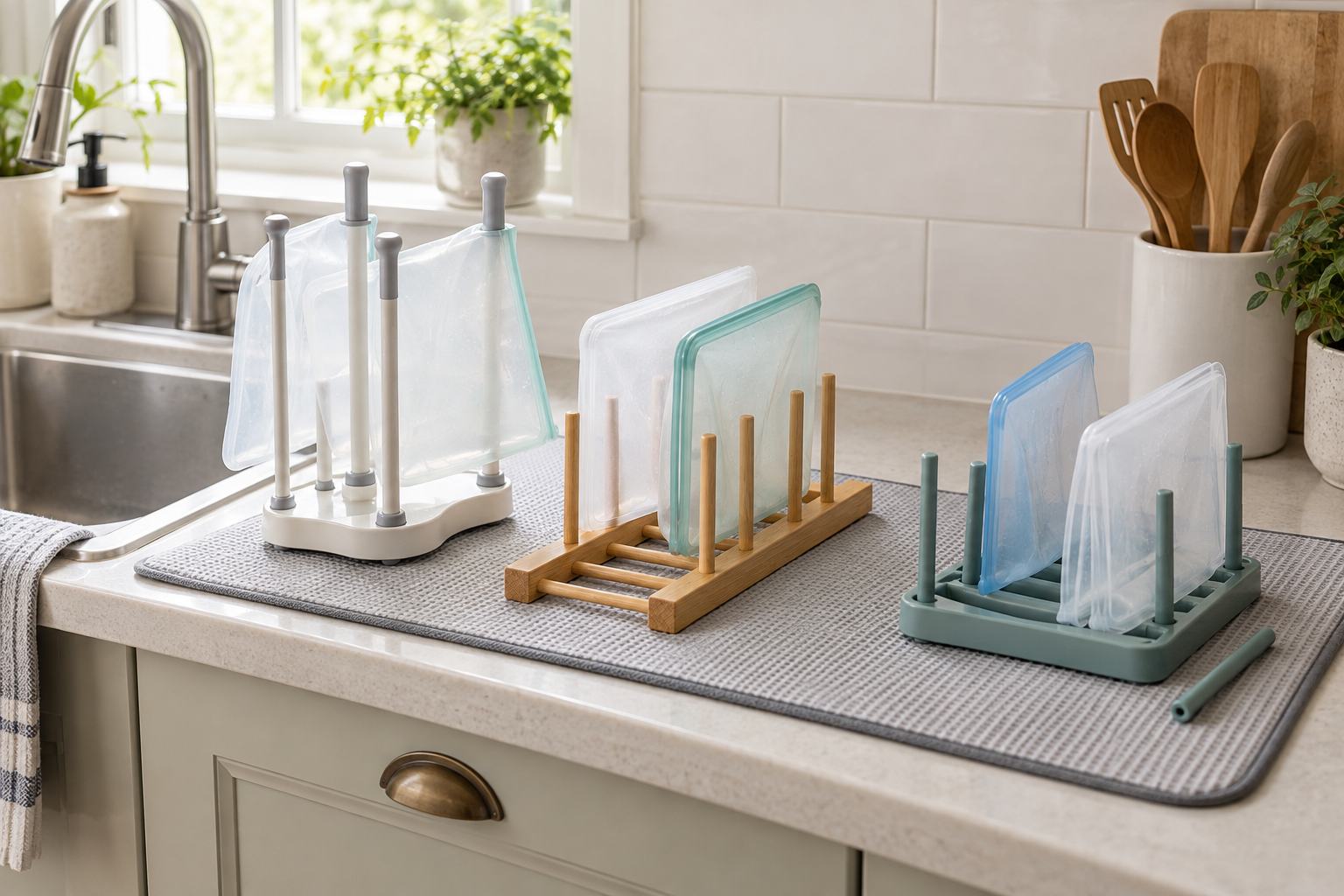
Once a typical batch proves that a dedicated rack would help, compare formats by the bags you own and the counter space they occupy when loaded. This guide covers measurable fit and upkeep—not named winners, hands-on tests, hygiene claims, or promised drying times.
As an Amazon Associate, GoodWeighFinds earns from qualifying purchases.
Start after the buy-or-skip test
This guide is for adults who regularly wash reusable snack or food-storage bags and have already found that clean supports they own do not handle the usual batch. If that need is still uncertain, run the reusable food-bag drying-rack test first. It separates the ownership decision from model selection.
This page supports the broader routine-support tools guide. A drying rack is ordinary kitchen organization; it does not sanitize a bag or affect nutrition or weight-loss outcomes.
The useful formats
| Format | Check first | Main tradeoff |
|---|---|---|
| Fixed upright arms | Arm height, tip shape, spacing, and complete loaded width | Quick setup, but the permanent shape needs dedicated counter or cabinet space |
| Fold-flat peg rack | Locked-open base, peg spacing, fold direction, and stored thickness | Compact storage may add hinges, joints, or setup steps to clean |
| Removable or modular arms | Socket spacing, supported layouts, loose-part storage, and assembly | Flexible spacing can mean more pieces to wash, dry, and keep together |
| Multi-use stand | Whether the maker states that the arms suit the bag material and opening | A broader job list is useful only if the real bag batch fits without crowding |
Measure the bags and loaded counter space
Follow each bag maker's washing and drying directions. Measure the opening width, bag depth, gusset, closure, and stiffness of every size in the normal batch. The support should hold the bag open without forcing a closure, stretching a seam, or placing it against a sharp edge.
Sketch the loaded rack at full bag width and height. Include overhang beyond the base, the hand space needed to place and remove bags, nearby faucet movement, cabinet clearance, outlets, and the path used for meal prep. A compact empty rack can become a wide obstacle once bags are attached.
Selection criteria that matter
- Arm geometry: Compare usable height, spacing, width, and tip shape with actual bag openings and depths.
- Useful capacity: Count only bags that can remain open without crowding, touching the counter, or destabilizing the arrangement.
- Base design: Keep every foot on a level supported surface and treat seller stability statements as claims to verify.
- Drainage route: Identify where drips land and whether the mat, tray, or counter can be cleaned and dried as directed.
- Cleaning access: Check joints, sockets, hinges, feet, and narrow gaps rather than assuming a simple silhouette is easy to wash.
- Stored size: Verify folded or disassembled dimensions and account for loose arms or pegs.
- Materials and care: Use the exact listing and maker directions; appearance alone does not establish material, appliance compatibility, or durability.
- Seller and returns: Re-check included parts, seller identity, and return terms before ordering.
Run a cardboard footprint test
Mark the listed base dimensions on cardboard, then add paper outlines for the widest bags overhanging each side. Place the template where the rack would drain during the usual wash cycle. Confirm the faucet, cabinet doors, outlets, dish handling, and prep route still work.
If the template blocks the counter, reduce the planned batch, choose a narrower arrangement only when the arm spacing still fits, or keep using a clean support already owned. Do not assume a taller rack solves a narrow-counter problem; tall bags still need lateral space.
Claims to treat cautiously
A rack may hold compatible bags open and separated. That setup does not prove faster drying, sanitation, mold prevention, odor control, dishwasher safety, universal bag fit, or a particular useful life. Verify narrow product details in the current maker instructions and keep the purchase decision focused on geometry, drainage, upkeep, and storage.
Who should skip this purchase
Skip a dedicated rack when the normal batch already stays open on a clean dish-rack section or other maker-permitted support, when the loaded footprint blocks essential counter tasks, or when the listing omits the dimensions and care details needed to check fit. Also skip a model whose arms strain bag openings, whose parts would be awkward to clean, or whose loose pieces have no realistic storage place.
Bottom line
The best reusable food-bag drying rack is the simplest format that fits the actual bag openings, supports the normal batch, stays within a measured loaded footprint, drains to a manageable surface, and can be cleaned and stored. If an existing setup passes those same checks, keep it.