Buy, reuse, or skip
Is a Reusable Food-Bag Drying Rack Worth It?
A dedicated rack can be worth buying when several washable food-storage bags regularly collapse against one another or take over the dish rack. It is probably unnecessary when a small batch already dries open and securely on equipment you own.
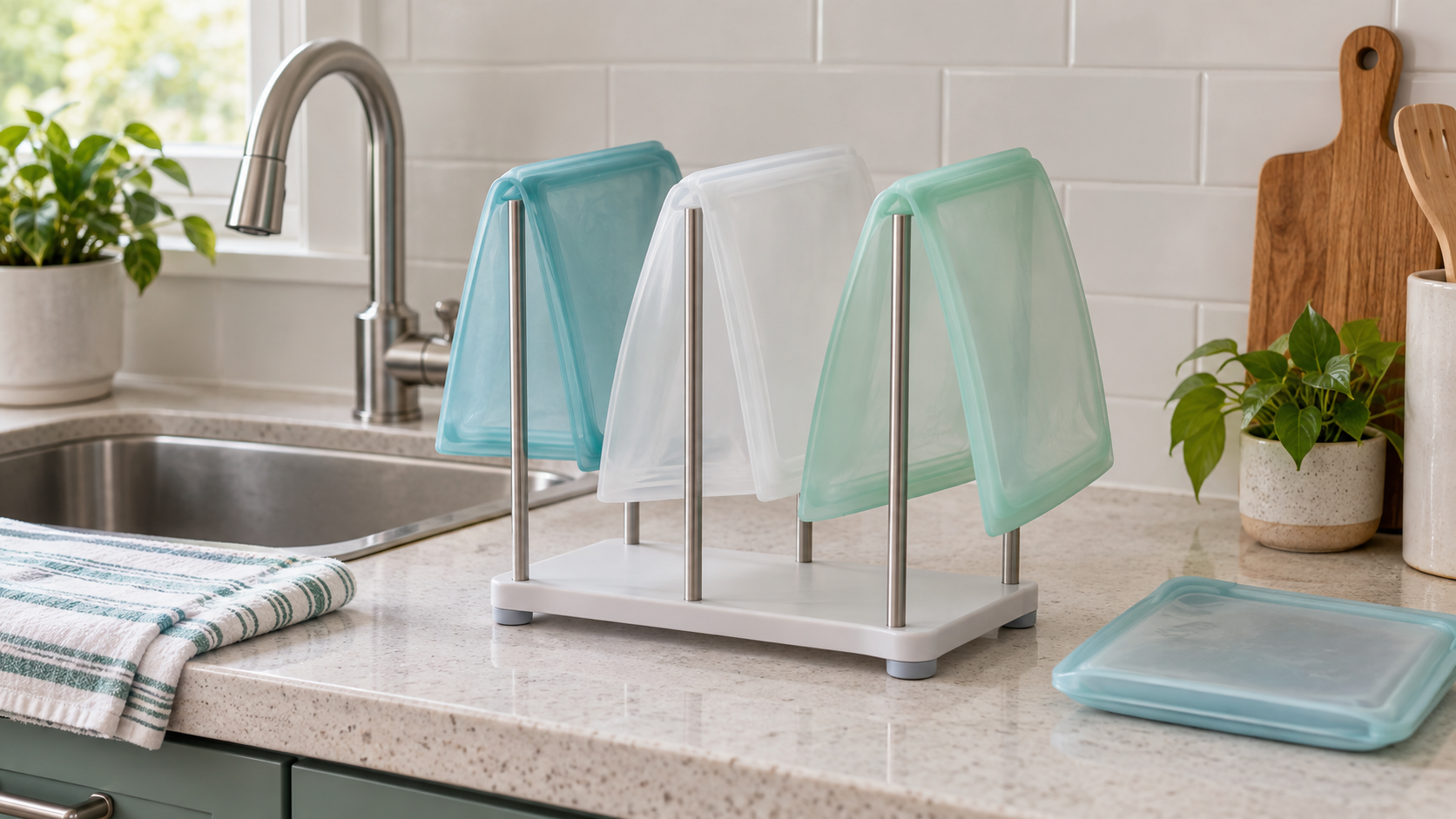
As an Amazon Associate, GoodWeighFinds earns from qualifying purchases.
The quick answer
- Likely worth it: you wash several reusable bags most weeks, the bags are difficult to hold open in your current setup, and a measured rack has a stable place to drain.
- Test first: wash a typical batch and use a clean dish-rack section, manufacturer-permitted clips, or stable cups or jars that do not strain the bag openings.
- Probably skip it: bags are washed occasionally, your existing setup keeps them open, or a permanent rack would consume needed prep space.
Start with the bags, not the rack
Follow each bag maker's washing and drying directions first. Reusable bags vary in opening width, depth, stiffness, seam shape, and whether they can be turned inside out. A rack that looks useful in a staged photo may not support the bags you own in the way their maker permits.
Count the largest batch you actually wash together during one normal week. Include small snack bags and tall storage bags separately. The useful capacity is the number of your bags that can sit open without touching the counter, crowding one another, or making the stand unstable—not the largest number shown in a listing.
Run a no-buy drying test
For one week, dry the usual batch with safe, clean supports already in the kitchen. An open section of a dish rack may work. A stable cup or jar may hold one compatible bag open if the bag maker allows that arrangement. Avoid sharp edges, improvised balancing, and clips that could damage seams or closures.
Record the actual failure: bags collapse, the interiors stay difficult to expose, loose bags occupy the whole rack, or the supports themselves are awkward to clean and store. If none of those problems repeats, a dedicated tool is unlikely to earn its space.
Measure the loaded setup
- Arm fit: compare arm height, width, tip shape, and spacing with every bag size you intend to dry.
- Loaded footprint: add any bag overhang to the base dimensions and leave room to place and remove bags.
- Clearance: check cabinets, windows, faucets, outlets, and the route used to move food and dishes around the counter.
- Stability: look for a broad base and maker instructions about loading order; do not assume an empty product photo proves loaded stability.
- Drainage: decide where drips go and whether that surface, tray, or mat is easy to clean.
Cleaning and storage are part of the purchase
A rack adds another item that needs cleaning. Check whether arms detach, joints trap residue, feet can be wiped, and the maker permits dishwasher cleaning. If the rack folds, confirm its folded dimensions and whether loose parts need separate storage. “Collapsible” does not establish that it fits your drawer or cabinet.
Do not treat a rack as proof of sanitation, mold prevention, or a particular drying time. Those outcomes depend on the bag, washing method, airflow, room conditions, spacing, and upkeep. The modest product job is to hold compatible bags open and separated in a stable arrangement.
When a different tool fits better
If bottles, lids, straws, and seals—not bags—create the recurring bottleneck, use the bottle drying-rack decision guide. If mixed dishes and container lids need space, compare general dish racks for meal-prep containers and lids. A bag-only stand is a poor substitute when the real problem is broader dish capacity.
Reasons to skip or delay
- The listing omits assembled dimensions, arm spacing, care directions, or clear loaded views.
- Your bags' maker directions conflict with the rack design or required loading method.
- A clean, stable setup you already own handles the typical batch.
- The rack would live permanently in active prep space but is used only occasionally.
- The design adds narrow joints or loose pieces you are unlikely to clean and store.
Choose a format only after the test
If the one-week test shows a recurring need, use the food-bag drying rack buying guide to compare fixed-arm, fold-flat, modular, and multi-use formats by bag geometry, loaded footprint, drainage, cleaning, and storage.
Bottom line
A reusable food-bag drying rack is worth considering only after a typical batch repeatedly defeats the drying space you already have. Buy for measured bag fit, loaded stability, drainage, cleanup, and storage—not promises about drying speed or hygiene. For other low-claim routine tools, start with the routine-support tools guide.