Buy, reuse, or skip
Is a Bottle Drying Rack Worth It for Multi-Part Bottles?
A dedicated bottle drying rack can be worth buying when reusable bottles regularly leave bodies, lids, straws, seals, and brushes competing for limited dish-rack space. It is usually unnecessary when one or two bottles fit securely on the rack or clean towel you already use.
As an Amazon Associate, GoodWeighFinds earns from qualifying purchases.
The quick answer
- Likely worth it: several bottles with removable parts are washed most weeks, those pieces crowd the main dish rack, and a measured rack has a clear drainage plan.
- Test first: the problem may be timing rather than equipment. Wash one batch, lay all parts on a clean towel or use open dish-rack slots, and note what actually falls, pools, or gets misplaced.
- Probably skip it: bottle washing is occasional, current drying space works, the rack would permanently crowd food-prep space, or its pegs do not fit your bottles and small parts.
Run a one-week parts audit
Count bottle bodies, lids, mouthpieces, straws, removable seals, and any dedicated brush pieces washed during a typical week. Record the largest single batch rather than the household's total bottle collection. A rack sized for every bottle you own may waste space if only a few are washed together.
Notice where the existing setup fails. Bottles may be too tall for a rack, small seals may slip through its openings, or the main dish rack may simply be busy at dinner. Those are different problems and need different layouts.
Test what you already have
Follow each bottle maker's cleaning and drying directions. For the ownership test, place washed parts securely in the existing dish rack or on a clean, dry towel where they will not roll into the sink or onto the floor. Do not balance heavy bottles on narrow tines.
If everything fits with space between parts and the counter can be restored after drying, a dedicated rack may add little. If bottle pieces repeatedly displace dishes or are hard to keep together, measure the temporary layout before shopping.
Measure the loaded footprint
- Base width and depth: include a drain tray, spout, mat, or overhanging parts—not only the rack frame.
- Loaded height: measure the tallest bottle upside down on the stated support and check cabinets, shelves, and window ledges above it.
- Peg fit: compare peg diameter, height, and spacing with bottle openings and the widest bottle bodies.
- Small-part space: confirm lids, seals, and straw pieces have supported positions rather than falling through the base.
- Working clearance: leave room to lower and lift bottles without hitting a faucet, wall, or neighboring rack.
Drainage changes the counter cost
A tray may contain drips but adds a part to empty and clean. A sloped or sink-directed design still needs a compatible counter position. An open base placed on a mat or towel moves the drainage job to that surface. Check the maker's intended setup; do not assume a product prevents pooling, mold, or contamination.
Whatever format you consider, inspect how every removable piece can be reached for cleaning and drying. Narrow channels, fixed pegs, and textured trays may add upkeep. Use only the stated cleaning method and check whether the assembled rack can be stored when it is not needed.
Choose only after the ownership test
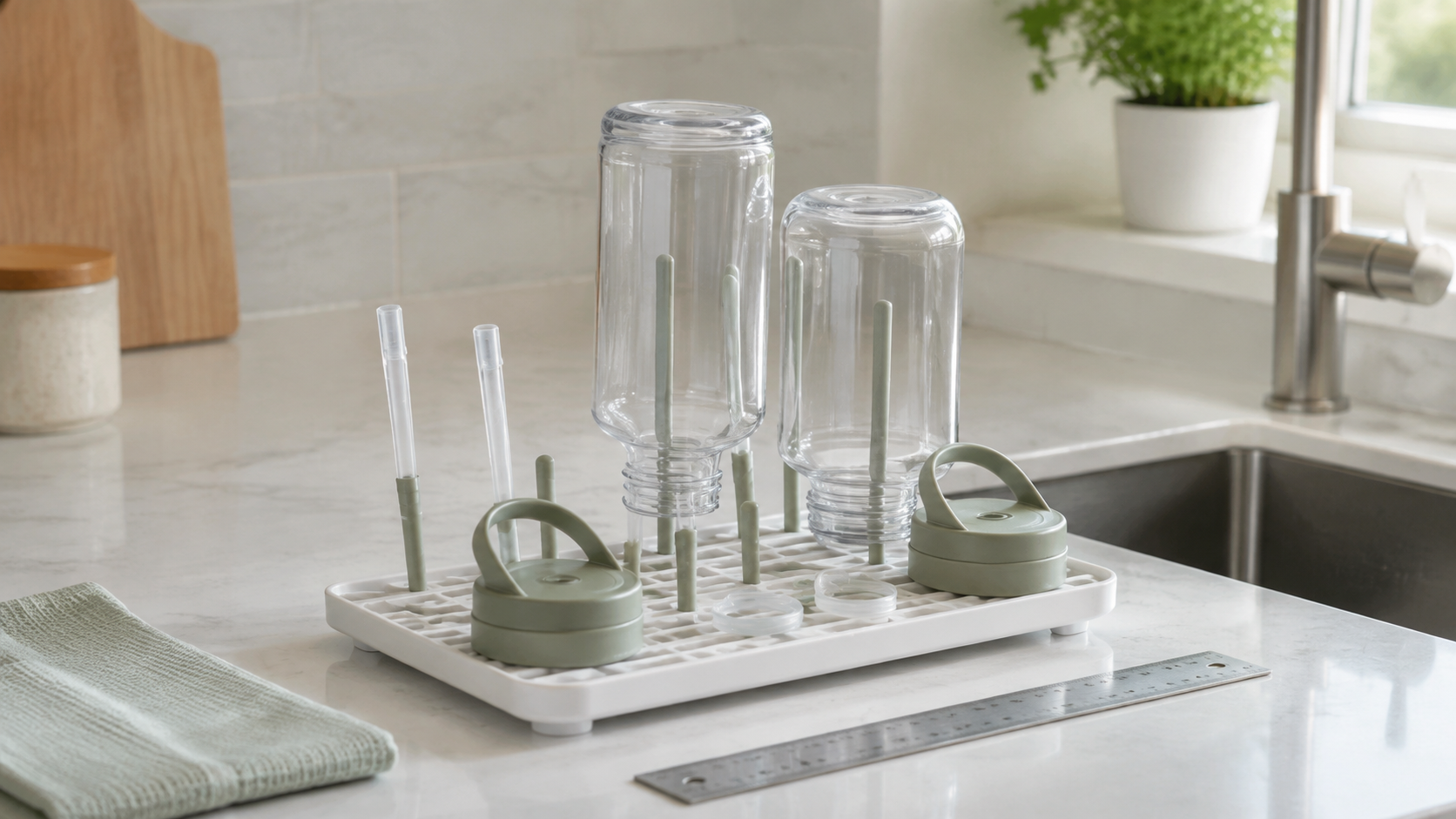
If the audit shows a dedicated rack would help, use the bottle drying-rack comparison guide to evaluate open peg racks, tray-based formats, and small-part holders. Keep your measurements beside the listing; staged images do not establish fit or capacity.
Reasons to skip or delay
- You can solve the bottleneck by washing bottles at a quieter time or clearing one stable dish-rack section.
- The rack's loaded size consumes counter area needed for regular food preparation.
- Your bottle maker requires a drying arrangement the rack does not support.
- The listing omits assembled dimensions, peg spacing, care directions, or a clear view of drainage.
- Small removable parts would still need a separate supported container or drying area.
Bottom line
A bottle drying rack is worth it when a repeat, counted batch of bottle parts does not fit the drying space you already have and a measured rack gives every piece a stable place without taking over the counter. Test the routine first, then buy for the actual bottle openings, loose parts, clearance, drainage, and cleanup job. For other low-claim tools, see the routine-support tools guide.