Routine-support buying guide
Best Reusable Grocery Bags for Public-Transit Shopping
A grocery bag that works from a car trunk may be awkward on a bus or train. For transit shopping, the useful choice has a carry style you can control, a closure that contains the load, and a folded size that does not become another thing to manage between trips.
As an Amazon Associate, GoodWeighFinds earns from qualifying purchases.
Who this guide is for
This guide is for adults carrying ordinary grocery loads on buses or trains who want bags that are easier to hold close, close securely, and store between trips. It does not rank current named products or assume that one carry style suits every route, body, or mobility need.
Use the routine-support tools guide for the broader product-checking framework. If the main problem is temperature control, compare insulated grocery bags. If the route is mostly on foot and the load should roll, compare compact grocery carts.
Useful bag formats—not ranked winners
GoodWeighFinds did not load-test current bags or verify named-product inventory. These formats organize distinct transit tradeoffs without inventing a universal best bag:
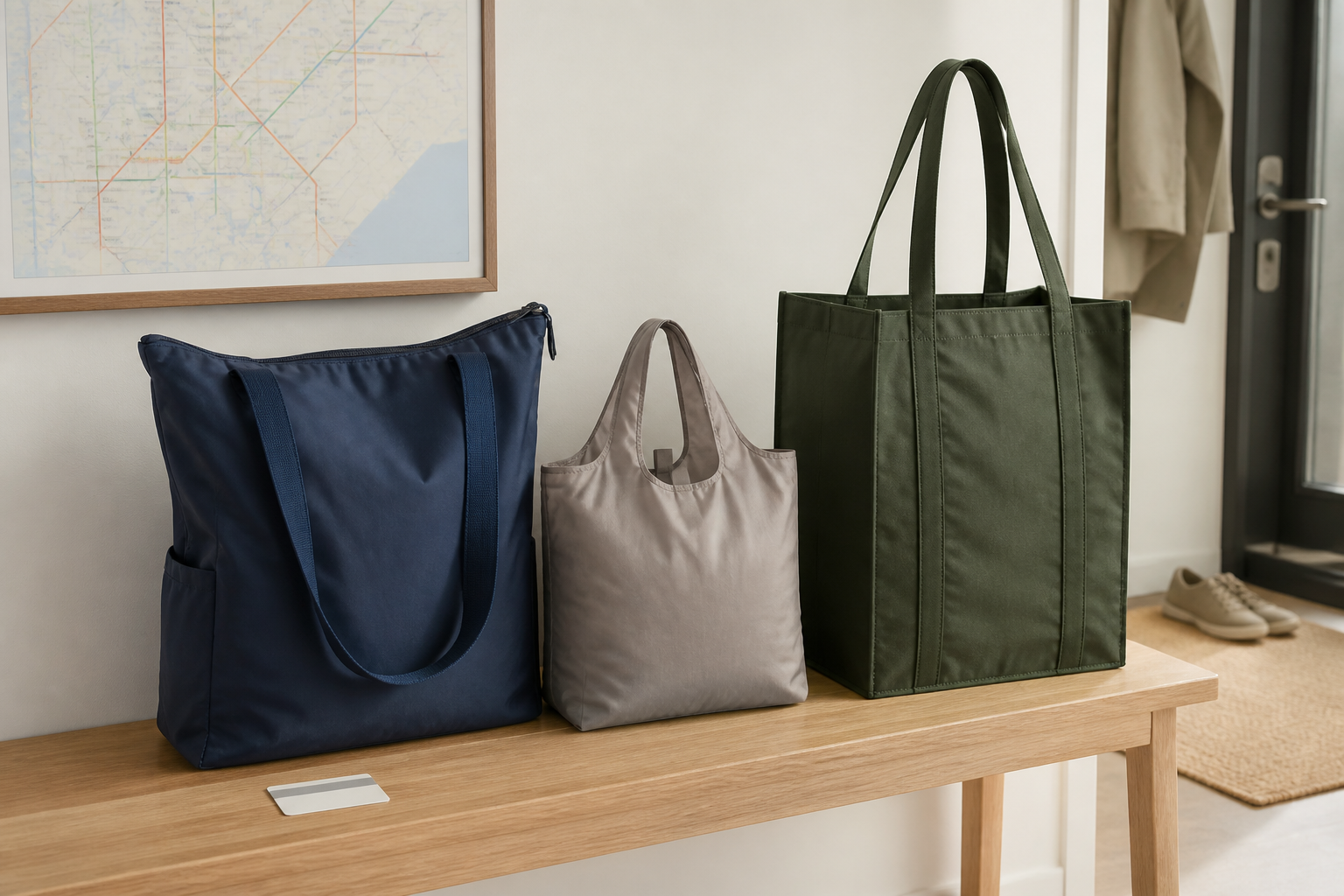
- Zip-top shoulder tote: A long strap and full closure can help keep the load close and contained, but the filled bag may become uncomfortable on one shoulder.
- Structured box bag: A reinforced base can help cartons and containers stay upright, although the bag usually folds less compactly and can be bulky on a crowded vehicle.
- Fold-flat nylon tote: Easy to keep in a day bag for unplanned shopping, but thin handles and an open top may be poor fits for heavier or loose loads.
- Backpack-style grocery bag: Keeps both hands available, but fit, ventilation, closures, and leak containment need the same scrutiny as an everyday backpack.
- Two-handle convertible bag: Short and long handles offer options only when both sets are securely stitched and do not drag or snag when unused.
Selection criteria that matter on transit
- Carry style and handle drop: Check whether the handles fit over the intended clothing and allow the bag to stay controlled while boarding, paying, holding a rail, or moving through a narrow aisle.
- Closure: A zipper, drawcord, or secure flap can contain light packages during stops and turns. Verify the usable opening after the closure is engaged.
- Realistic load: Treat a maker’s load claim as a ceiling, not a target. Groceries still need to be lifted, carried, and controlled for the whole trip.
- Empty weight and folded size: Include the bag itself in the carried load, and check whether it folds into a pocket, day bag, or home storage spot.
- Base and shape: A flat or reinforced base can support upright packing, while a soft bag may conform more easily against the body. Match the shape to the usual purchases.
- Leak containment: Look for a clearly described lining or removable insert, but do not treat “waterproof” as proven beyond the exact maker claim. Separate potentially leaking items.
- Wash care: Verify machine-wash or hand-wash instructions for the complete bag, including coatings, inserts, and closures; “reusable” does not automatically mean machine washable.
- Visibility and snag points: Reflective trim may help in low light, but it does not make a person visible from every direction. Check dangling straps, hooks, and rigid corners that can catch in doors or aisles.
A practical comparison framework
Write down the usual route and grocery load before opening listings. Mark every candidate yes, no, or unclear:
- Can the closed bag hold the usual groceries without relying on its maximum load claim?
- Do the handle length and width fit the intended carry position and clothing?
- Can one hand remain available where the route requires it?
- Will the filled bag fit near the feet or lap without blocking an aisle or seat?
- Does the closure contain light items through braking, turns, and transfers?
- Are the base, seams, and handle attachment clearly shown?
- Are material, lining, and wash instructions stated for the exact model?
- Does the folded bag fit where it will actually be stored or carried empty?
- Are current seller and return terms understandable?
Plan the load, not just the bag
A very large tote can invite a load that is difficult to carry or control. Compare the usual purchase by volume, shape, and weight; keep rigid or leak-prone items upright; and consider two smaller bags only if their combined carry is genuinely easier to manage. Bag capacity does not establish that a particular load is appropriate for a particular person.
If pain, balance, grip, lifting limits, or another health concern changes the carrying decision, generic bag criteria are not enough. A qualified professional familiar with the individual situation can help assess the task.
Who should skip this purchase
Skip a new bag if existing bags already close securely, fit the regular load, and are comfortable to control. Also skip transit-specific totes when grocery delivery, a rolling cart, or smaller shopping trips better solve the actual transport problem.
Avoid listings that omit dimensions, closure details, wash care, or handle construction. Skip body-result marketing too: a reusable grocery bag can organize and carry a shopping load, but it cannot cause weight loss or guarantee a walking habit.
Bottom line
The best reusable grocery bag for a transit trip is the one that keeps a realistic load contained, fits the chosen carry position, leaves enough control for boarding and transfers, and stores easily afterward. Compare handle fit, closure, empty weight, base shape, wash care, and folded size before capacity slogans.