Routine-support buying guide
Best Compact Grocery Carts for Walking Trips to the Store
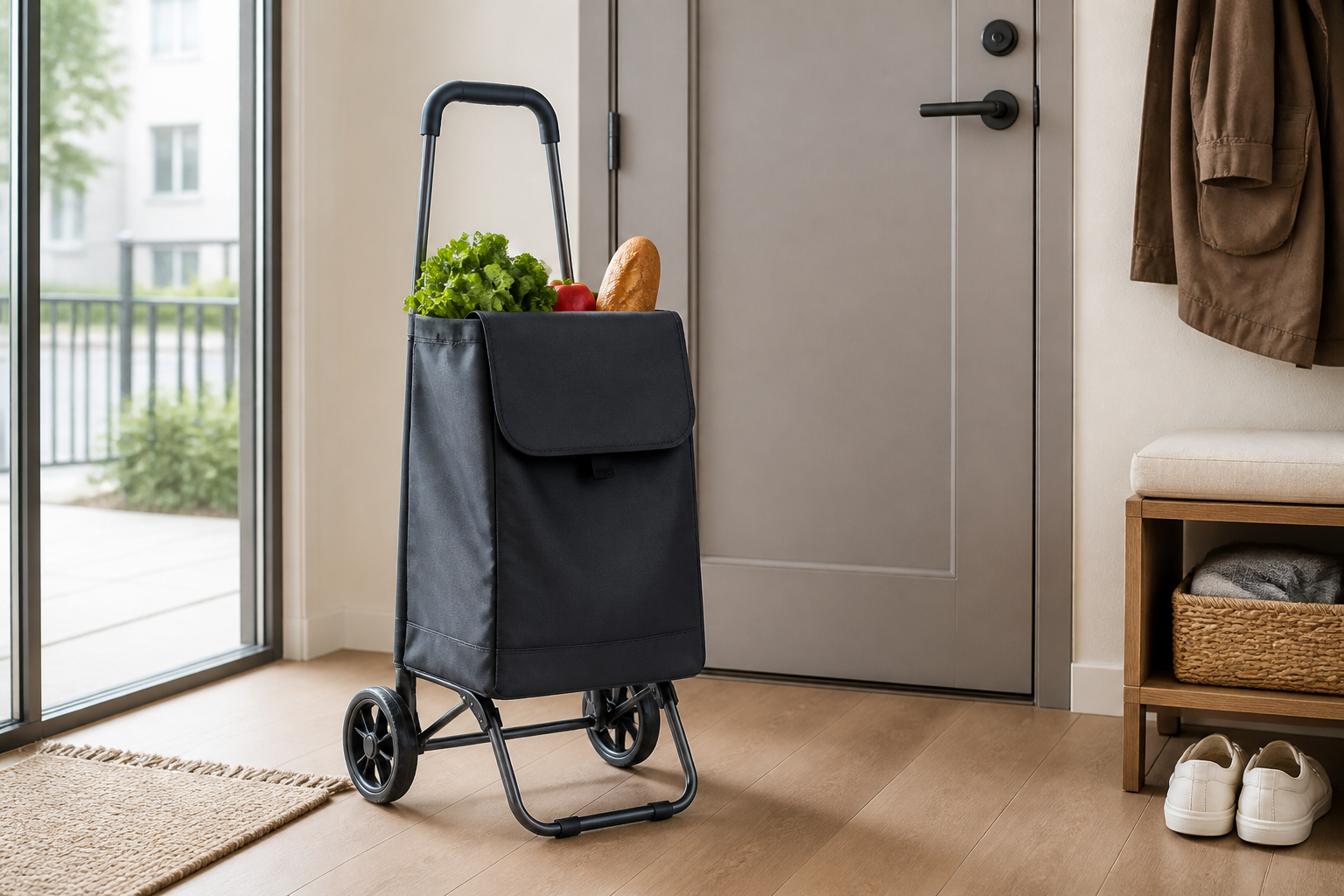
Carrying planned groceries home can be the hardest part of a walking store trip. A compact cart can move the load onto wheels, but the useful choice is not simply the cart with the largest bag. It must fit the route, the shopper, the groceries, and the space where it will be stored.
As an Amazon Associate, GoodWeighFinds earns from qualifying purchases.
Who this guide is for
This guide is for adults who walk to a grocery store and want a wheeled way to bring an ordinary shopping load home. It covers transport and storage fit—not calorie burn, weight-loss results, rehabilitation, or a promise that walking is appropriate for every person or route.
First use the compact grocery cart worth-it check to decide whether ownership fits the route and storage space. Then use the routine-support tools guide for the broader practical framework. If keeping food cool is the main problem, compare insulated grocery bags instead; those solve temperature-management rather than wheeled transport.
Useful cart formats—not ranked winners
GoodWeighFinds did not load-test current carts or verify named-product inventory. These formats organize the tradeoffs without inventing a universal winner:
- Basic two-wheel cart: Usually light and simple, but it must be tilted while moving and may be less stable when parked.
- Four-wheel push cart: Can roll upright on smooth surfaces, although extra wheels and frame parts may increase stored size and weight.
- Stair-climbing wheel cluster: Designed to roll over steps, but it can be heavier and still requires controlled lifting and pulling; a listing label is not proof that it fits a particular staircase.
- Removable-bag frame: Easier to clean or repurpose when the attachment is secure and the bare frame does not have sharp grocery-contact points.
- Very compact folding frame: Useful for tight storage only if the folded latch is secure and the smaller wheels still suit the route.
Selection criteria that matter
- Route surface: Note curbs, cracked pavement, thresholds, gravel, stairs, and transit boarding. Larger wheels often clear small obstacles more easily, but exact fit depends on the full design and load.
- Handle fit: Compare the stated handle height and grip width with a comfortable pulling or pushing position. A fixed handle that is too short can make even a light cart awkward.
- Realistic load: Use the maker’s stated load rating as a ceiling, not a target. The shopper must still control the cart on slopes, turns, curbs, and steps.
- Bag shape and closure: Check volume, opening width, bottom support, closure, interior lining, and whether fragile items can stay upright.
- Empty weight: Include the cart itself when deciding what must be lifted into storage, over a threshold, onto transit, or up steps.
- Folded dimensions: Measure the closet, entryway, or wall gap in all three directions and include protruding wheels or handles.
- Parking stability: Check how the frame rests when stopped and whether loading the open bag could make it tip.
- Cleaning and repair: Look for clear bag-care instructions, accessible wheel axles, replaceable parts, assembly details, and return terms.
A practical comparison framework
Map the route and measure the storage spot before opening product listings. Then mark each cart yes, no, or unclear:
- Does the handle adjust to a comfortable position?
- Do the wheel design and ground clearance match the roughest routine surface?
- Can the empty cart be lifted wherever the route requires lifting?
- Will the bag hold the usual purchase without relying on the maximum load claim?
- Does it remain stable while groceries are loaded and unloaded?
- Do the folded dimensions fit the measured storage space?
- Can the bag and wheel area be cleaned according to clear instructions?
- Are assembly, replacement parts, warranty, and returns understandable?
Stairs, slopes, and mobility need a separate check
A “stair-climbing” label does not remove the effort or balance needed to control a loaded cart. Count the steps, note landings and rail placement, and consider the cart’s empty weight plus the planned load. Do not assume a wheel cluster makes a cart safe for every staircase, curb, hill, or mobility need.
If pain, balance, grip, lifting limits, dizziness, or another health concern affects this decision, the right cart cannot be chosen from generic shopping criteria alone. An appropriate qualified professional can help assess the individual task and route.
Who should skip this purchase
Skip a cart if the route requires more lifting than rolling, the building has no practical storage, an existing backpack or delivery option already solves the load, or product listings omit the measurements needed to check fit. A smaller shopping list or two balanced bags may be simpler for some shoppers, but they are not automatically safer for everyone.
Also skip listings that turn an ordinary transport tool into a fat-loss promise or imply that buying a cart guarantees more walking. A grocery cart can carry groceries; it cannot determine health outcomes or make a route accessible.
Accessories should solve a measured problem
If the cart lacks reachable drink storage, compare clip-on cup holders for walking carts only after measuring the handlebar, bottle, installed clearance, and folded cart. Skip the attachment if it blocks the grip, controls, hinge, doorway clearance, or the cart maker does not allow it.
If the frame is already a good fit but the open bag is awkward on damp trips, compare removable grocery cart liners by exact frame dimensions, closure, attachment, wheel clearance, and care. Do not assume a universal-fit or waterproof claim.
Bottom line
The best compact grocery cart is the one that fits the roughest part of the route, a comfortable handle position, a realistic grocery load, and the measured storage space. Compare wheels, empty weight, folded dimensions, and stability before capacity claims or extra features.