Worth-it decision guide
Is a Compact Grocery Cart Worth It for Car-Free Shopping?
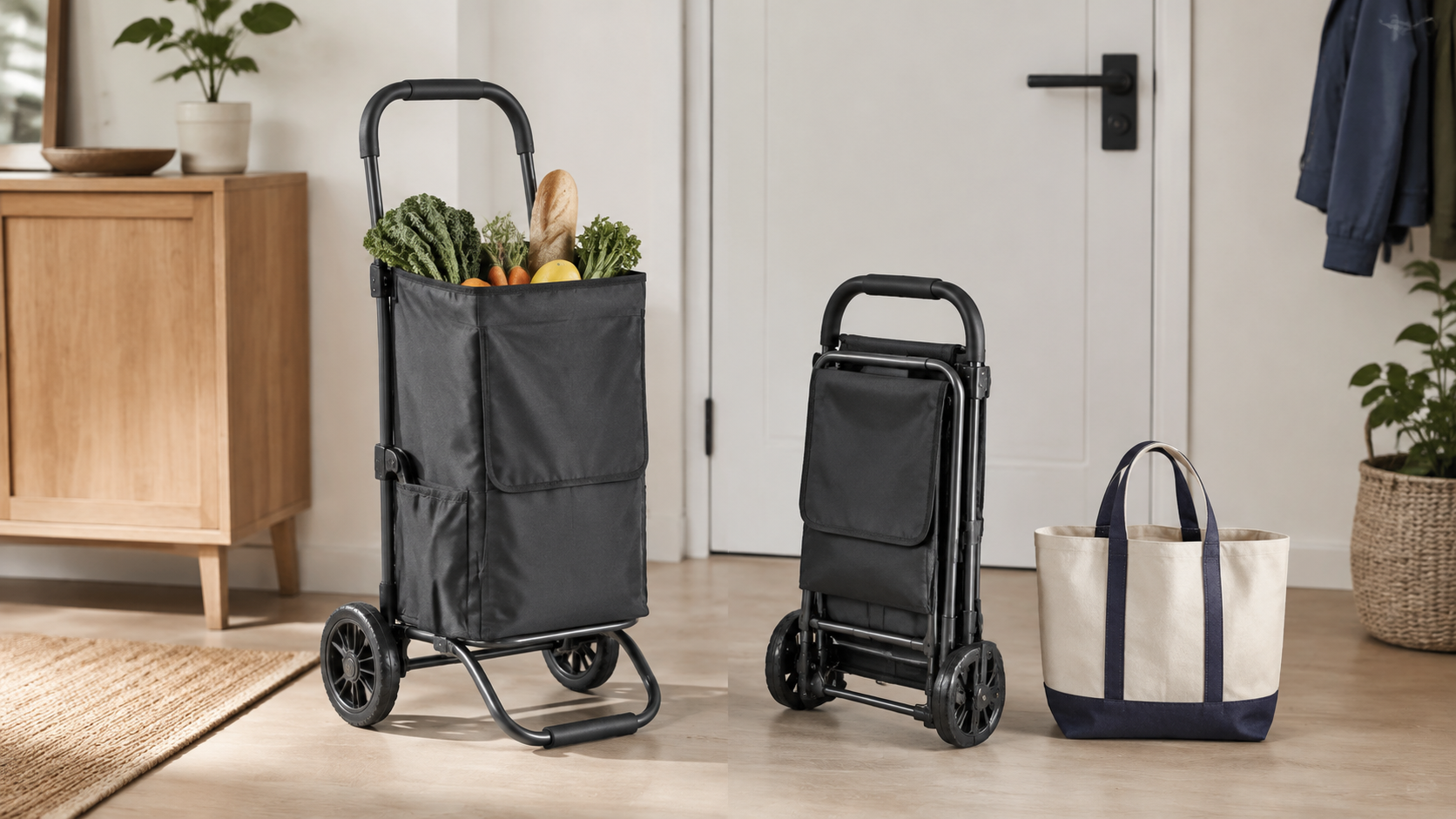
A compact grocery cart can be worth owning when a repeated walking or transit trip turns an ordinary grocery load into an awkward carry. It can also become one more bulky object to lift over steps, steer around curbs, and store at home. Decide from the whole route and a realistic load before comparing cart models.
As an Amazon Associate, GoodWeighFinds earns from qualifying purchases.
Quick verdict
- Buy when the trip happens regularly, most of the route is rollable, the usual load stays manageable, and the folded cart has a measured storage spot.
- Try bags first when loads are modest, the route has frequent stairs, or reusable bags already work.
- Choose delivery or a different trip when the hardest part is lifting, steep terrain, inaccessible transit, or an occasional unusually large shop.
- Delay when you have not measured the route, storage space, and typical load.
- Skip when the cart would need to be carried more often than rolled or the empty cart is already difficult to manage.
Run a one-trip test before buying
On a normal grocery trip, note what you buy, how many bags it fills, and where carrying becomes inconvenient. Count door thresholds, curbs, broken pavement, stairs, slopes, transit boarding, narrow aisles, and the final path to storage. A cart solves only the parts where it can roll and remain controlled.
Use your usual shop rather than an unusually large stock-up trip. A product bought for the largest imaginable load may be too bulky for ordinary trips. If the need appears only a few times a year, delivery, a taxi, or splitting the shop may cost less and occupy no home storage.
When a cart earns its space
- The need repeats: Wheeled transport addresses a recurring friction point.
- The route is mostly rollable: Smooth sections outnumber stairs, tight turns, and required lifts.
- The load is predictable: Usable bag dimensions can be compared with a normal shop.
- Transit allows a stable footprint: The cart can be boarded, positioned, and controlled without blocking movement.
- Storage is assigned: The folded cart fits a measured spot without becoming a trip hazard.
When bags or delivery fit better
Reusable bags may be simpler for light, short trips with frequent lifting. A backpack can keep hands available, while two smaller bags can distribute a modest load, but neither option suits every person. Compare the complete filled setup rather than assuming carrying or pulling is automatically easier. If both formats still seem plausible, use the cart-versus-reusable-bags comparison to check the whole route before choosing.
Delivery can fit infrequent trips, routes dominated by stairs or steep slopes, or trips where a cart would still require difficult transfers. Compare recurring delivery cost with purchase price, storage, maintenance, and likely use. Do not treat either choice as a test of willpower.
Measurements to collect before opening listings
- Typical grocery volume: Measure a representative packed load or the bags you normally fill.
- Storage envelope: Record available height, width, and depth, including room to remove the cart.
- Narrowest route point: Include doors, turnstiles, bus aisles, elevators, and checkout lanes.
- Required lifts: Count steps and thresholds; cart weight is added to the groceries.
- Handle position: A fixed handle must support a comfortable, controlled posture.
- Ground obstacles: Note curb lips, gaps, rough paving, and slopes. Wheel count or a “stair-climbing” label does not prove fit.
What to verify on a current listing
Check open and folded dimensions, empty weight, stated load limit, handle height or range, wheel configuration, bag attachment and closure, parking stance, assembly, cleaning instructions, warranty, replacement-part information, and returns. Treat a load rating as a maker-supplied ceiling—not a comfortable target or proof of control on your route.
Listing photos can hide protruding wheels, handles, and hinges. Reject listings that omit the details needed to check fit. Claims such as “all terrain,” “effortless,” or “stair climbing” cannot account for a particular surface, staircase, load, or user.
Mobility and pain need an individual check
A shopping cart is an ordinary transport tool, not mobility equipment or treatment. It may still require grip, balance, steering, lifting, and control on slopes. If pain, dizziness, balance, grip, lifting limits, or another health concern shapes the decision, generic criteria are not enough; an appropriate qualified professional can help assess the actual task and route.
Choose a format only after deciding yes
If the route, frequency, load, and storage checks support ownership, use the compact grocery cart buying guide to compare formats. If bags remain the better fit, compare reusable grocery bags for public-transit trips. The broader routine-support tools guide keeps the purchase tied to a real routine problem.
Bottom line
A compact grocery cart is worth it when a frequent, mostly rollable car-free route creates a repeat carrying problem and the cart fits the load, transit spaces, required lifts, and home storage. If the route demands more carrying than rolling, or the need is occasional, bags, a smaller shop, delivery, or delaying the purchase may be better.