Wheels or carried bags
Compact Grocery Cart vs Reusable Bags for Car-Free Shopping
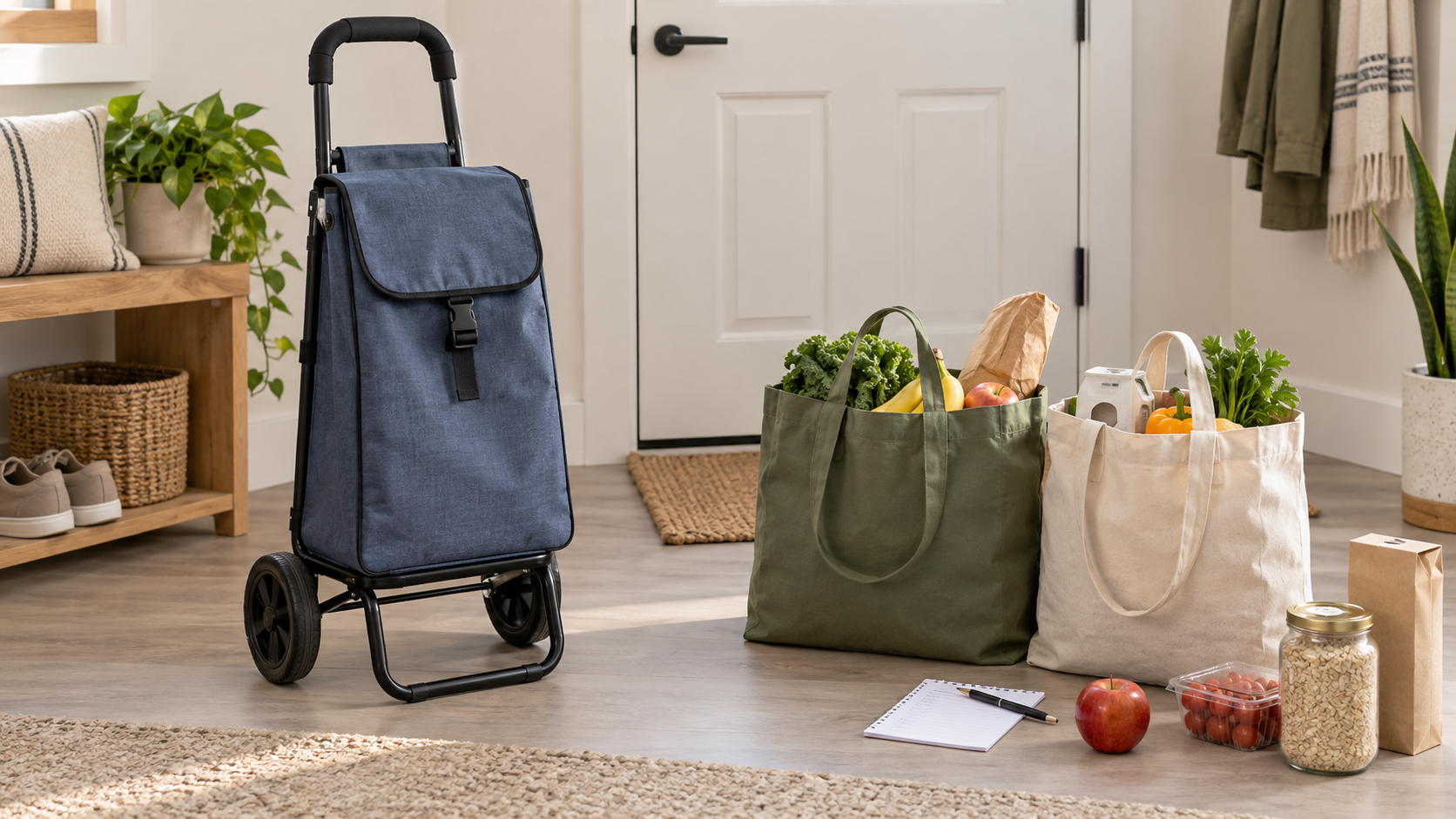
A compact grocery cart can roll a planned load across suitable ground, but it adds empty weight, wheels, storage, and a frame that may need lifting. Reusable bags are simpler to store and carry through frequent transitions, but every filled bag stays in your hands, on a shoulder, or against your body. Choose from the usual shop and the hardest part of the complete route—not the biggest capacity claim.
As an Amazon Associate, GoodWeighFinds earns from qualifying purchases.
The quick comparison
- Compact grocery cart: may fit a regular, mostly rollable trip with a predictable load, few required lifts, enough maneuvering room, and a measured home storage spot.
- Reusable bags: may fit smaller loads, routes with repeated stairs or transfers, and homes where a rigid folded frame would be difficult to store.
- Use both selectively: keep fold-flat bags for light trips and use a cart only for routes and loads that pass a route test.
- Choose neither: split the shop, use delivery, or change transportation when neither format makes the whole trip manageable.
Who a compact grocery cart fits
A cart fits when the repeated trip contains long rollable sections and relatively few points where the frame and groceries must be lifted together. Walk the route before shopping: count steps, curbs, thresholds, narrow turns, rough surfaces, slopes, checkout lanes, elevators, and transit boarding. Check local transit rules if the cart will enter a bus or train.
Measure the cart's open footprint against the narrowest point and its folded dimensions against the actual storage location. Include empty weight when considering every unavoidable lift. A maker's stated load limit is a ceiling under its conditions, not proof that the cart will be easy to steer, stop, lift, or control on a particular route.
Who reusable bags fit
Bags fit when the ordinary load is modest enough to carry through the entire route and the trip involves frequent lifting, folding, or tight transitions. Compare open dimensions, handle drop, closure, empty weight, base shape, seams, material disclosure, and care instructions. A very large bag is not automatically useful if filling it creates a load that is awkward to control.
Test existing bags with a typical shop before buying more. Note whether the handles fit the intended hand, shoulder, or carry position while wearing normal clothing and whether the closed bags fit the space available on transit. Do not infer comfort, load safety, or leak protection from broad listing language.
Tradeoffs that decide the format
- Route surface: wheels matter only on sections where the cart can roll and remain controlled; bags behave more consistently across stairs but must be carried.
- Required lifts: a cart combines its own weight with the groceries at every step, curb, vehicle, or storage transition.
- Usual load: compare a representative shop, not an occasional stock-up trip or a maximum capacity.
- Hands and access: a cart occupies one hand while moving; bags may occupy one or both hands unless their verified design supports another carry position.
- Transit and crowds: compare the complete footprint, turning space, parking stability, and ability to keep aisles and doors clear.
- Home storage: bags may fold into a small space; a cart needs a measured location that includes wheels, handles, and protruding hardware.
Setup and maintenance
For a cart, confirm assembly steps, wheel attachment, handle operation, bag attachment, closure, standing position, and folding sequence before the first loaded trip. Follow the maker's inspection and cleaning directions. Check wheels, fasteners, frame joints, fabric, and closures regularly, and stop using damaged equipment rather than assuming a listed capacity still applies.
For reusable bags, inspect handles, seams, base, lining, and closures before loading. Follow the exact wash and drying instructions; “reusable” does not establish machine-wash compatibility. Keep a realistic number in the departure routine rather than buying a large set that will not be carried.
Skip criteria
- Skip a new cart if existing bags already handle the usual load and route without a recurring problem.
- Skip a cart when it must be lifted or folded more often than rolled, cannot fit the narrowest route point, or lacks a suitable storage spot.
- Skip new bags if current bags have suitable handles, closures, care, and capacity for the ordinary trip.
- Skip oversized bags when the likely filled load would be difficult to control or the route requires a hand for rails, doors, payment, or another task.
- Skip both purchases when splitting the shop, delivery, or a different travel plan solves an occasional problem more directly.
Choose the format, then compare models
If wheels fit the route, use the compact grocery cart guide to compare folded size, wheel layout, handle position, storage, and model-specific claims. If carried bags fit better, use the reusable grocery bag guide to compare handle fit, closure, base shape, care, and folded size. If the ownership decision is still unclear, test it with the compact grocery cart worth-it guide. For the broader buy-or-skip framework, return to the routine-support tools guide.
Bottom line
Choose a compact grocery cart when a recurring load can roll through most of a measured route and the frame's lifting, turning, transit, and storage demands fit. Choose reusable bags when loads are smaller, transitions are frequent, and compact storage matters more than wheels. Test what you already own with an ordinary shop before adding either product.