Routine-support buying guide
Best Grocery Cart Liners for Rainy Walking Trips
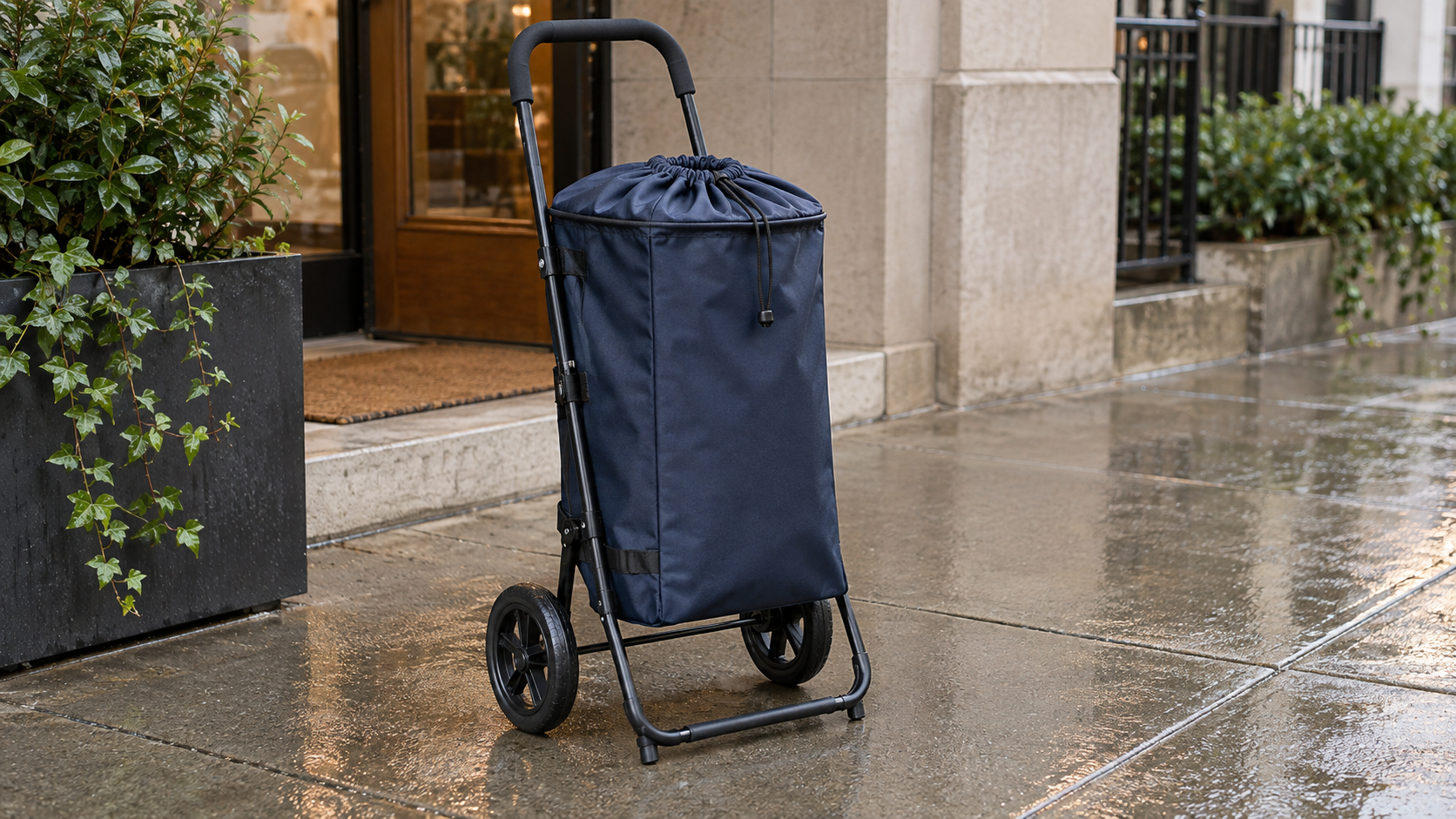
A removable liner can make an open grocery cart easier to close and clean during a damp walk home, but only when it fits the actual frame. Start with measurements and the cart maker’s instructions: a loose universal bag can rub a wheel, drag on the ground, obstruct folding, or leave the top exposed.
As an Amazon Associate, GoodWeighFinds earns from qualifying purchases.
Who this guide is for
This guide is for adults who already own or have chosen a folding grocery cart and need a removable bag or cover for ordinary walking trips in light rain. If the cart itself is still undecided, begin with the compact grocery cart guide. A well-fitted liner can organize and cover a load; it does not make a route accessible, keep food at a safe temperature, or produce a health or weight-loss result.
For the site’s broader buy-less, measure-first approach, use the routine-support tools guide.
Useful liner formats—not ranked winners
The right format depends on the cart frame and the exposure the trip actually creates:
- Drawstring liner: A cord can narrow the opening, but verify whether it closes far enough and whether the cord or toggle stays clear of wheels and hands.
- Flap-top liner: A fabric flap may cover a loaded opening without a cord, though wind, cart height, and underfilled loads can change how it sits.
- Zippered liner: A zipper offers a defined closure when the packed load stays below it; check opening width, corner stress, and whether the zipper can be reached with the cart parked.
- Open liner with separate cover: Separate pieces can be easier to replace, but the cover needs its own retention and storage plan.
- Maker-specific replacement bag: The clearest compatibility information may come from the cart maker, provided the exact model and current instructions match.
Measure the cart before shopping
Remove the existing bag if the maker permits it, then measure the usable frame rather than copying the cart’s overall dimensions. Record the top opening width and depth, usable bag height, bottom support dimensions, distance to each wheel, and location of hinges, hooks, crossbars, and folding latches. Photograph the attachment layout for comparison while shopping.
A liner advertised as “universal” still needs dimension-by-dimension verification. Leave clearance around wheels, axles, brakes, hinges, and the ground throughout a turn and while the cart is tilted. Do not improvise attachments that conflict with the cart maker’s directions.
How to compare rainy-trip details
- Weather wording: Distinguish water-resistant, water-repellent, and waterproof claims. Look for the maker’s stated construction and limitations rather than inferring protection from fabric appearance.
- Top coverage: Check the closure with a realistic load below the stated fill line. A tall item can hold a flap or drawstring open.
- Attachment: Verify the number, position, and method of straps, loops, hooks, or sleeves against the frame.
- Lower clearance: Confirm the loaded liner cannot sag into wheels, axles, the kickstand, or wet pavement.
- Removal: A liner meant for cleanup should detach without dismantling unrelated frame parts or trapping its fasteners.
- Care and drying: Follow stated washing and drying directions. Check whether seams, pockets, stiff panels, and folded hems can be opened enough to dry.
- Visibility: Dark fabric can be difficult to see in low light. If a listing mentions reflective material, treat it as a maker claim and do not assume it replaces route lighting or active visibility gear.
- Stored fit: Measure the liner when folded or rolled and decide where a damp liner can dry before being stored.
What a liner cannot promise
A rain-oriented liner does not automatically make a cart waterproof. Water can enter around the opening, seams, fasteners, abrasion points, or a separate cover, and puddle splash can reach the lower bag. Protect items according to their own requirements and do not use the liner as evidence of food-temperature control.
Likewise, a larger replacement bag does not increase the frame’s stated load limit. Capacity, seam strength, abrasion resistance, colorfastness, and coating life must not be assumed from photos or customer anecdotes.
A practical pre-purchase checklist
- Is the exact cart model or every relevant frame measurement compatible?
- Are all straps and loose closure parts clear of wheels, axles, hinges, and the ground?
- Can the top close over the usual load without overfilling?
- Does the listing state what its weather claim means and identify important limits?
- Can the liner be removed, cleaned, fully dried, and reattached using clear directions?
- Does the cart still fold and park as its maker directs?
- Are seller identity and return terms clear enough to handle a fit failure?
- Would a cover or suitable bag already owned solve the occasional rainy trip?
Who should skip this purchase
Skip a separate liner if rain exposure is rare, the existing cart bag already closes adequately, an umbrella or route change solves the occasional trip, or no listing provides enough compatibility detail. Also skip a liner that needs dangling straps, blocks the fold, reduces wheel clearance, or encourages loading beyond the cart’s stated limit.
If temperature management is the actual problem, a cart liner is the wrong category. Compare an insulated grocery bag for a car-free trip using its own time, carry, cleaning, and storage criteria.
Bottom line
The best grocery cart liner for a rainy walking trip is not the one with the broadest “universal” or “waterproof” wording. It is the removable format whose documented dimensions, attachments, closure, clearance, care, and limitations fit the cart and the route. Measure first, keep loose parts away from moving hardware, and skip the accessory when the existing setup already handles the job.