Routine-support buying guide
Best Reusable Snack Bags for Commutes and Desk Drawers
A reusable snack bag can replace some disposable bags and make small foods easier to carry, but the practical choice depends on closure, dimensions, cleaning, drying, and where the empty bag will live. This guide compares useful formats without treating a smaller bag as portion advice or a weight-loss tool.
As an Amazon Associate, GoodWeighFinds earns from qualifying purchases.
Who this guide is for
This guide is for adults who pack crackers, fruit, sandwiches, or other small foods for a commute, or who keep shelf-stable snacks in a desk drawer. It focuses on flexible reusable storage rather than rigid containers, calorie targets, or prescribed portions.
For the broader low-hype approach to practical planning tools, start with the routine-support tools guide. If crushing or leaks are the main problem, a rigid option from the workday bento-box guide may fit better.
Best-fit formats, not unsupported rankings
- Best format for a shallow desk drawer: A flat bag with a low-bulk closure and published empty dimensions.
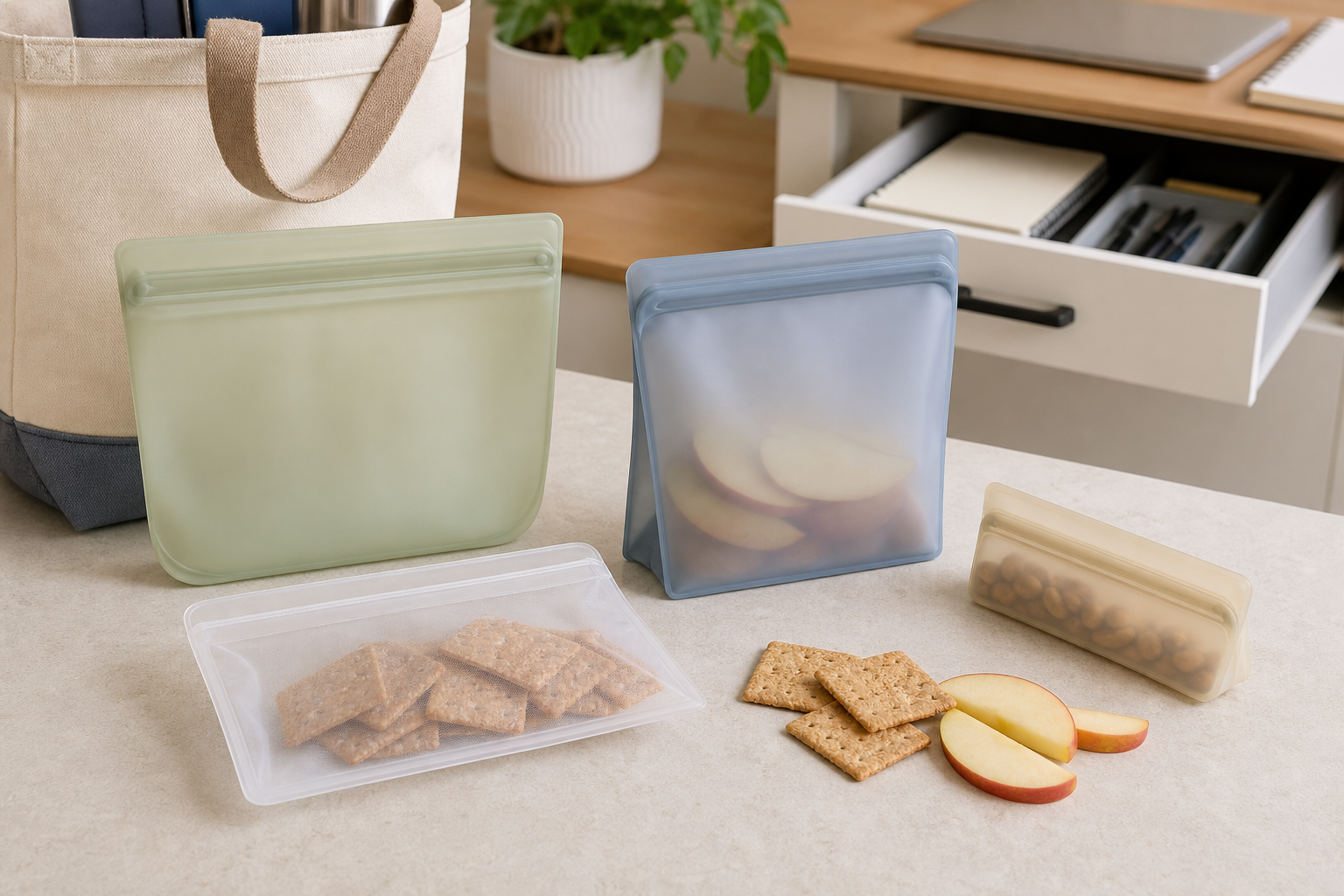
- Best format for easy filling: A stand-up gusseted bag that remains open without being held, provided the base can be cleaned and dried fully.
- Best format for a crowded commute bag: A flexible bag sized to the food, with seams and closure protected from keys or sharp objects.
- Best format for simple visual checks: A translucent bag that makes leftover crumbs and incomplete drying easier to spot.
- Best format for frequent rotation: A small set whose pieces can be washed and dried before the next packing day, rather than a large assortment of unused sizes.
Selection criteria that matter
- Usable dimensions: Compare interior length and width plus closure depth. Exterior measurements alone can overstate capacity.
- Closure design: Press seals, sliders, zippers, and hook-and-loop closures differ in bulk, alignment, crumb collection, and ease of use. Verify how the maker says to close and inspect the bag.
- Material disclosure: Look for a specific material description for every food-contact layer, not just broad wording such as “eco” or “non-toxic.” Treat safety language as a claim to verify rather than proof.
- Cleaning directions: Confirm hand-wash or dishwasher instructions for the exact model, including whether bags must be turned inside out and whether high heat is restricted.
- Drying: Check whether the bag opens widely, stands inverted, or needs a rack. Gussets and closure channels can hold water when airflow is poor.
- Stains and odors: Product promises do not make a material immune to strongly colored, oily, or aromatic foods. Read the maker’s care and replacement guidance.
- Empty storage: Decide whether bags will nest, lie flat, roll, or stand. Measure the drawer or shelf instead of assuming “compact” has a standard meaning.
- Replacement expectations: Inspect closures, seams, peeling layers, punctures, and persistent residue. A reusable product still has a finite service life.
A practical comparison framework
Give each candidate a yes, no, or unclear for these questions:
- Are the material and food-contact surfaces clearly identified?
- Do the usable dimensions fit both the intended food and its place in the commute bag or drawer?
- Can the closure be cleaned along its full channel or seam?
- Can the bag stay open or inverted long enough to dry completely?
- Are dishwasher, microwave, freezer, and temperature claims specific to this exact model?
- Does the empty bag store without stressing the closure or creasing a restricted area?
- Are inspection, replacement, and disposal directions available?
- Would the bag still solve a useful packing problem if it changed no body measurement at all?
Claims and use limits
“Leakproof,” “stain-proof,” “odor-proof,” and “dishwasher safe” are product claims whose conditions matter. A closure that handles dry crackers may not be suitable for liquid, and dishwasher compatibility may depend on rack placement or temperature. Follow the current directions for the exact bag rather than relying on a category-wide assumption.
Reusable snack bags do not keep food safe indefinitely. Storage time, food type, starting temperature, cleanliness, commute conditions, and access to refrigeration all matter. Follow current applicable food-safety guidance for the food being packed. Do not use a damaged, incompletely cleaned, or damp bag when the maker directs replacement.
Who should skip this purchase
Skip reusable bags if an existing washable container already fits, if complete drying is unrealistic in your space, or if the intended food is easily crushed or likely to leak. A rigid container may be the more direct solution for liquids, fragile foods, or a bag shared with sharp objects.
Skip listings that hide material details, provide no useful dimensions, or make sweeping safety and durability promises without care limits. Also skip oversized multipacks until you know which one or two sizes work in your routine.
Bottom line
The best reusable snack bag is one whose size fits the food and storage spot, whose closure is easy to inspect, and whose seams can be washed and dried without fuss. Compare one useful format first, follow the exact care directions, and treat durability and leak language as claims—not guarantees.