Small-sink tool buying guide
Best Roll-Up Dish Drying Racks for Small-Sink Meal Prep
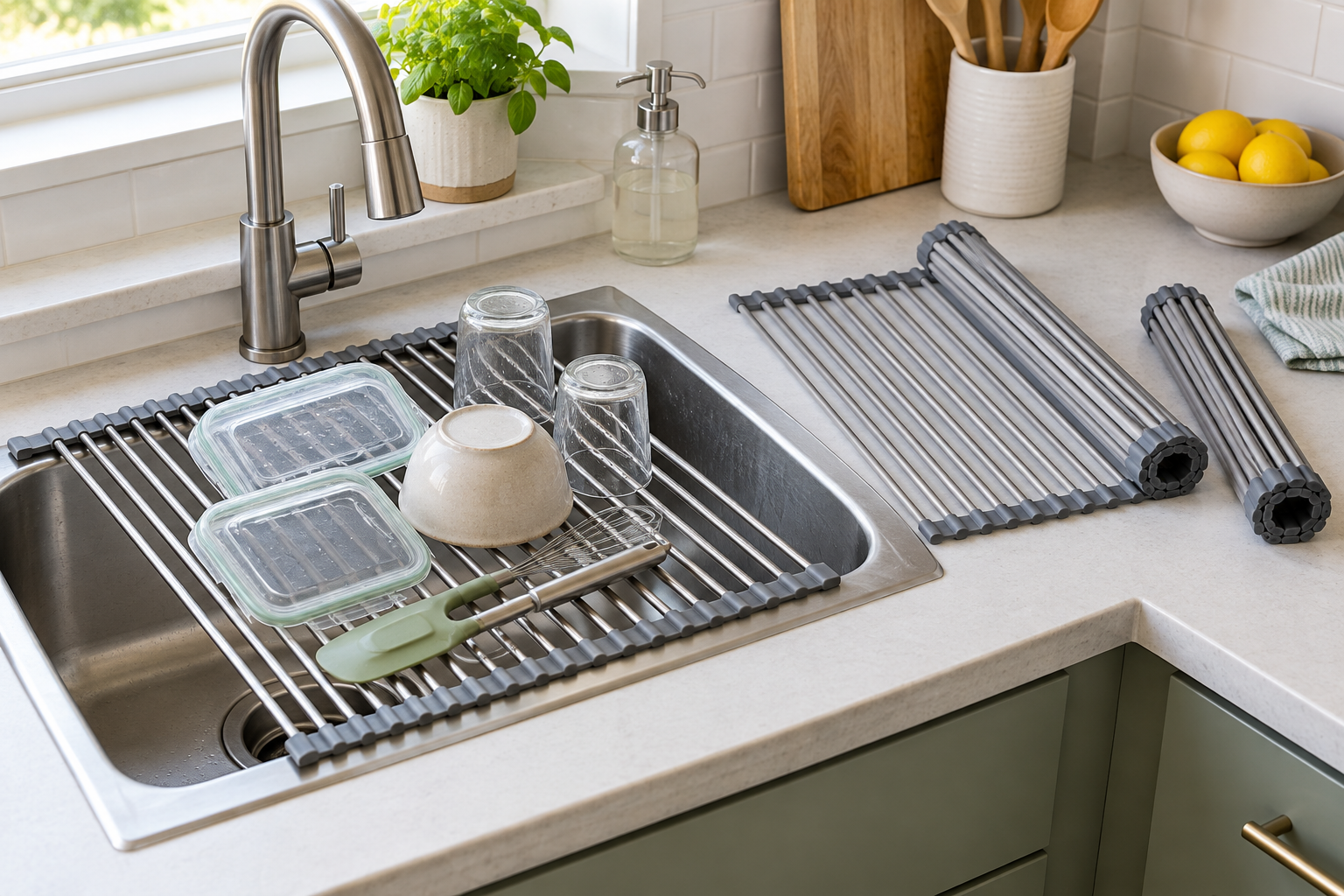
A roll-up rack can turn part of a sink opening into a temporary drying surface, then pack down when the counter is needed again. The useful choice starts with the exact sink span, supported overlap, rod spacing, loaded clearance, cleaning, and a real storage spot—not with “universal fit” or “space-saving” copy.
Who this guide is for
This guide is for adults with limited counter space who repeatedly need a temporary place for a few washed meal-prep tools, container parts, or cups. It covers flexible rod racks that rest across a sink rim and roll for storage. It does not cover freestanding dish racks, sink inserts, cutting boards, or using a drying rack as a trivet.
For broader low-pressure kitchen tools, use the routine-support tools pillar. If the unresolved decision is a flat mat versus an upright rack for loose lids, begin with the dish drying mat versus dish rack comparison.
Useful formats, not universal winners
No current models were purchased, load-tested, or ranked for this guide. These formats organize the fit checks without inventing a winner.
- Narrow rod rack: suits a small basin only when both end bands rest fully on supported rim and the usable width holds the actual items.
- Wide rod rack: offers more surface area but can cover the faucet path, disposal controls, or too much of a divided sink.
- Silicone-coated rods: may change grip and feel, but coating quality, care, temperature, and durability remain model-specific claims.
- Partial-roll use: can leave part of the basin open only when the maker permits it and the remaining rack stays fully supported.
Measure the support, not just the basin
- Sink opening: measure the front-to-back span where the rack will cross.
- Support overlap: compare the complete rack length with the open span and flat rim available at both ends.
- Usable width: subtract end bands and any rolled section, then compare the remaining rods with the normal batch.
- Rod spacing: small lids, utensils, and narrow bottle parts need a span they cannot slip through.
- Loaded clearance: check the faucet, handles, backsplash, neighboring basin, cabinet edge, and access below the rack.
- Storage diameter: measure the rolled bundle and include straps or stiff end bands.
Match the rack to the drying job
A roll-up rack works best for a modest, predictable batch whose pieces sit securely across several rods. It is a poor match for tiny loose parts, unstable tall items, heavy pieces, sharp edges, or anything that blocks access to the sink. Follow each item's own drying instructions rather than assuming open-air placement on a rack is required.
Do not infer a safe load, temperature limit, food-contact use, dishwasher care, rust resistance, or heat protection from appearance. Verify the exact maker wording. Keep hot cookware out of this comparison unless the exact product instructions explicitly support that use.
Cleaning and storage framework
- Can residue be reached between every rod and inside the flexible end bands?
- Do the care directions match the tools and time available?
- Can the rack drain and dry fully before it is rolled?
- Will a damp roll sit against cabinet material or other clean tools?
- Does the stored bundle stay contained without deforming neighboring items?
- Would an existing towel or rack solve the same occasional job?
Claims and listing gaps to reject
Treat “universal,” “non-slip,” “heavy duty,” “rustproof,” “heat resistant,” and “food safe” as exact-product claims that need relevant specifications and instructions. A staged photo spanning a sink does not establish your rim geometry, supported overlap, loaded stability, or safe use.
Skip listings that omit complete dimensions, rod spacing, material description, care instructions, stated-use limits, seller identity, or current return terms.
Who should skip this purchase
Skip a roll-up rack if the sink has little flat rim, rounded or raised edges, an obstructing faucet, controls that would be covered, or no way to keep both ends supported. Also skip it when the normal load is too heavy, too small between rods, too unstable, or large enough that a freestanding rack works better.
A clean towel may be enough for rare batches. A freestanding rack may suit larger loads, and an over-sink cutting board is a different tool when stable prep space—not drying—is the actual job.
Bottom line
The best roll-up drying rack is the simplest one whose complete length and end support fit the measured sink, whose rod spacing holds the actual pieces, and whose cleaning, drying, and rolled storage fit the routine. Reject universal-fit language, test the workflow with what you own, and buy only when temporary sink-spanning space solves a repeated problem.