Meal-prep cleanup comparison
Dish Drying Mat vs Dish Rack for Meal-Prep Container Lids
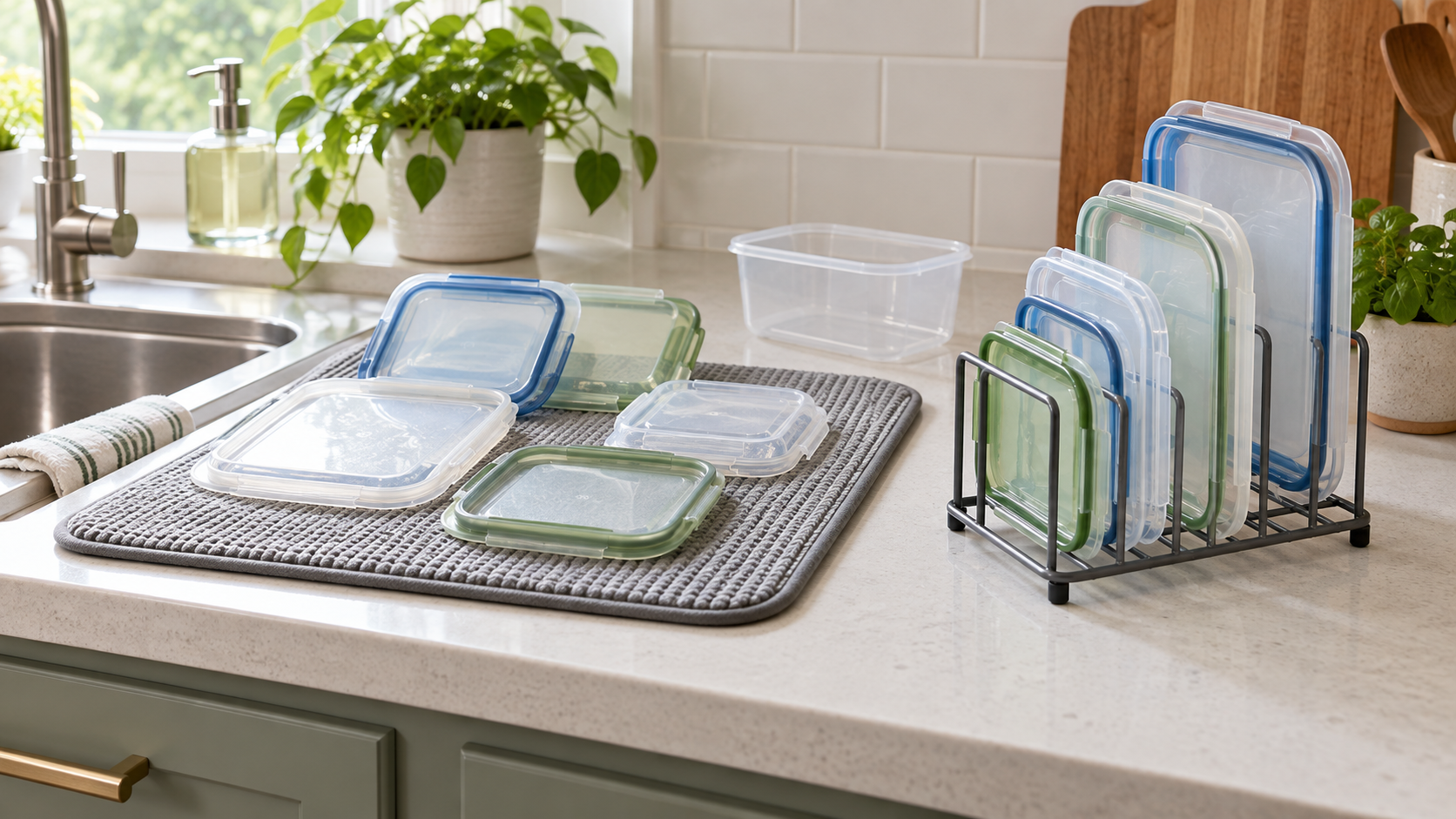
A drying mat offers a broad, low-profile surface that can fold away. An upright rack separates lids in slots and uses counter height. Neither format guarantees faster, cleaner, or safer drying: the better choice fits the actual lid batch, drainage path, counter, cleaning routine, and storage space.
As an Amazon Associate, GoodWeighFinds earns from qualifying purchases.
Quick decision
| Choose a drying mat when… | Choose an upright rack when… |
|---|---|
| The batch varies and needs flexible flat space beside the sink. | Most lids fit measured slots and benefit from upright separation. |
| You can spread lids without stacking and the full mat fits the clear counter. | A smaller base plus the loaded lid height fits under cabinets and away from faucets. |
| The mat can be washed and dried between uses as its maker directs. | The rack, base, joints, and any drain tray are accessible for cleaning. |
| Folded or rolled storage is easier than storing a rigid frame. | A dedicated counter or cabinet location can hold the complete rack. |
Who each option fits
A drying mat fits households with changing batches, mismatched lid shapes, and a counter area that can temporarily become a drying zone. It also suits kitchens where a rigid rack would have no permanent home. The tradeoff is that flat items can trap water when they overlap or rest without spacing, and the mat itself must be cleaned and dried according to its care label.
An upright dish rack fits repeated batches when slot width, spacing, and support match the real lids. Vertical separation can make each piece easier to see, but narrow slots may reject thick rims, clips, valves, or small gaskets. A rack remains a rigid object after the dishes are put away, so its stored footprint matters as much as its counter footprint.
Measure the full setup, not the empty product
Wash an ordinary batch and count the lids by width, height, thickness, and shape. Include removable seals and small pieces only if the container maker says they should be removed for cleaning or drying. Trace the proposed mat or rack base on the counter, then add the space needed to load items without blocking the faucet, soap, outlets, cabinet doors, or the main prep area.
For a rack, compare the narrowest slot opening and usable height with the thickest and tallest lids. Include the rack's feet, drain tray, utensil cup, and any projecting drain spout. For a mat, compare the usable flat area after leaving gaps between pieces; product dimensions do not prove how many lids fit without overlap.
Drainage and placement tradeoffs
A mat may absorb, channel, or simply hold moisture depending on its materials and construction. Confirm the maker's intended orientation, permitted surfaces, and directions for handling moisture. Do not assume that an absorbent surface can remain wet indefinitely or that a grooved mat automatically drains toward the sink.
A rack may use a removable tray, a sloped board, a drain spout, or direct sink placement. Trace where water can actually go when the rack is loaded, including seams and counter edges. “Self-draining” is an exact-product claim, not a category guarantee. Follow the food-container maker's drying and reassembly directions rather than treating either accessory as a sanitation device.
Setup, cleaning, and maintenance
- Mat care: Verify machine-wash, hand-wash, dishwasher, or wipe-clean directions; drying method; and whether folding or rolling is allowed.
- Rack care: Check whether trays, cups, dividers, feet, and drain parts detach and whether narrow joints remain reachable.
- Between uses: Give the mat or rack itself a defined place to dry before storage. A product that stays damp or blocks the sink creates a new task.
- Surface protection: Follow the counter maker's guidance and inspect beneath the setup rather than assuming a backing prevents trapped moisture, marks, or scratches.
- Replacement: Check whether worn mats, drain trays, feet, or other parts are sold separately and whether a specialized size creates a replacement dependency.
- Total storage: Measure the mat in its permitted stored form and the rack with any trays or accessories attached.
Run a no-buy test
Use a clean towel or the dish rack you already own for two ordinary washing batches. Count how many lids need support, note which pieces pool water or fall over, and record how long the temporary setup occupies the counter. The test is about workflow—not drying speed—because room conditions, placement, lid design, and the material beneath them all vary.
If careful spacing on an existing towel solves the job and the towel has a dependable wash-and-dry routine, a dedicated mat may add little. If an existing rack holds the lids without crowding everyday dishes, another rack is probably redundant. Buy only when the test reveals a repeated fit, separation, cleanup, or storage problem that one format clearly addresses.
Who should skip each format
- Skip the mat when lids routinely overlap, the counter cannot stay clear, the material's care routine will be ignored, or there is no place for the mat itself to dry.
- Skip the rack when the real lids do not fit its measured slots, the loaded height blocks cabinets or faucets, small pieces fall through, or the rigid frame has no storage location.
- Skip both when an existing towel or rack handles the normal batch, the listing hides complete dimensions or care directions, or the container maker requires a different drying setup.
- Use a different guide when reusable bottles, straws, and narrow parts—not food-container lids—are the main problem; compare a bottle drying rack with a general dish rack.
Next steps
If a flexible surface wins, compare dish drying mat formats by usable area, construction, backing, edge finish, care, and storage. If an upright rack wins, use the dish-rack buying guide to compare slot spacing, drainage layout, small-part handling, cleaning access, and stored size without relying on rankings. For the wider decision framework, the routine-support tools pillar keeps kitchen purchases tied to a repeated job rather than nutrition or weight-loss promises.
Bottom line
Choose a dish drying mat when a flexible surface fits changing lid batches and you can clean, dry, and store the mat itself. Choose an upright rack when measured slots separate the usual lids and the rigid frame fits both the loaded counter and storage space. Skip a new accessory when careful spacing on a washable towel or rack you already own solves the same problem.