Meal-prep cleanup buying guide
Best Dish Drying Mats for Meal-Prep Container Lids
The best drying mat is not the one with the biggest absorbency claim. It is the smallest washable surface that holds your ordinary lid batch without crowding, fits the clear counter beside the sink, and has a realistic place to dry and store between uses.
As an Amazon Associate, GoodWeighFinds earns from qualifying purchases.
Start after choosing a mat over a rack
This guide is for households that have already decided a flexible, low-profile drying surface fits better than an upright rack. If that choice is still open, first compare a dish drying mat with a dish rack. A mat generally uses more flat counter area while offering easier temporary storage; it does not automatically dry lids faster or more hygienically.
A drying mat is a routine-support accessory, not a weight-loss product. Judge it by workflow, fit, care, and replacement burden—not portion control, discipline, or body-result language.
Three formats worth comparing
| Format | Useful when | Check closely | Main tradeoff |
|---|---|---|---|
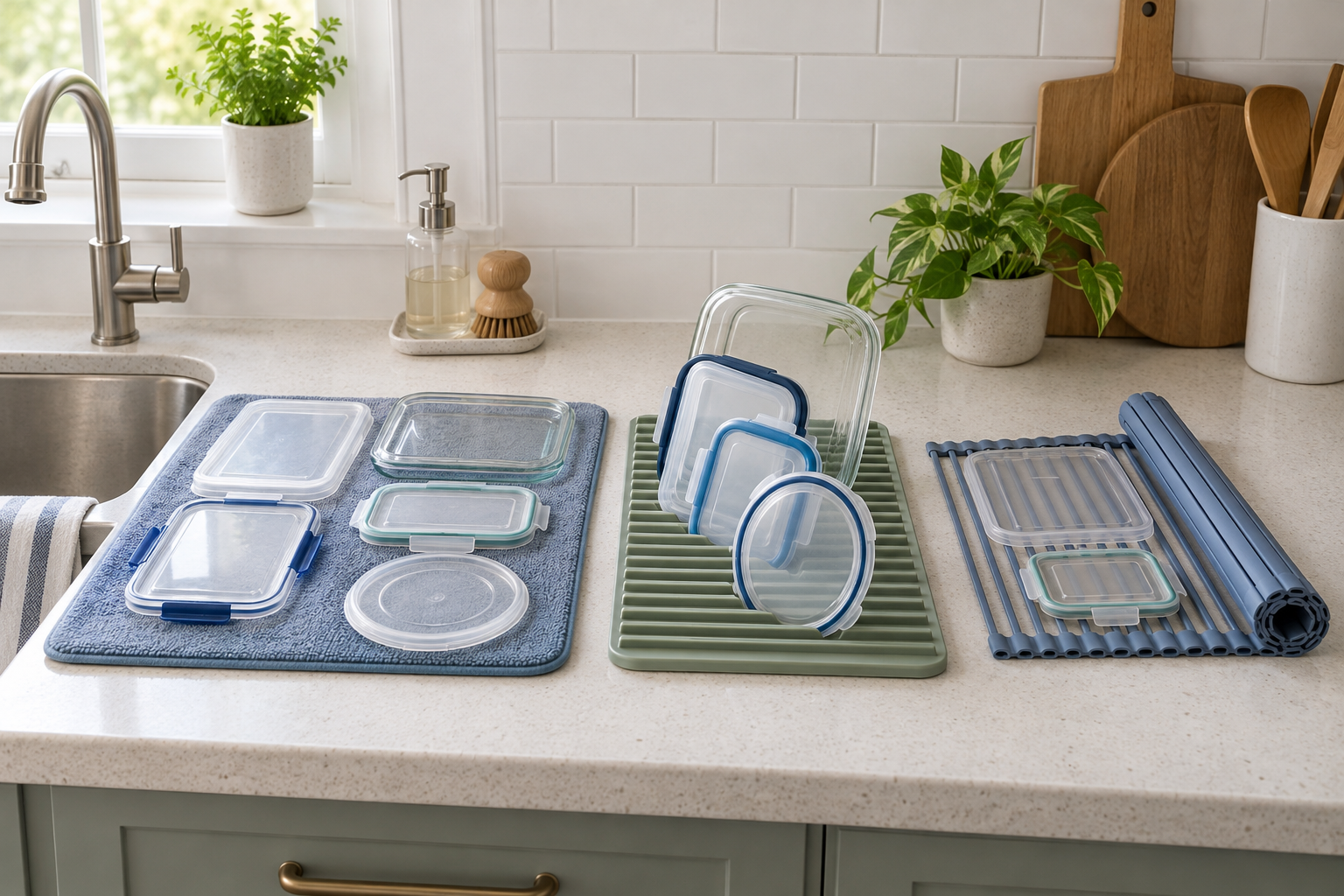
| Woven or microfiber mat | You want a soft, foldable surface for changing batches | Wash method, seams, backing, permitted drying method | The mat can become another textile to wash and fully dry |
| Ribbed silicone mat | You want defined channels and a wipeable molded surface | Rib spacing, slope, edge height, drainage direction, dishwasher label | Grooves and edges still need cleaning; rolling may be restricted |
| Foldable or roll-up surface | Stored size matters as much as the working footprint | Hinges or roll direction, full opened size, care before storage | Joints and rolled layers can add cleanup or drying steps |
Measure the real lid batch first
- Count an ordinary wash: group the lids, seals, clips, and small parts that usually compete for space. Follow each container maker's directions for removing and drying parts.
- Lay them out with gaps: use a clean towel to find the working area the batch needs without stacking. The resulting rectangle is more useful than a seller's dish-count claim.
- Trace the counter limit: keep the faucet, soap, outlets, cabinet doors, counter edge, and main prep zone clear. Measure only the space that can actually become a temporary drying area.
- Include the loaded profile: propped lids and tall clips may extend beyond the mat or interfere with nearby objects even when the mat base fits.
- Measure stored size: confirm whether the maker permits folding or rolling, then identify the exact shelf, drawer, hook, or upright slot where the dry mat will go.
Seven listing details that matter
- Usable dimensions: compare the working surface, not decorative borders, raised edges, drain lips, or packaging dimensions.
- Construction: distinguish textile layers, molded silicone, foam cores, rigid inserts, and attached backing. Material names alone do not establish performance.
- Edge finish: inspect binding, seams, corners, and molded rims because they affect usable area and access for cleaning.
- Backing and surface directions: confirm which side faces down, what counters are permitted, and whether the maker calls for lifting or checking beneath the mat during use.
- Care instructions: look for exact machine-wash, hand-wash, wipe-clean, dishwasher, heat, and drying directions. “Easy clean” is not an instruction.
- Storage method: verify that folding, rolling, hanging, or standing is allowed; do not assume a flexible-looking product can be tightly rolled.
- Seller and returns: make sure the listing identifies the size and variant being shipped and read current return terms before opening or washing it.
Claims that need better evidence
Words such as “super absorbent,” “quick drying,” “antimicrobial,” “non-slip,” “mold resistant,” and “protects every counter” are exact-product claims, not category facts. Look for a defined material, test method, conditions, care limits, and the part of the product covered. A mat that absorbs water still needs its own cleaning and drying routine. A ribbed surface does not prove that water reaches the sink, and a backing claim does not remove the need to follow the counter maker's care guidance.
Do not treat product photography as proof of capacity. Lid shape, clips, rims, removable seals, spacing, placement, room conditions, and the mat's construction all affect the loaded setup. This guide does not make sanitation or food-storage claims; use the container maker's cleaning, drying, and reassembly directions.
Run a no-buy towel test
Use a clean washable towel for two normal lid-washing batches. Mark the smallest area that holds the pieces without overlap, note any edges that hang over, and record whether the temporary surface blocks another task. Then wash and dry the towel using the routine you would realistically use for a mat.
The test does not reproduce a mat's materials, backing, channels, or manufacturer claims. It does reveal the needed dimensions and whether a flexible drying surface solves a repeated problem. If the towel already fits, gets washed reliably, and stores easily, another product may add little.
When to skip each format
- Skip a textile mat if there is no dependable laundry and drying routine or its permitted care conflicts with your setup.
- Skip a silicone mat if its channels cannot drain in the available orientation, its edges are hard to reach, or its stored shape has no home.
- Skip a foldable format if joints create inaccessible cleaning areas or the listing does not clearly state how it should be dried before folding.
- Skip every new mat if lids still have to overlap, the counter cannot remain clear, the full dimensions or care instructions are missing, or an existing towel or rack handles the job.
Next steps
If flat counter area is the bottleneck, compare roll-up over-sink drying racks by measured sink support and rod spacing. If a rigid upright layout is more practical, use the dish-rack buying guide. For the broader no-hype framework, visit the routine-support tools guide.
Bottom line
Choose by measured usable area, construction, backing, edge finish, exact care directions, and stored size. Microfiber can suit a flexible laundry routine, ribbed silicone can suit a molded wipeable surface, and a roll-up format can suit limited storage—but none is a universal winner. The best purchase is the format that fixes a repeated lid-drying bottleneck without creating a larger cleaning or storage problem.