Work-lunch buying guide
Best Salad Containers for Work Without Soggy Ingredients
A useful salad container keeps dressing and wet toppings separate, leaves room to mix, and fits the bag and refrigerator you actually use. Compare those basics before paying for extra compartments or wellness language.
As an Amazon Associate, GoodWeighFinds earns from qualifying purchases.
Who this guide is for
This guide is for adults who carry mixed cold lunches and want greens, dressing, or moist toppings kept apart until mealtime. The container can reduce packing friction and texture problems. It does not make a meal nutritionally appropriate for a particular person or cause weight loss.
For broader low-pressure meal-prep and walking tools, start with the routine-support tools guide. If you pack several small foods rather than one large mixed lunch, compare the bento-box guide instead.
Best-fit types, not unsupported rankings
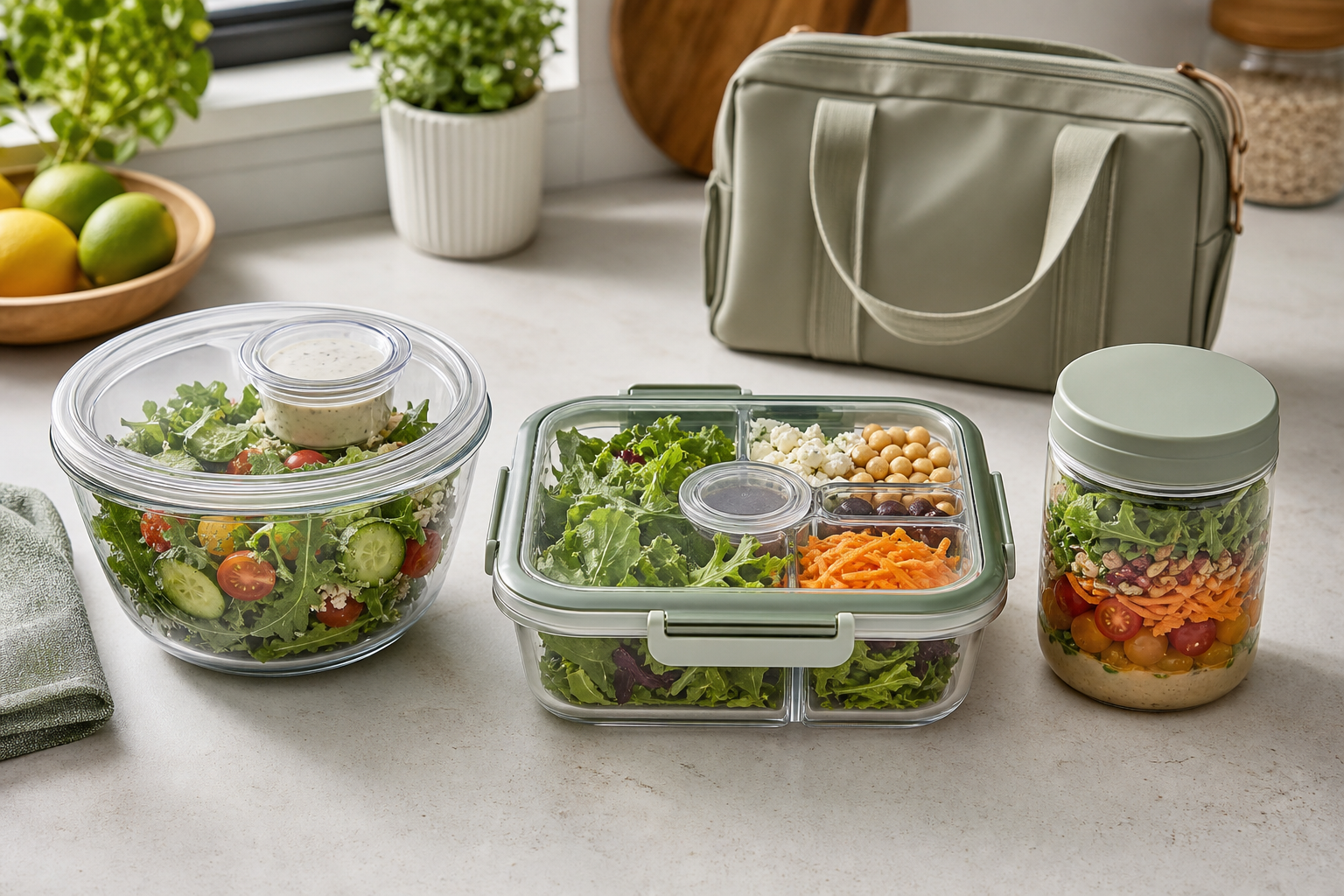
- Best fit for tossing at lunch: A wide bowl with enough empty headroom after it is packed and a genuinely separate dressing cup.
- Best fit for several toppings: A divided tray whose lid is designed to contact each divider, with the seal details verified on the exact model.
- Best fit for a narrow bag: A tall jar-style or compact container, if the opening is wide enough to fill, empty, and clean comfortably.
- Best fit for a shared office refrigerator: A stackable, clearly identifiable container with dimensions that fit the available shelf.
- Best fit for fewer loose parts: A simple bowl, lid, and dressing cup rather than a multi-tier system with pieces that are easy to misplace.
Selection criteria that matter
- Main capacity: Check the stated volume, then look at dimensions. A wide bowl usually gives more mixing room than a narrow container with the same nominal capacity.
- Mixing headroom: A container filled to the lid cannot be tossed easily. Plan for unused space or bring a separate bowl.
- Dressing-cup seal: Verify that the cup has its own secure cap. A cup merely resting in a tray may tip when carried.
- Divider design: Confirm whether the lid seals against the dividers. Open gaps can let small or wet ingredients migrate between sections.
- Overall leak claim: Treat “leakproof” as a product claim, not a guarantee. Check closure style, gasket placement, use instructions, and return terms.
- Carry fit: Compare exterior length, width, and height with the lunch bag. Include ice packs and any upright-only requirement.
- Utensil storage: An included fork is useful only if it is comfortable to use and its compartment does not compromise the lid.
- Cleaning: Count the lid, cup, cap, gaskets, trays, and utensils. Verify dishwasher labels for every piece and check whether seals remove for drying.
- Appliance labels: Confirm refrigerator, freezer, microwave, and dishwasher directions for the exact components; do not infer them from the base material.
- Replacement parts: A replaceable cup, gasket, or lid can matter more than a large set of accessories.
A practical comparison framework
Mark each candidate yes, no, or unclear. Treat unclear specifications as questions for the manufacturer or seller before buying.
- Does the main bowl hold the planned lunch with space left to mix?
- Does the dressing cup close independently and fit the amount you normally carry?
- Do wet toppings remain separated by the lid-and-divider design?
- Does the closed container fit the lunch bag and work refrigerator?
- Can every groove, gasket, and small cup be reached, washed, and dried?
- Are appliance and care directions stated for each part?
- Are the seller, return window, and replacement-part options clear?
- Would a container already at home solve the same problem?
Salad container or bento box?
Choose a salad container when one large mixed dish needs generous bowl space and a separate dressing cup. Choose a bento box when several foods need distinct portions and you do not need to toss them together. A broad bento box may have many compartments but too little depth or headroom for leafy ingredients.
Before buying either, pack the usual ingredients into an existing bowl and measure the filled volume. Then mock up the candidate’s exterior dimensions inside the lunch bag. That simple check is more useful than choosing by the number of accessories.
Who should skip a dedicated salad container
Skip it if a jar, bowl, or food-storage container you already own can keep dressing separate in a small sealed cup. Also skip models with more parts than you are willing to wash, sizes that crowd the office refrigerator, or a tall shape that must travel sideways despite unclear leak performance.
A dedicated container may also be a poor fit if visible meal tracking or food-specific gear adds pressure rather than reducing routine friction. A plain multipurpose container is often cheaper and easier to replace.
Claims and limits to keep straight
A container can separate ingredients and make a packed lunch easier to carry. It cannot preserve food indefinitely, guarantee food safety, control appetite, create a balanced diet, or produce weight loss. Follow workplace refrigeration practices and the container maker’s use instructions rather than “healthy,” “portion-control,” or freshness marketing.
Bottom line
The best salad container for work is the one with enough mixing room, an independently sealed dressing cup, manageable cleaning, and dimensions that fit the full commute. Compare the physical design and current terms; skip unsupported health claims and accessories that do not solve your actual packing problem.