Refrigerator cleanup buying guide
Best Washable Refrigerator Shelf Liners for Meal-Prep Spills
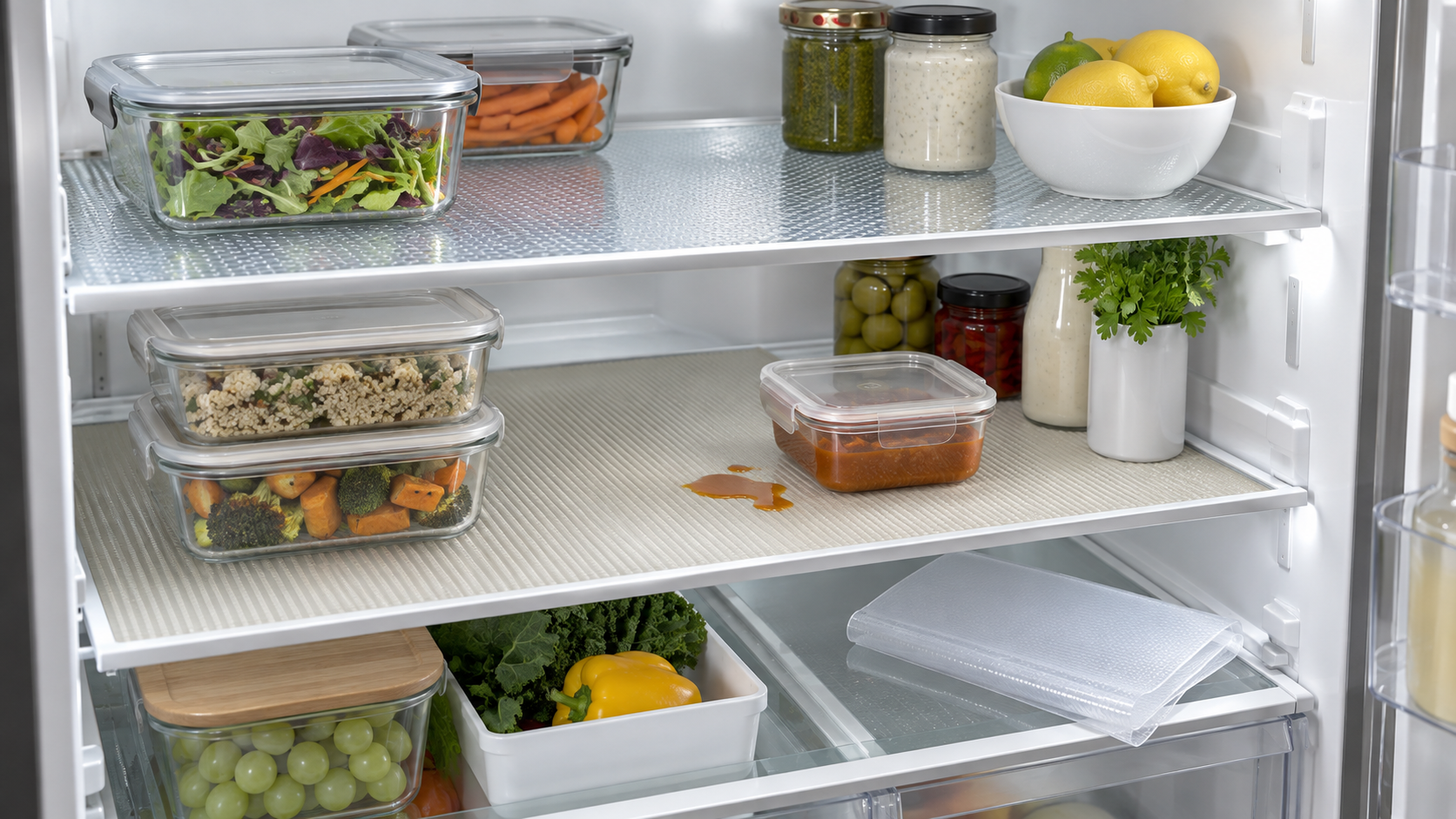
A removable shelf liner can make one recurring drip easier to carry to the sink, but a poor fit can curl, cover vents, hide spills, or complicate cleanup. Measure each refrigerator shelf and test the idea with paper before comparing products.
As an Amazon Associate, GoodWeighFinds earns from qualifying purchases.
Start with the cleanup problem
Identify the one shelf that repeatedly catches residue from meal-prep containers, jars, or opened ingredients. A liner is most defensible when it can be removed without unloading unrelated shelves and when washing the liner is simpler than wiping the glass in place. It is not automatically useful across the whole refrigerator.
This guide covers removable shelf liners, not drawer liners, absorbent pads, or food-storage containers. For access rather than spill cleanup, compare refrigerator turntables or use the broader fridge organizer guide. For lower-pressure routine tools generally, start with the routine-support tools pillar.
Useful formats, not unsupported winners
- Clear smooth sheets: Keep the glass shelf visible, but verify whether the material shifts, reflects glare, or shows trapped moisture.
- Clear textured sheets: Add surface pattern without hiding the shelf; check whether grooves make residue harder to remove.
- Opaque or pale ribbed liners: May make a spill easier to see by contrast, but can also hide the condition of the shelf underneath.
- Precut sets: Reduce trimming only when the listed dimensions match each shelf, including supports and rear housings.
- Roll or trim-to-fit sheets: Suit irregular dimensions only if the maker provides cutting guidance and the cut edges stay manageable.
Seven checks before buying
- Exact shelf dimensions: Measure usable width and depth around shelf frames, supports, lights, vents, and door-bin overlap.
- Refrigerator-use wording: Confirm that the exact item is described for refrigerator shelves. A cabinet or drawer liner is not automatically interchangeable.
- Vent and drainage clearance: Follow the appliance manual and leave required openings exposed. Do not cover a vent, drain, sensor, light, or moving shelf part.
- Edge behavior: Look for current photos and return terms, but treat flat-lay, curl-resistance, and non-slip language as product claims rather than guarantees.
- Visibility: Decide whether clear or opaque material makes it easier to notice residue on that particular shelf.
- Wash and dry directions: Verify hand-wash, machine-wash, dishwasher, temperature, and drying claims for the exact model instead of assuming “washable” explains the method.
- Removal path: A loaded shelf must still allow the liner to slide out without tipping containers or flexing around fixed hardware.
Run a paper-template test first
Cut ordinary paper to the listed dimensions of a candidate sheet. Place it on an empty, dry shelf and mark every obstruction and required opening. Add the usual containers, close the refrigerator door slowly, and check whether the template catches on supports or extends into the door-bin path.
Then practice removing the paper with the normal container load nearby. If removal requires unloading most of the refrigerator, wiping the bare shelf may be the simpler routine. If the paper curls or slides in the test, do not assume a product will correct that without model-specific evidence.
Claims to verify, not assume
- “Antimicrobial” or “antibacterial”: Do not use this as a substitute for cleaning, appliance guidance, or ordinary food-storage practices.
- “Non-slip”: Check the claimed surface, load, temperature, and orientation; do not treat it as a universal performance guarantee.
- “Waterproof”: Verify what the claim covers. A flat sheet without raised edges may not contain a moving spill.
- “Food safe”: Check the exact manufacturer statement and intended use; a shelf liner is not permission to place unpackaged food directly on it.
- “Universal fit”: Ignore the phrase and use your measurements, appliance manual, and a paper template.
- “Easy to clean”: Compare actual wash and drying instructions, texture depth, sheet size, and sink fit.
Who should skip a shelf liner
Skip it when the refrigerator manual discourages shelf coverings, when a liner would cover vents or drainage, or when fixed shelf geometry prevents easy removal. Also skip it when the cleanup problem comes from one leaking container that should be replaced or set in a small removable tray instead.
A liner is also a poor fit when the sheet must be cut into fragile narrow strips, when edges interfere with drawers or door bins, or when the household is unlikely to wash and fully dry it between uses. A bare glass shelf may be the simplest option.
A short buying checklist
- The appliance guidance allows a removable liner in the intended location.
- The measured sheet leaves vents, drains, sensors, lights, and moving parts clear.
- The product is explicitly described for refrigerator use.
- The material and complete wash-and-dry directions are stated.
- The sheet can be removed with a realistic container load nearby.
- Clear or opaque material suits how the household notices spills.
- Trimming instructions and seller return terms are clear.
- A paper template shows that the liner simplifies a recurring cleanup task.
Bottom line
The best washable refrigerator shelf liner is the one that fits a measured shelf, leaves every appliance opening clear, comes out without a complicated unload, and has care directions the household will actually follow. It cannot preserve food, prevent contamination, or fix a leaking container. If a paper template does not make the cleanup routine simpler, skip the liner.