Refrigerator organization buying guide
Best Refrigerator Turntables for Meal-Prep Condiments
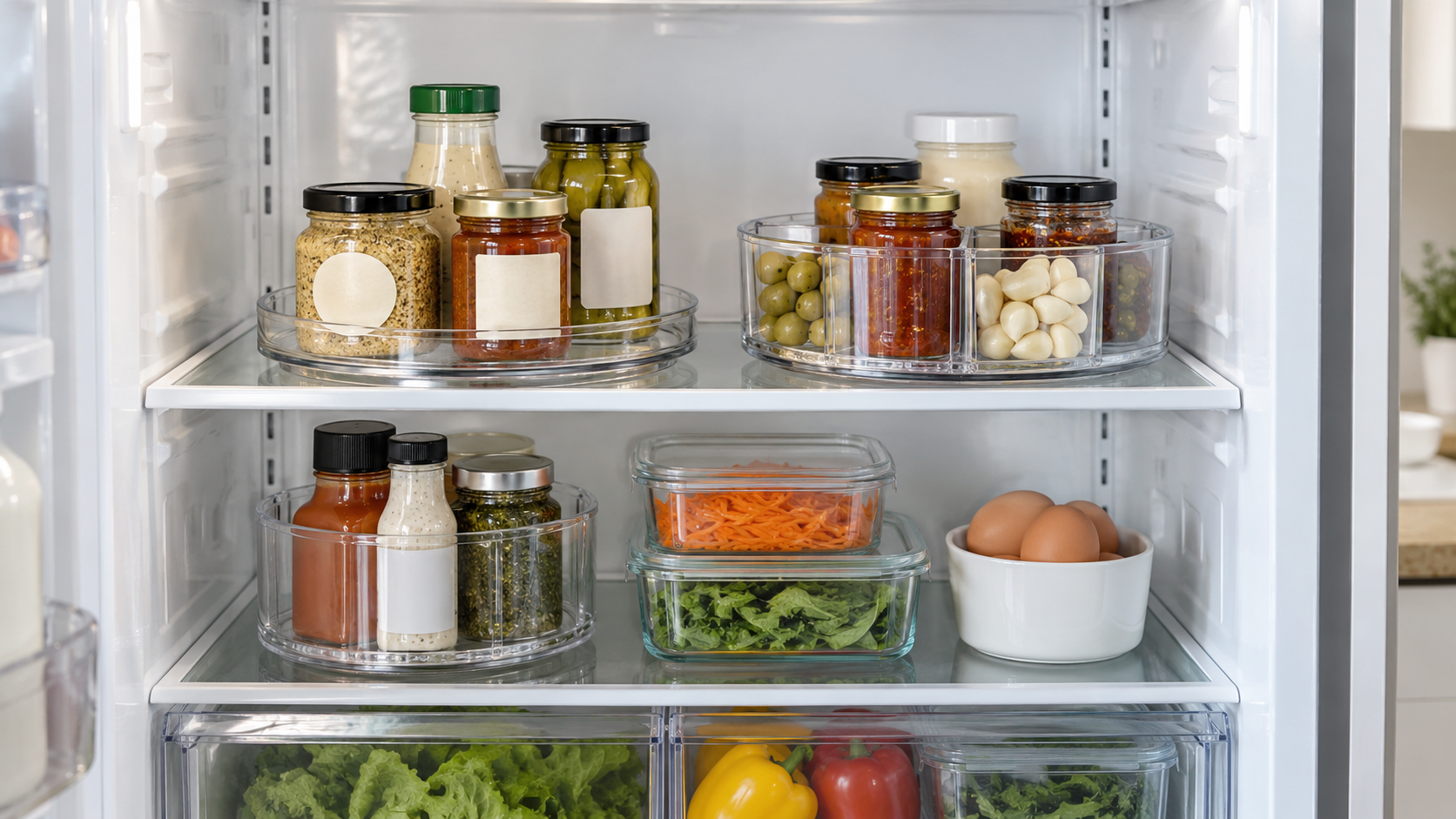
A refrigerator turntable can bring small jars forward without unloading a whole shelf, but only when its full circle fits and the bottles remain easy to lift out. Measure the cold shelf and the containers you actually use before comparing formats.
As an Amazon Associate, GoodWeighFinds earns from qualifying purchases.
Start with the shelf, not a “best” label
The useful question is whether a complete loaded circle improves access on one refrigerator shelf. Measure the shelf width and depth at the narrowest usable points, including door bins, hinges, shelf supports, a rear light housing, and anything that intrudes when the door closes. Then measure the bases and heights of the jars that repeatedly disappear at the back.
This guide is for refrigerated condiments and small jars. For dry pantry staples, use the pantry lazy Susan guide; pantry fit does not establish that a product is labeled or practical for refrigerator use. For broader low-pressure kitchen tools, see the routine-support tools guide.
Best-fit formats, not unsupported winners
- Low rim: Usually the first format to compare when short jars need visible labels and an unobstructed lift-out path.
- Raised rim: Worth comparing for taller narrow bottles, provided the rim leaves labels visible and does not make a full bottle awkward to remove.
- Divided: Can separate a small repeat set, but fixed sections may waste space when jar bases vary.
- Compact single tier: A candidate for a narrow shelf when a common larger diameter would strike the wall or door bin.
- Open, removable insert: Easier to carry to the counter only if the listing describes that use and the loaded shape remains manageable.
Seven measurements and checks that matter
- Outside diameter: Use the complete listed width, then leave enough clearance for an uninterrupted turn. A round organizer does not use rectangular shelf corners.
- Usable inside diameter: Rims, dividers, and center posts reduce the flat area. Compare the actual jar-base layout with the usable surface, not the headline diameter.
- Loaded height: Add the turntable base to the tallest bottle and allow room to lift that bottle over the rim without striking the shelf above.
- Door clearance: Close the refrigerator door slowly with a paper footprint in place. Door bins can overlap shelf space even when the empty shelf measurement looks generous.
- Refrigerator-use wording: Verify that the exact listing or manufacturer information describes refrigerator use. Do not infer temperature suitability from a similar-looking pantry organizer.
- Cleaning access: Condensation and drips make easy removal, a simple surface, and documented wash directions more useful than decorative compartments.
- Return terms: Confirm seller and return conditions before ordering; product photos are poor substitutes for a measured loaded-shelf test.
Run a no-buy paper test first
Cut a paper circle to the candidate’s outside diameter. Set it on the intended shelf, place the usual jars inside its boundary, and slowly rotate the paper by hand. Check every obstruction with the door both open and nearly closed. Mark how much rectangular shelf area the circle leaves unusable.
Next, simulate the organizer height with folded cardboard. Lift the tallest bottle up and over that height. If the shelf above blocks the movement, a turntable may make access worse even though the loaded items technically fit.
How refrigerator and pantry turntables differ
A pantry guide can focus on deep-cabinet reach, dry shelves, and jars or cans that stay at room temperature. A refrigerator adds door-bin overlap, colder material conditions, condensation, drips, and a more frequent removal-and-cleaning cycle. Those constraints make refrigerator-use labeling and a simple washable shape part of the decision. If repeated shelf spills are the real problem, compare removable refrigerator shelf liners instead of buying another organizer.
Do not treat a refrigerator turntable as a food-preservation tool. It can change access and visibility; it cannot make food last longer, establish storage safety, or replace label instructions and normal refrigerator care.
Claims to verify, not assume
- “Non-slip”: Check what surface or feet provide grip and whether the claim applies to a cold glass shelf.
- “Smooth rotation”: Treat this as listing language. Look for return terms in case the mechanism binds under the intended load.
- Material claims: Confirm any statement for the exact model from the manufacturer or current listing; do not extend it into a broad safety conclusion.
- “Dishwasher safe”: Verify whether the whole organizer or only a removable tray is covered, and which rack or temperature limits apply.
- “Fits most refrigerators”: Ignore the generalization and use the measurements of your shelf, door bins, and jars.
- Capacity or load claims: Check whether they describe weight, item count, or merely an illustrated example.
Who should skip a refrigerator turntable
Skip it when the shelf is already shallow and visible, when door bins interrupt the circle, or when a round footprint sacrifices too much usable space. A shallow rectangular bin may work better for packets or a group that needs to move to the counter together. Moving the most-used jars to the front may be enough.
Also skip it when the intended containers are top-heavy, tightly packed, difficult to lift over the rim, or too tall for the shelf above. Avoid placing an overloaded moving organizer where a spill would be difficult to clean.
A short buying checklist
- The outside diameter completes a full turn with the refrigerator door closed.
- The intended jar bases fit within the usable surface.
- The tallest bottle has lift-out clearance above the selected rim.
- The exact item is described for refrigerator use.
- Materials and wash directions are stated rather than inferred.
- The organizer can be removed for cleaning without unloading unrelated items.
- The seller and return terms are clear.
- A paper-circle test shows a real improvement over moving jars forward or using a shallow bin.
Bottom line
The best refrigerator turntable is a measured fit for one recurring condiment-access problem—not the model with the most compartments. Start with outside diameter, usable inside space, loaded height, door clearance, refrigerator-use wording, and cleaning directions. If a paper circle does not improve access, keep the shelf simple and skip the purchase.