Small-pantry buying guide
Best Lazy Susans for Small Pantry Staples
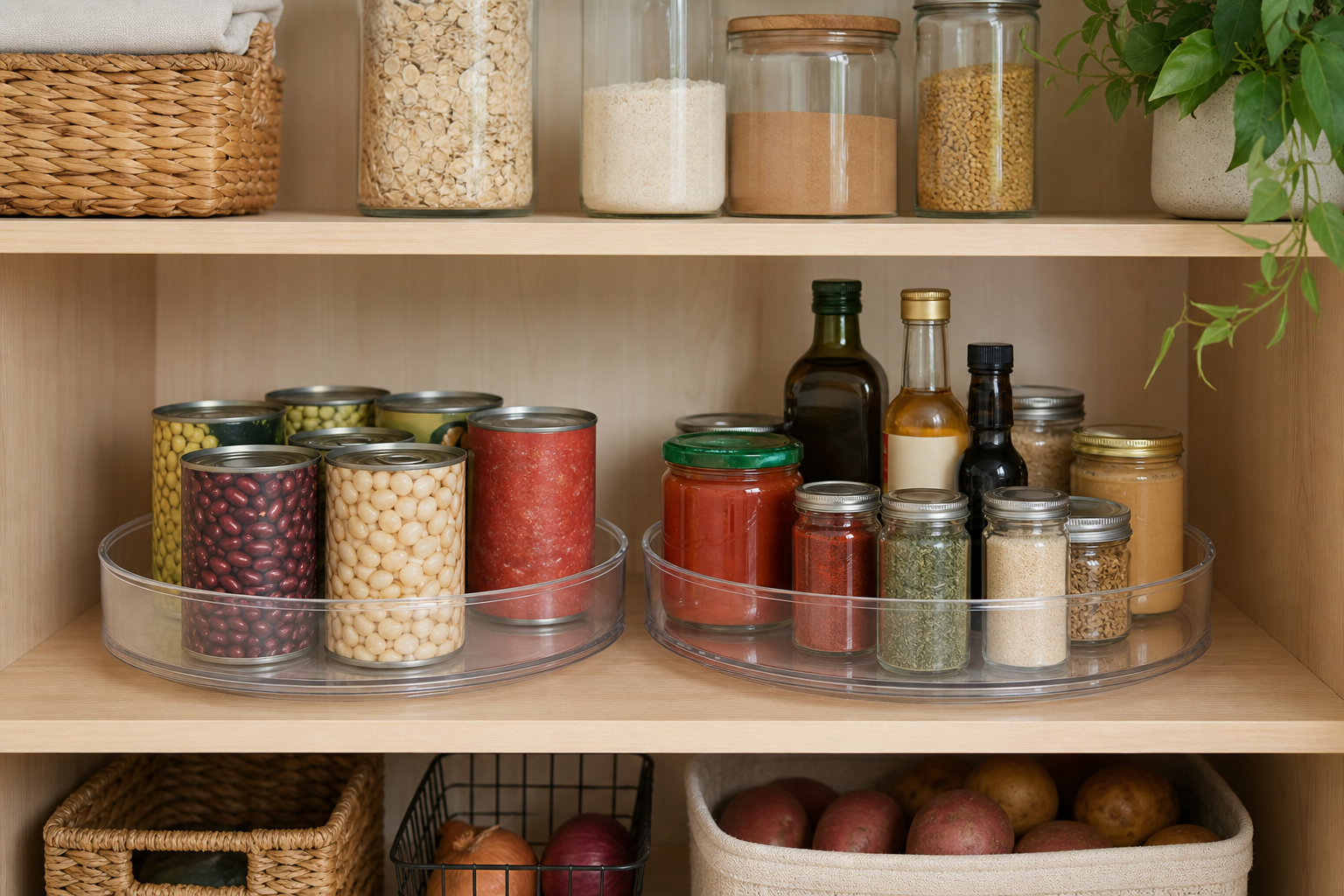
A lazy Susan can bring jars, seasonings, and repeat meal-prep staples out of a deep corner, but the wrong diameter can waste space or jam against a wall. Measure the shelf and the tallest item first, then choose a turntable for that exact access problem.
As an Amazon Associate, GoodWeighFinds earns from qualifying purchases.
Who this guide is for
This guide is for adults who lose sight of jars, spices, oils, cans, or other meal-prep staples at the back of a deep or corner pantry shelf. The product’s job is access and visibility. It does not control portions, improve the food itself, or cause weight loss.
For broader low-pressure kitchen and walking tools, start with the routine-support tools guide. If rectangular packages and packets are the main problem, the pantry-bin guide may fit the shelf better. If the intended location is a cold shelf, use the refrigerator turntable guide for door clearance, refrigerator-use wording, condensation cleanup, and lift-out criteria.
Best-fit types, not unsupported rankings
- Best fit for jars and cans: A clear turntable with a low raised rim, sized so labels remain visible.
- Best fit for a tight cabinet: A compact single-tier model with verified clearance around its full rotation.
- Best fit for tall bottles: A wide, stable base with a grippy surface and enough overhead clearance to lift bottles over the rim.
- Best fit for mixed small items: A divided turntable only when the dividers match the items you actually store.
- Best fit for upper shelves: A lightweight model carrying lighter items; avoid loading hard-to-reach shelves with heavy glass containers.
Selection criteria that matter
- Outside diameter: Measure the shelf at its narrowest point and allow clearance from walls, hinges, trim, and the door.
- Usable surface: The raised rim reduces the flat area. Compare the inside diameter with the bases of the intended jars or bottles.
- Total height: Add the turntable base and rim height to the tallest stored item, then leave room to lift it out.
- Rim design: A rim can keep items aboard during rotation. A tall opaque rim can conceal short containers.
- Rotation: Treat “smooth 360-degree rotation” as a listing claim. Look for a stable bearing design and verify return terms in case it binds under the planned load.
- Grip and stability: Check for a non-slip base and surface, especially on smooth shelves. A turntable should not walk forward as it spins.
- Load guidance: Confirm a stated load limit where available and distribute weight evenly. Heavy jars clustered on one side can make rotation unstable.
- Cleaning: Verify whether the model separates for cleaning and whether it is hand-wash or dishwasher labeled.
- Return terms: Shelf fit can be deceptive in listing photos. Confirm the seller, return window, and return-shipping terms.
A practical comparison framework
Mark each candidate yes, no, or unclear. Treat “unclear” as something to verify before buying rather than an invitation to guess.
- Does the outside diameter fit with clearance through a complete rotation?
- Do the planned containers fit inside the usable surface, not merely inside the listed outside diameter?
- Can the tallest item clear the shelf above when lifted over the rim?
- Will labels and small containers remain visible?
- Is the base stable on the actual shelf material?
- Are rotation, load, material, and cleaning details stated for the exact model?
- Can you test one turntable before buying a multipack?
- Would the tool still solve a real access problem if it had no effect on weight?
Lazy Susan or pantry bin?
Choose a turntable when the problem is reaching bottles or jars at the back and you have enough round clearance to rotate them forward. Choose a bin when rectangular packets, cans, or boxed staples need to be grouped and pulled out together. A deep rectangular shelf can lose usable corners around a round turntable, while a corner cabinet may make rotation especially useful.
Do not buy both by default. Mock up the footprint with paper or cardboard, place the intended staples inside it, and see which movement—rotating or pulling—actually improves access.
Who should skip a pantry turntable
Skip it if the shelf is shallower than the turntable, the door or hinge interrupts the rotation, or rectangular bins use the space more efficiently. Also skip it when items are too tall, heavy, or unstable to rotate safely, or when the existing shelf is already visible and reachable.
A shelf riser, shallow tray, or moving frequently used staples forward may solve the problem for less. On an upper shelf, prioritize comfortable reach and low load rather than adding another moving part.
What a lazy Susan cannot do
A turntable can improve pantry access. It cannot preserve food beyond its storage instructions, make a meal plan medically appropriate, prevent cravings, or produce weight loss. Treat “portion-control organizer,” “healthy eating solution,” and similar body-result language as marketing rather than a product capability.
Bottom line
The best pantry lazy Susan is the one that completes a full turn inside a measured shelf, keeps the planned containers visible, and stays stable under a realistic load. Measure outside diameter, usable surface, and vertical clearance; then try one before buying a matching set.