Meal-prep tool buying guide
Best Wide-Mouth Funnels for Filling Meal-Prep Containers
A wide-mouth kitchen funnel can make a rigid-container opening easier to target, but “wide mouth” is not a standard fit. The useful comparison starts with the destination opening, ingredient size, stem geometry, supported uses, cleaning, and storage—not a promise of spill-free filling.
Who this guide is for
This guide is for adults who repeatedly transfer ordinary dry staples, chopped ingredients, or cooled pourable foods into rigid jars or containers and find the opening difficult to target. It does not cover canning, hot filling, food preservation, or commercial processing. For broader low-pressure kitchen tools, use the routine-support tools pillar.
If flexible freezer bags are the destination, a funnel may not support the bag at all. Compare a freezer bag holder with a wide-mouth funnel before choosing a format.
Useful formats, not universal winners
No funnels were purchased, fit-tested, or ranked for this guide. These formats are starting points for checking current listings against a measured task.
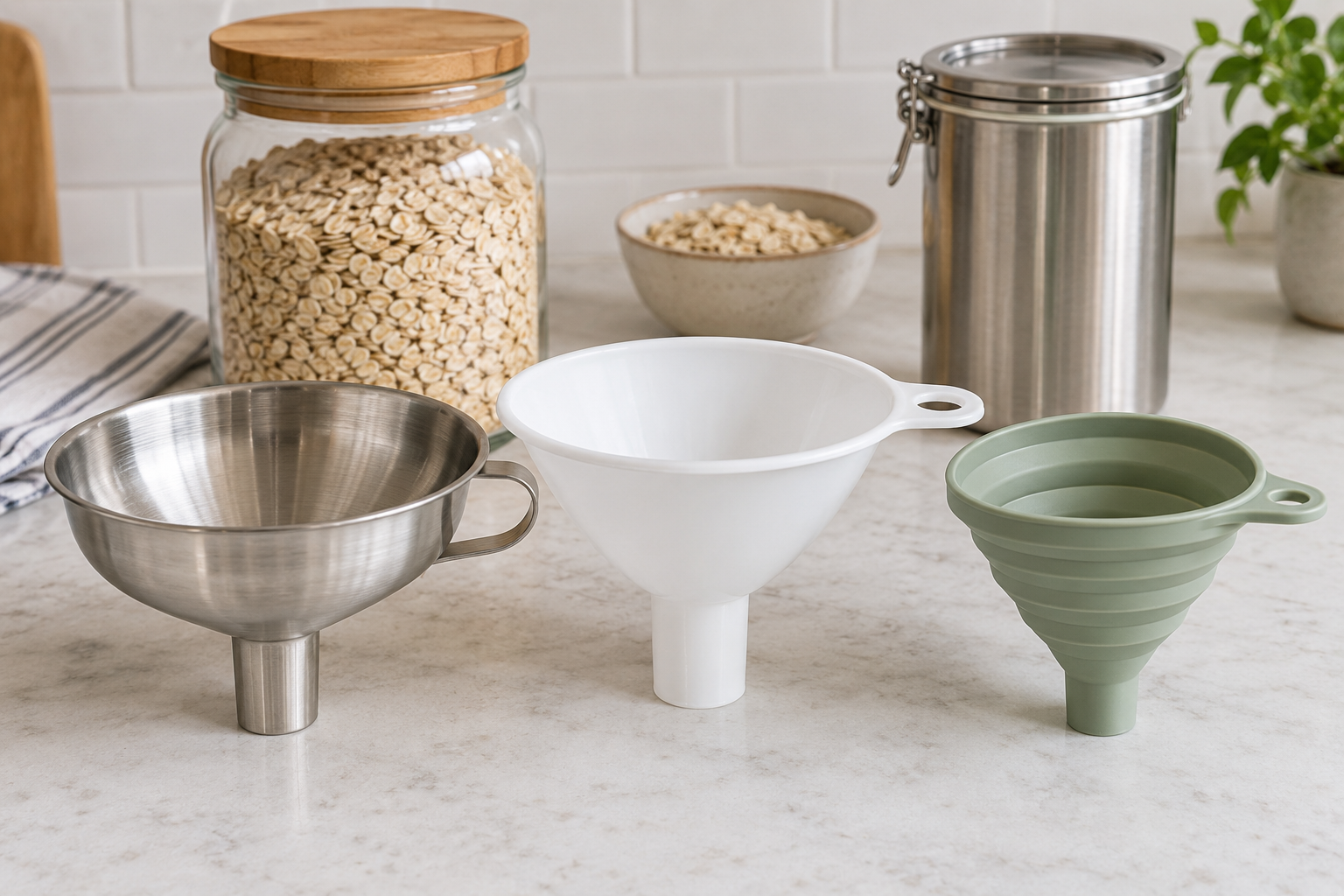
- Rigid stainless-steel format: worth comparing when a fixed shape and plainly stated material matter; confirm seams, edges, handle shape, care, and every supported-use claim.
- Rigid plastic format: often lighter and available in broad shapes; verify the exact material description, intended food use, temperature instructions, and cleaning method rather than inferring them from appearance.
- Collapsible format: reduces stored height, but the expanded shape must remain suitable for the stated use. Check folds, stem shape, care access, and the maker's temperature and material wording.
- Handled format: can provide a place to hold or hang the tool, but the handle can interfere with neighboring containers or drawer fit.
Measure both ends of the funnel
- Container mouth: measure the narrowest inside diameter of the destination opening. The funnel stem needs stated clearance rather than a visual guess from listing photos.
- Stem diameter and length: a stem that is too wide will not enter; one that is too long may sit awkwardly in a shallow vessel or reach the contents too soon.
- Upper opening: compare the usable opening with the scoop, spoon, and ingredient pieces you actually transfer. “Wide” by itself supplies no measurement.
- Support and overlap: check what part of the funnel rests on the vessel and whether it can sit as the maker directs without relying on the handle or an unstable angle.
- Working clearance: include the height of the container plus funnel, cabinet clearance, source bowl, and hand path.
Match the funnel to the transfer
Fine dry staples, larger chopped pieces, and cooled sauces do not behave the same way. Look for a stem and transition wide enough for the intended ingredient, and use only tasks covered by the maker's instructions. A broad upper bowl does not prevent a narrow stem from clogging, and a funnel does not make an unstable container safe to fill.
Do not infer hot-food, dishwasher, microwave, freezer, canning, or food-contact suitability from material appearance. Those are model-specific labels or instructions to verify. For preservation or canning, use the process-specific equipment and current authoritative directions rather than this general meal-prep guide.
Cleaning and storage checks
- Can a brush or hand reach the stem transition, seams, folds, rolled edges, and handle joint?
- Does the maker clearly state hand-wash or dishwasher instructions for the exact model?
- Can every surface drain and dry before the funnel is folded or put away?
- Does the full rigid shape, projecting handle, or collapsed profile fit the storage spot?
- Would a funnel already in the kitchen do the same job after its fit and instructions are checked?
Claims and listing gaps to reject
Treat “universal fit,” “spill-proof,” “clog-free,” “food safe,” “heat resistant,” and “indestructible” as claims requiring precise, relevant support for the exact product. Photos with jars do not establish the mouth dimensions, and customer anecdotes do not prove compatibility with your containers or ingredients.
Skip a listing when the dimensions are incomplete, the material or intended use is unclear, care instructions are missing, or the seller and return route cannot be identified. A cheap funnel that does not fit is still wasted storage.
Who should skip this purchase
Skip a new funnel if transfers are rare, an existing scoop or pitcher works without creating a cleanup problem, or the destination is usually a flexible bag. Also skip when the funnel would need to balance on an incompatible opening, when the ingredient pieces cannot pass through the stated stem, or when the tool's supported temperatures and uses do not match the task.
Bottom line
The best wide-mouth funnel is the simplest format whose measured stem fits the destination, whose upper opening suits the actual ingredient and transfer tool, and whose stated use and care instructions match the routine. Measure first, reject vague listings, and buy only when the repeated task is annoying enough to justify another tool.