Meal-prep tool comparison
Freezer Bag Holder vs Wide-Mouth Funnel for Filling Portions
Choose a freezer bag holder when the recurring problem is keeping a flexible bag open and upright. Choose a wide-mouth funnel when the destination is a compatible rigid jar or container and the recurring problem is guiding ingredients through its opening. Neither tool controls portions, prevents spills, or improves a meal routine by itself.
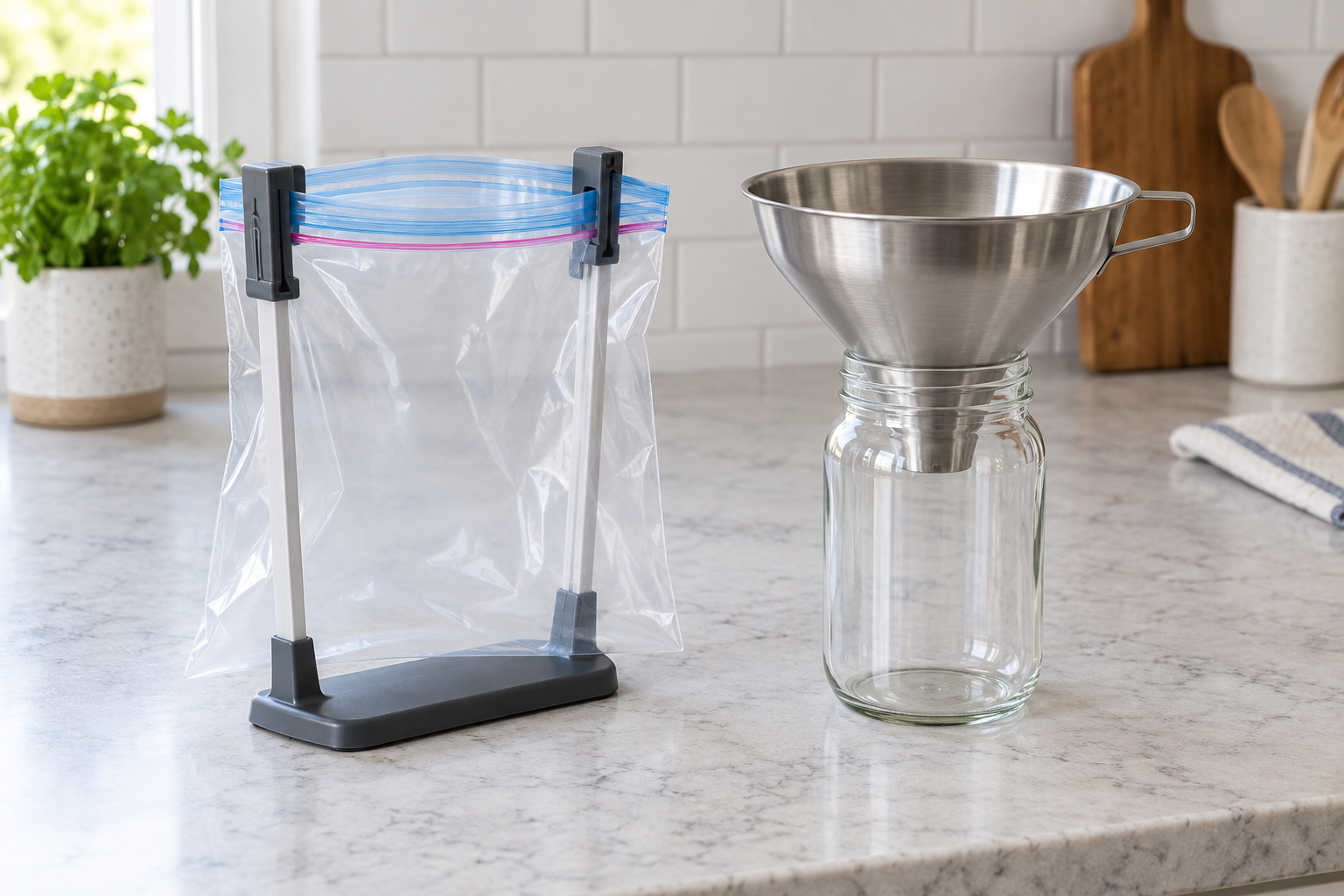
The short answer
| Decision | Freezer bag holder | Wide-mouth funnel |
|---|---|---|
| Best fit | Holding a compatible flexible bag open and upright | Guiding compatible ingredients into a rigid jar or container |
| Main advantage | Supports the bag without continuously holding its rim | Creates a broader target above a narrower rigid opening |
| Main constraint | Clip spacing, usable height, and base footprint | Upper opening, stem diameter and length, and vessel stability |
| Skip when | The bag, counter, or clips do not fit | The ingredients or vessel opening do not fit the funnel |
Who a freezer bag holder fits
A holder stand fits a repeat workflow built around flexible storage bags. The arms or clips must reach the actual bag rim while the base remains fully supported on the counter. Adjustable height can be useful only when its listed range matches the bags you already own and leaves enough room to add and remove them.
Measure clip-to-clip spacing, usable height, open footprint, and folded size. Treat “hands-free,” “universal,” and “spill-free” as seller claims rather than guarantees. Clip pressure, bag seams, counter bumps, and an uneven load can all change the real setup.
Who a wide-mouth funnel fits
A wide-mouth funnel fits a rigid-vessel workflow. It can broaden the target above a jar or container, but the lower stem must fit inside the opening without wedging, and its length must not leave an awkward obstruction inside a shallow vessel. The vessel itself still needs a stable base.
Measure the funnel's upper opening, narrowest stem diameter, stem length, and complete outside dimensions. Compare those numbers with the container mouth and the size or flow of what you transfer. This article does not cover canning, hot filling, or food-preservation processes; follow the food, vessel, and tool makers' directions for those tasks. If this format fits the job, use the wide-mouth funnel buying guide to compare rigid metal, rigid plastic, and collapsible formats.
Setup and transfer tradeoffs
- Bag holder: setup includes unfolding or extending the stand, attaching the bag evenly, checking base clearance, and releasing the filled bag without catching or tipping it.
- Funnel: setup includes seating the funnel on a stable compatible vessel, keeping the stem clear, and choosing a transfer tool and ingredient size that fit the opening.
- Both: reserve counter room for the source container, destination, scoop or spoon, and a safe route between them. A smaller stored tool is not automatically the less awkward working setup.
Cleaning and maintenance
A bag holder may expose clips, hinges, telescoping arms, and the base to drips. Check whether those areas are accessible and whether the maker permits immersion or dishwasher cleaning. A funnel has fewer moving parts, but its stem transition and rolled edges may need direct inspection and thorough drying.
Material appearance does not prove temperature suitability, dishwasher compatibility, stain resistance, or food-contact use. Verify the exact current product's labels and care directions. Retire either tool if a damaged clip, unstable base, cracked surface, sharp edge, or loose joint makes the intended setup unreliable.
Storage and cost
Compare the complete stored shape, not a staged listing photo. A folding holder may still have projecting clips or a wide base. A funnel may nest with bowls or jars, but its handle and stem can prevent a tidy fit. Include replacement likelihood, return shipping, and cleaning time alongside the purchase price.
If one format serves only an occasional task already handled by a stable container or existing funnel, the simplest choice may be to buy neither. A low price does not make redundant storage free.
When to skip the freezer bag holder
- Your usual destination is a rigid jar or container rather than a flexible bag.
- The seller does not provide enough clip spacing, height, base, material, care, or return information to check fit.
- The stand crowds the filling area or does not sit fully supported on the available counter.
- A stable bowl or cup already supports the bag adequately without an improvised or unsafe setup.
When to skip the wide-mouth funnel
- The destination is a flexible bag that needs its rim held open.
- The stem diameter or length does not match the vessel opening and depth.
- The ingredient pieces do not move through the narrowest part without repeated clearing.
- The maker's material, temperature, food-contact, or care information does not cover the intended use.
A no-buy workflow test
For one ordinary week, record the source, destination, ingredient form, batch size, and point where the transfer becomes awkward. Measure the bag opening or rigid vessel mouth, available counter area, and storage. Do not improvise unsupported hot filling, canning, or preservation methods; the test is for workflow and geometry only.
Next steps
If flexible bags are the clear destination, first decide whether a freezer bag holder solves a frequent enough problem, then compare holder formats in the freezer bag holder guide. If you need longer freezer storage rather than a filling aid, compare meal-prep and freezer containers by workflow. For the broader buy-or-skip framework, use the routine-support tools guide.
Bottom line
A freezer bag holder supports a compatible flexible bag; a wide-mouth funnel guides compatible ingredients into a rigid vessel. Choose by the destination and measured transfer path, include cleanup and storage, and skip both when an existing setup already handles the task without meaningful friction.