Buy, delay, or skip
Is a Freezer Bag Holder Stand Worth It for Meal Prep?
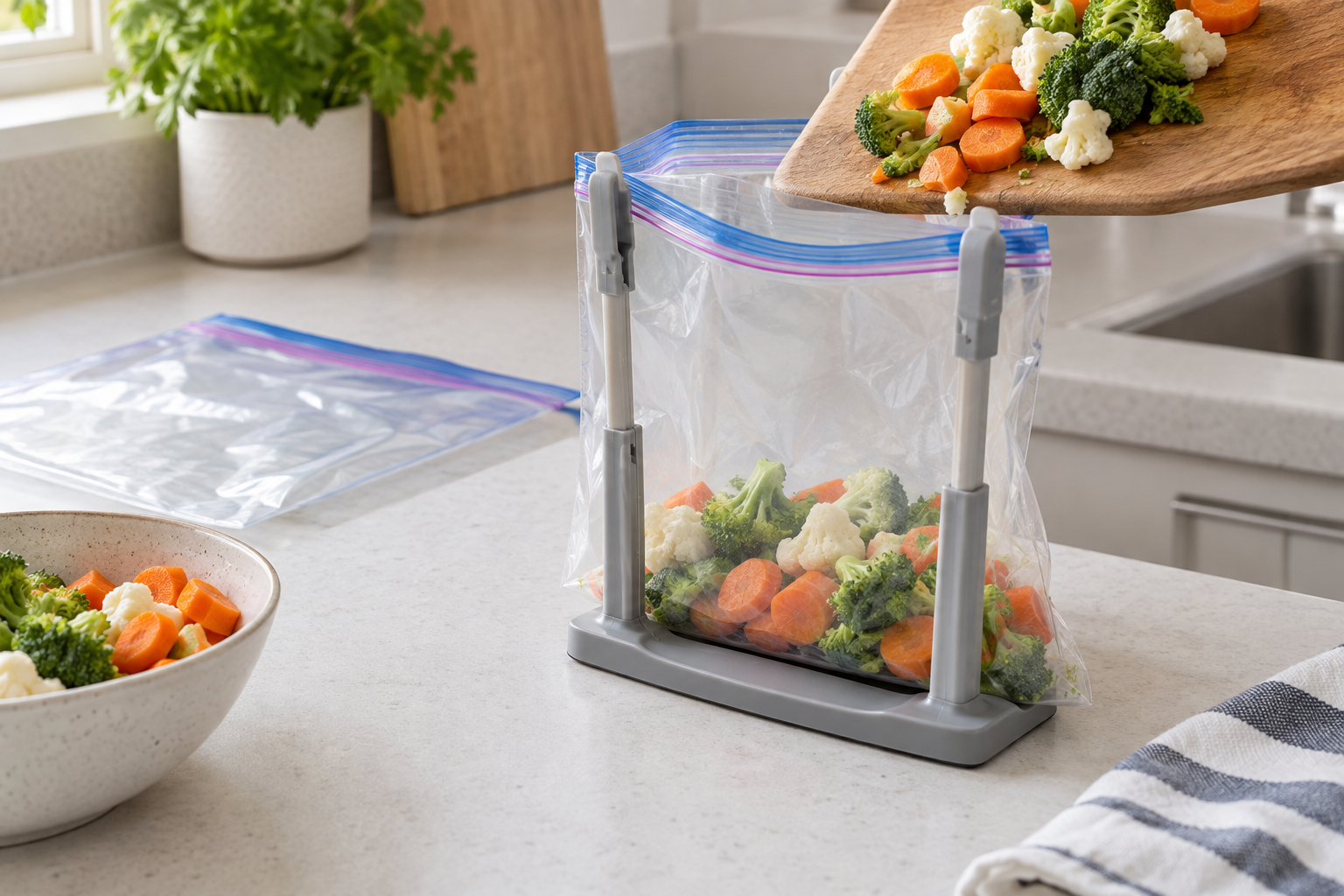
A freezer bag holder stand can be worth buying when flexible bags collapse during a frequent filling task, the clips and height fit the bags you already use, and the stand is easy to clean and store. Skip it when bag filling is occasional, rigid containers work better, or a stable bowl or cup already solves the problem.
The quick decision
- Buy: you fill flexible bags several times in a normal week, keeping the opening upright is the recurring bottleneck, and a measured stand fits both the bags and its storage spot.
- Delay and test: you have not counted filling tasks or tried a stable bowl or wide cup as temporary support.
- Choose a different format: use rigid freezer containers when stacking, carrying, or filling heavier foods matters more than compact empty storage.
- Skip: the task is rare, the listing gives no useful dimensions, or clips, joints, and storage add more upkeep than the stand removes.
Start with a one-week task audit
Count how often you fill a flexible food-storage bag during an ordinary week. Note the bag size, what you transfer, which tool you use, and what goes wrong. A stand addresses one narrow problem: holding a compatible bag open during filling. It does not make the bag suitable for a food, establish storage time, guarantee a seal, or prevent spills.
Separate recurring friction from a single awkward batch. If you only fill one bag occasionally, placing it inside a stable bowl or wide cup may provide enough support without adding another tool. Do not use glassware or another improvised support when the fit is unstable or the transfer could tip it.
Measure the bags, stand, and work area
- Bag height: measure from the bag base to the section of the open edge a clip would hold. Compare that with the stand's usable clip-height range.
- Opening and clip spacing: check whether the arms can hold the mouth open without stretching the bag or forcing folds into the clip area.
- Base footprint: mark the listed open dimensions on the counter and leave room for the source bowl, utensil, and your hands.
- Filled shape: allow for the bag to widen or settle as it fills. The base and posts should not block the bag from resting naturally.
- Stored size: verify the complete folded dimensions against a specific drawer or shelf. “Collapsible” and “compact” are not measurements.
Check the whole filling workflow
A product photo shows a moment, not the complete task. Think through opening the bag, attaching it, transferring food, releasing the clips, closing the bag, moving it to storage, wiping the counter, cleaning the holder, drying it, and putting it away. A stand is useful only if that full sequence is easier for you.
Clip shape and tension matter, but seller language such as “secure,” “spill-free,” or “universal” does not prove performance. Look for clear product dimensions and maker directions. Keep the setup away from a counter edge, do not exceed stated product limits, and avoid transferring food at a temperature the bag or holder maker does not permit.
Cost, cleaning, and storage tradeoffs
Include return shipping and storage cost in the decision, especially when fit cannot be checked locally. Food can reach the clips, posts, adjustment points, and base. Review the current care instructions for every part instead of assuming the holder is dishwasher-safe or easy to sanitize from its appearance.
Folding models can reduce stored bulk, but hinges and telescoping parts add surfaces to inspect and dry. A fixed stand may be simpler to wipe but harder to store. Neither format is automatically more stable or durable; those are product-specific claims that need current evidence.
Red flags on a listing
- No measured clip-height range, base dimensions, folded size, material details, or care directions.
- “Fits every bag,” “spill-proof,” or similar absolute language without defined conditions.
- Photos that hide the clip contact area, adjustment points, base, or the holder's folded form.
- Durability, stability, or food-contact conclusions supported only by seller copy or customer anecdotes.
- An unclear seller or return path when bag fit cannot be verified before purchase.
Who should skip a stand
Skip it if attaching or releasing clips is uncomfortable, if the filled bag would be difficult to lift or seal, or if vision, reach, hand strength, balance, or counter layout makes the setup hard to control. A rigid container or help from another person may be a better practical fit. When a functional limitation affects safe kitchen-tool use, an occupational therapist or another qualified professional can help assess the setup.
Also skip it when a stable container already supports the bag, when your normal foods are easier to portion into rigid freezer containers, or when another washable countertop tool would create unwanted clutter.
When to move from deciding to comparing
If your one-week audit identifies a repeat bag-filling problem and your measurements support the format, use the freezer bag holder comparison guide to compare adjustable, folding, compact-base, and fixed formats by fit, clips, stability wording, cleaning, and storage. If the real decision is flexible bags versus rigid storage, compare reusable freezer bags and rigid containers for small freezers first.
Bottom line
A freezer bag holder stand is worth considering when it solves a frequent, specific filling problem and passes measured bag, counter, cleaning, and storage checks. If the job is occasional or an existing stable container works, keep the simpler setup. For a broader way to judge practical purchases without body-result promises, see the routine-support tools guide.