Storage-location comparison
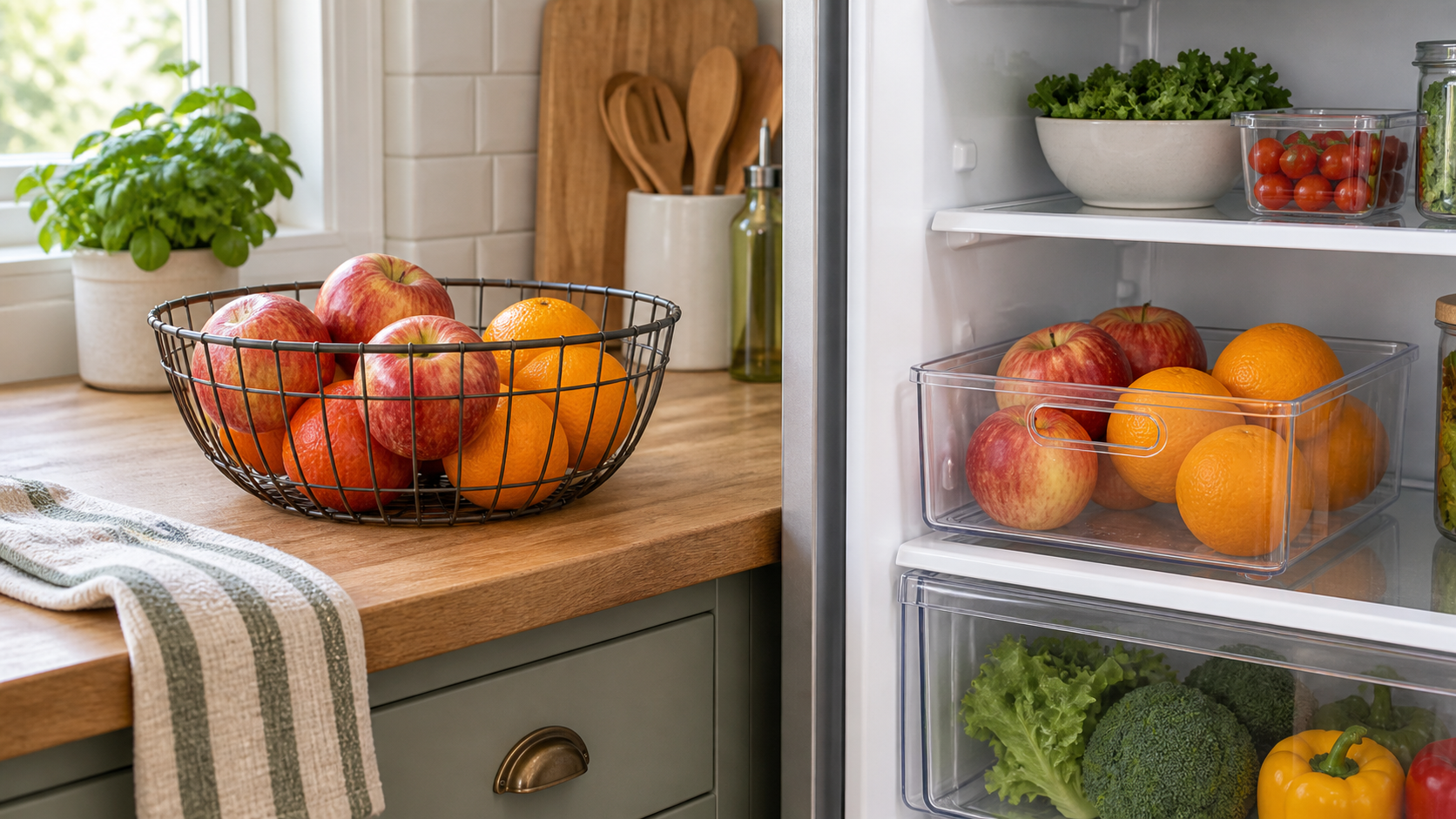
Countertop Produce Basket vs Fridge Bin for Produce Visibility
Neither format is the universal winner. First follow the storage guidance for the specific produce you bought; then choose the location that keeps it noticeable without crowding the counter, blocking refrigerator airflow, or adding a bin you will not clean.
As an Amazon Associate, GoodWeighFinds earns from qualifying purchases.
The quick comparison
| Decision | Countertop basket | Refrigerator bin |
|---|---|---|
| Start here | Only for produce appropriately stored at room temperature | Only for produce appropriately stored chilled |
| Visibility | Openly visible in the kitchen | Visible when the refrigerator is opened; clear walls may help |
| Space used | Permanent counter footprint | Shelf area plus wall and handle clearance |
| Access | Usually one-step access | May require opening the door and pulling the bin |
| Cleaning | Basket wires, base, and counter beneath | Bin corners, handles, shelf, and drying space |
| Best reason to choose it | Suitable room-temperature produce otherwise disappears from the routine | Suitable chilled produce gets scattered or hidden on a shelf |
Storage needs decide before visibility does
Do not move produce to the counter merely to see it, or chill it merely because a bin looks organized. Storage needs vary by produce type, ripeness, whether it has been cut, and the instructions that came with it. Use packaging directions and an authoritative food-storage reference for the particular item when you are unsure.
One household may reasonably use both formats: a basket for suitable whole produce on the counter and a bin for suitable chilled produce. Keep cut produce and other perishable foods according to appropriate refrigeration guidance; an organizer does not change those requirements.
When a countertop basket fits better
A basket fits when appropriate room-temperature produce is used often, there is a stable counter location away from cooking splatter and other obvious exposure, and an open container makes the contents easier to notice. Wire or perforated sides expose more of the contents, but “ventilated” marketing does not prove longer freshness.
- Measure the full footprint: include handles, flared sides, feet, and the space needed to lift produce out.
- Check the loaded view: deep bowls can hide the bottom layer even when they look open.
- Avoid heavy piling: choose a capacity that suits the normal amount rather than stacking delicate items deeply.
- Plan the cleanup: confirm the basket's care directions and make sure the counter beneath is easy to reach.
When a refrigerator bin fits better
A clear bin can group appropriate chilled produce that would otherwise spread across a shelf. It works best when the bin can be removed without shifting other food and when its height does not block the shelf above. Clear walls improve the view from some angles, but a crowded or opaque front can still hide contents.
- Measure usable shelf space: account for door closure, lights, vents, shelf lips, and the handle's pull distance.
- Leave intended airflow paths clear: do not block refrigerator vents, and follow the appliance maker's loading guidance.
- Check access before capacity: a very deep bin may hold more but make rear items harder to see.
- Count care steps: verify washing instructions and where the bin can fully dry before returning it.
Run a no-buy visibility test
For several days, place suitable room-temperature produce in an open bowl you already own and group suitable chilled produce in an existing clean container without blocking vents. Notice which location is actually seen during the routine, whether anyone has to move other items, and whether the container is easy to empty and clean. This tests placement, not storage life.
If a paper note on the refrigerator or a simple shelf reset solves the forgotten-produce problem, another organizer may not be useful. If broad refrigerator clutter is the issue, compare general fridge organizers with produce-specific containers before buying a narrow bin.
Questions to ask before buying either
- Which exact produce will go here, and is this an appropriate storage location for it?
- What are the maximum width, depth, and height available when doors and drawers move?
- Can the usual contents be seen without lifting or unstacking?
- Can every surface and the area underneath be cleaned and dried?
- Will grouping produce here block vents, light, preparation space, or another frequently used item?
- Does an existing bowl, tray, drawer, or container already pass the same test?
Bottom line
Choose by the produce's actual storage needs first. A countertop basket earns its space when suitable room-temperature produce benefits from open, one-step access; a clear refrigerator bin earns its shelf space when suitable chilled produce needs a defined, visible home. Measure the complete placement, test it with containers you own, and skip either format if it merely relocates clutter. For more product-neutral setup decisions, use the routine-support tools guide.