Buy, reuse, or wait
Do You Need Meal-Prep Containers for Weight-Loss Routines?
Probably not at first. Ordinary food-storage containers can support planned meals when they fit the food, storage space, appliances, and trip. A dedicated set becomes useful only when a repeated problem—missing lids, poor stacking, the wrong capacity, or an awkward work bag—keeps disrupting the routine.
As an Amazon Associate, GoodWeighFinds earns from qualifying purchases.
The quick decision
- Reuse what you own: you can match sound lids, the containers fit your usual meals and storage, and their labels cover how you actually use them.
- Buy a few targeted pieces: one repeated job needs a size or feature your current set lacks, such as a shallow work-lunch container or freezer-labeled batch-cooking container.
- Consider a coordinated set: mismatched sizes and lids repeatedly slow packing, and one measured footprint will stack more predictably in the fridge, cabinet, and bag.
- Wait or skip: the routine is still changing, storage is tight, or buying containers would add more washing and organizing than it removes.
Run a one-week container audit
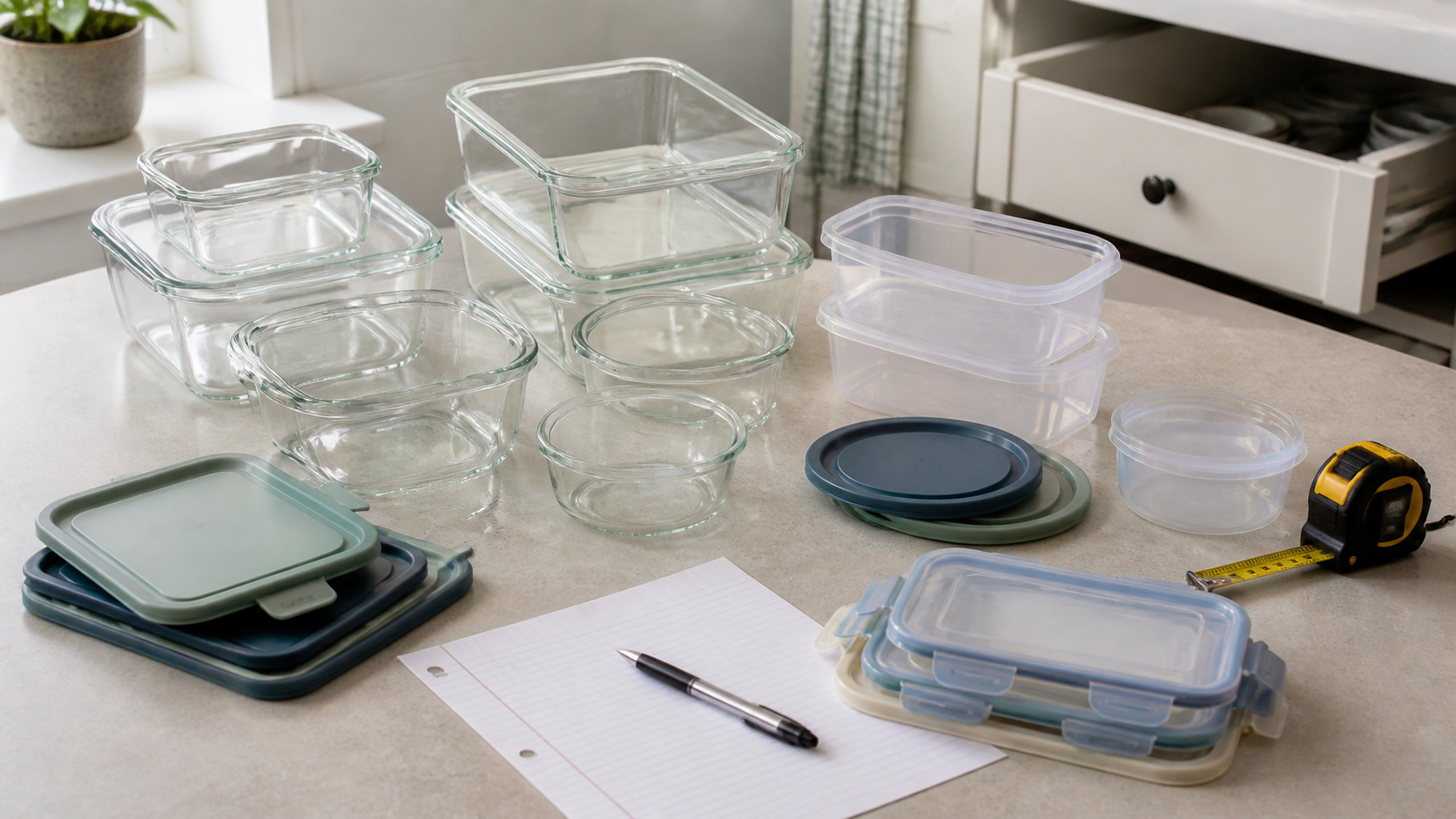
Match every usable base with its lid and set aside cracked, warped, or otherwise damaged pieces according to local disposal guidance. For one ordinary week, note the jobs you actually perform: refrigerating leftovers, packing lunch, freezing a batch, reheating, or carrying a snack. Record the container used and the friction—not a judgment about the meal.
A useful audit might reveal that two lids are difficult to find, tall containers waste lunch-bag space, or the family needs one larger shared-food container rather than ten matching portions. If the current pieces cover the week, a new set has no clear job.
“Meal prep” is a use case, not a performance standard
A product name does not prove that a container is suitable for a freezer, microwave, oven, dishwasher, or hot food. Read the maker's directions for the exact base and lid. Similar-looking parts may have different limits, and a label on one model should not be applied to another.
Containers can reduce packing friction or keep prepared food organized. They do not determine an appropriate portion for every person and do not cause weight loss. If rigid portions or detailed food tracking feel stressful, flexible storage you already own may be the calmer tool—or containers may not be the part of the routine that needs changing.
Five fit checks before you buy
- Food and capacity: list the meals or components you pack, then choose usable internal space rather than relying on a piece count.
- Fridge, freezer, and cabinet: measure the shelf depth, height, drawer, and nesting footprint. Include lids and latches.
- Appliance labels: verify the manufacturer's directions for freezing, reheating, dishwashing, or oven use separately; remove or vent lids only as directed.
- Carry needs: measure the lunch bag and decide whether upright transport, separate dressing, or a shallow shape is actually needed. A closed lid is not proof of leakproof performance.
- Cleanup: check grooves, removable seals, drying space, and whether small parts fit the household's real washing routine.
When a few pieces beat a large set
Large sets can inflate the advertised piece count by counting bases and lids separately. More pieces also require more cabinet room and more lid management. If the audit shows one missing function, replacing that function is usually clearer than replacing everything.
For example, a household might keep existing containers for leftovers and add two work-lunch pieces that fit the same bag. Someone who batch cooks might instead need containers specifically labeled for their freezer workflow. Use the meal-prep versus freezer-container comparison when storage duration and thawing are the real decision.
Material is a tradeoff, not a universal winner
Glass and plastic differ in weight, breakage risk, staining, storage, and maker-labeled uses. Neither material is automatically right for every kitchen or commute. The glass versus plastic guide lays out those tradeoffs without assigning one material to everyone.
Whatever the material, inspect the pieces and follow care directions. Retire a container when damage or a failed closure means it no longer fits its intended job; do not assume a new lid fits merely because the shape looks similar.
Three low-cost alternatives
- Label existing containers: removable food-storage labels can make dates and contents easier to scan without replacing sound containers.
- Create a small active set: move rarely used pieces elsewhere and keep the few matched containers used each week within easy reach.
- Change the packing workflow: pack shared components separately, use an existing bowl at home, or choose foods that fit the containers already available rather than forcing a compartment system.
When to use a detailed buying guide
Once the audit proves that dedicated containers solve a stable problem, use the meal-prep container buying guide to compare shape, capacity, closures, care, storage, and replacement options. If visual sections are the main reason for shopping, first compare portion-control container criteria and keep the sections as flexible organization cues rather than fixed instructions.
Bottom line
You do not need packaging labeled “meal prep” to begin planning meals. Start with a one-week audit, name the repeated problem, measure every place the container must fit, and buy only the pieces that solve that problem. For more tools that support routines without promising body results, use the routine-support tools guide.