Food-container storage comparison
Drawer Lid Organizer vs Cabinet-Door Lid Organizer
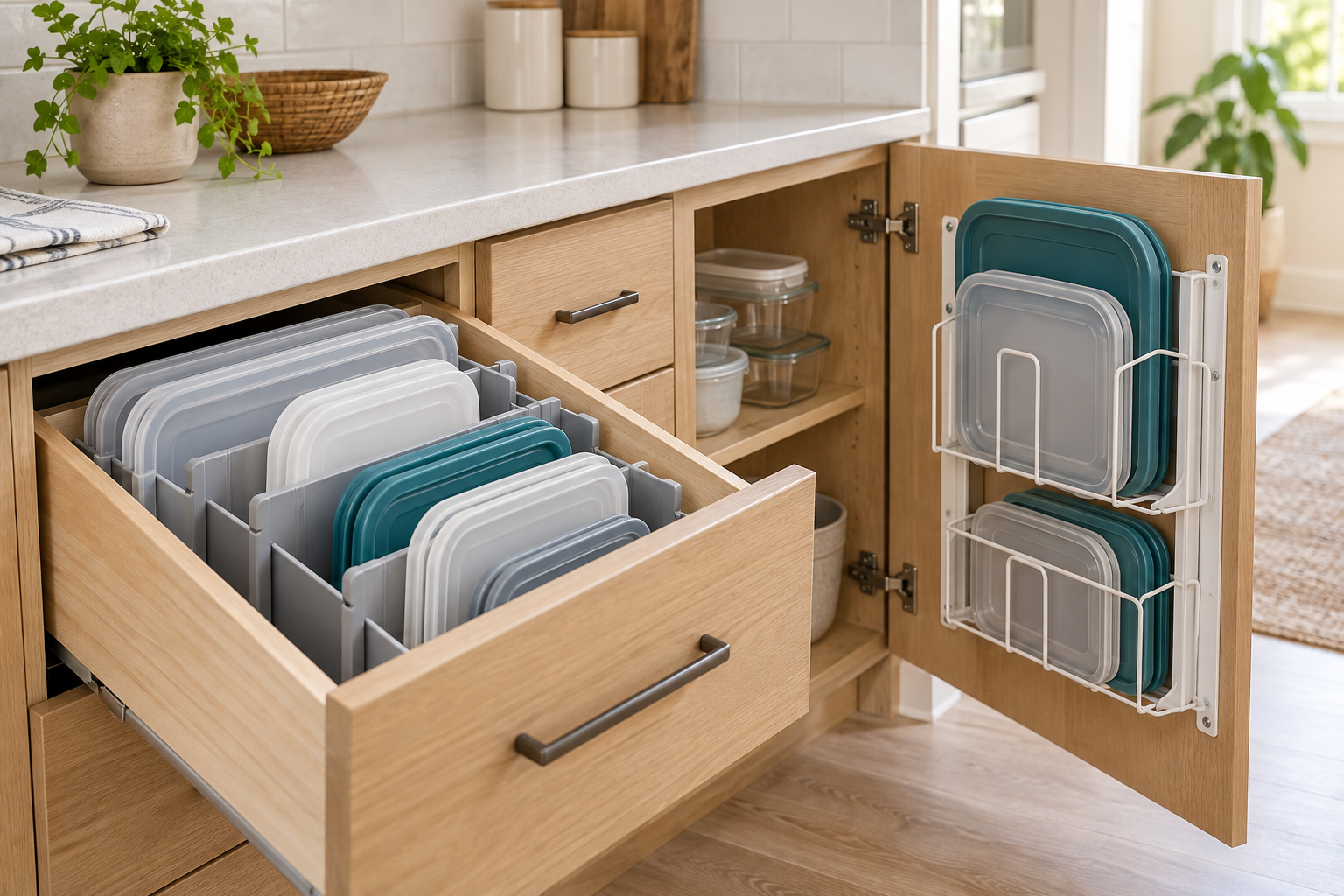
A drawer organizer uses horizontal storage and keeps lids visible from above. A cabinet-door organizer uses otherwise empty vertical space, but it adds mounting, hinge, shelf, and closing-clearance questions. The better fit depends on the lids and cabinet geometry you actually have—not a universal capacity claim.
As an Amazon Associate, GoodWeighFinds earns from qualifying purchases.
Quick decision: drawer or cabinet door?
| Decision | Drawer organizer | Cabinet-door organizer |
|---|---|---|
| Space consumed | Uses drawer width, depth, and height | Uses the door interior plus swing and closing clearance |
| Access | Top-down view after pulling out the drawer | Front-facing view after opening the cabinet |
| Setup | Often freestanding or divider-based, but still needs loaded fit | Usually hooks, adhesive, or fasteners with cabinet-specific limits |
| Main fit risk | Tall lids catch the cabinet frame or drawer above | Lids or rack collide with shelves, hinges, or stored containers |
| Maintenance | Remove loose pieces or the insert to clean the drawer | Inspect mounting and wipe around hardware or adhesive |
| Best no-buy test | Stand lids in a box already owned inside the drawer | Tape a cardboard depth mockup to the door without loading it |
Choose a drawer organizer when top-down access is the priority
A drawer setup fits when matched lids can stand on edge below the cabinet frame and a drawer can be dedicated without displacing more useful tools. It is especially practical when the drawer opens fully enough to reveal the rear dividers and when people in the household find lifting a lid from above easier than reaching into a lower cabinet.
Measure the drawer's usable inside width and depth, then measure height at the tightest point along the drawer's path—not only at the front. Add the tallest lid and the organizer base or divider height. Check handles, rails, screw heads, and any inward taper. A listing's outside dimension does not show how much divider space remains after the frame is installed.
Choose a cabinet-door organizer when vertical clearance is genuinely unused
A door-mounted organizer can preserve a drawer, but only when the loaded rack clears hinges, shelves, face frames, and everything inside the cabinet through the full closing arc. Trace the proposed rack and tallest lids on cardboard. Hold that template at the installed depth, then slowly close the empty door while watching every possible collision point.
Check the maker's supported door thickness, surface, mounting method, installation instructions, and stated load. Over-door hooks can affect closure or mark an edge; adhesive depends on exact surface preparation and removal instructions; screws make holes and may not suit thin panels or rentals. “Damage-free” should be treated as a claim for the exact product and surface, not a guarantee.
Setup and maintenance tradeoffs
Drawer setup
- Match every lid to a container and remove cracked, warped, or unmatched pieces before measuring capacity.
- Group lids by shape and stand the tallest example in the proposed location.
- Test whether the loaded drawer opens, closes, and exposes the rear section without snagging.
- Leave enough finger space to remove one lid without lifting the whole row.
- Choose an insert that can be removed or reached around for normal drawer cleaning.
Cabinet-door setup
- Map hinges, shelves, handles, and stored containers with the door open and closed.
- Mock up the loaded rack's full depth and height before drilling or applying adhesive.
- Follow the exact surface preparation, cure time, fastener, and stated-load instructions.
- Load gradually and confirm that lids cannot fall into hinge hardware or prevent closure.
- Inspect attachment points periodically and remove the organizer according to the maker's directions.
Who should skip each format?
Skip a drawer organizer if lids cannot stand below the tightest clearance, the drawer does not open far enough to reach the back, or giving up the drawer creates a worse storage problem. A plain open bin on a cabinet shelf may work with fewer measurements.
Skip a cabinet-door organizer if the door is thin, damaged, prohibited from alteration, heavily loaded already, or short on hinge and shelf clearance. Skip it when the mounting documentation does not name the actual surface or when removal risk is unacceptable.
Skip both if most lids are unmatched, the collection changes constantly, or matched containers already nest neatly with lids beneath or lightly attached. First use the lid-organizer buy-or-skip guide to decide whether a dedicated product solves a repeat problem.
A five-minute placement test
- Match lids and containers; count only the set you plan to keep.
- Measure the tallest, widest, and thickest lid groups.
- Put the lids upright in a spare box in the proposed drawer and use it for several days.
- For the door option, make an unloaded cardboard mockup of the organizer plus lid depth and test the full closing arc.
- Choose only after one location proves easier to reach without collisions or displaced essentials.
For broader lower-risk kitchen and planning tools, use the routine-support tools pillar. It keeps storage purchases tied to a specific recurring task rather than promising changes in eating habits or weight.
Bottom line
Choose a drawer organizer when a measured drawer can spare the footprint and top-down access fits the household. Choose a cabinet-door organizer only when a full loaded-depth mockup clears hinges, shelves, containers, and the closing path—and the mounting method fits the exact door. If neither location passes a no-buy trial, reduce the lid collection or use a simple bin already owned.